


In the interest of full disclosure: I have no financial relationship with Waymo nor Alphabet.
On the evening of 9 October, I was at Lighthaven in Berkeley, sitting in the green room of Progress Conference 2026. In a few minutes, I would walk on stage with Dmitri Dolgov, co-CEO of Waymo, to interview him in a live plenary session. The video of that interview will be available later this fall, and I’m eager to share it with the world: I asked him a lot of questions about Waymo’s strategy and plans for the future, and he had a lot of interesting things to share.
Dolgov impressed me: I shared only one of my questions with him in advance, so all his other answers were extemporaneous. That one was my very first question (given to him to help him warm up): when will Waymo be coming to my city? I meant it figuratively: how does Waymo decide what cities to pursue?
One of Dolgov’s team present with us did take it literally, and told me that Waymo would be coming to Toronto “soon”. Dolgov smiled enigmatically and said nothing. And our conversation proceeded onward.
I can’t tell you what else we talked about, because Progress Conference 2026 runs under the Chatham House Rule. But I feel comfortable telling you about this exchange, because the news it anticipated is public: one week after we spoke, on Friday 16 October, Waymo announced that it is coming to Canada, with Toronto its first service area. Waymo cars (specifically the first-gen Jaguar I-PACEs, rather than the next-gen Ojais) will begin to travel the city’s streets “in the coming days”. They won’t be in revenue service until 2028, and indeed for much of the intervening time won’t be operating empty. To ensure a successful launch, human specialists will pilot the vehicles from behind the Jaguar’s steering wheels, mapping roads and collecting sensor data.
This is the moment I have been telling Toronto to prepare for. In June, I wrote in The Hub that “On 26 October, Toronto will pick its next mayor. It’s not obvious, but robotaxis are on the ballot too.” Earlier this month, in a piece for the Dais, I urged the candidates to “say what they want from robotaxis, and say it now”, because it’s better to figure these things out before the moment arrives.
Well, the moment has arrived. And here’s how I think the next mayor of Toronto, whoever it may be, should think about the matter. Toronto should welcome Waymo and use its powers to set the service up for success. That’s because Toronto has everything to gain from robotaxi service, and little to lose.
I’ve watched Toronto turn away an Alphabet company once already. I don’t want to see it happen again.
What Toronto Stands to Gain
I have made the case for robotaxis many times before, but often in an American context. Today, let’s make it for Canada.
The first argument for welcoming Waymo is safety.
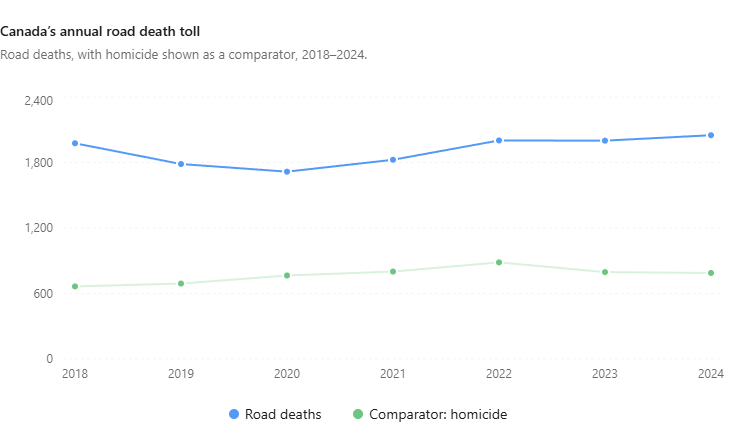
Chart courtesy of ChatGPT. Sources: Transport Canada: Canadian Motor Vehicle Traffic Collision Statistics, 2024 and Statistics Canada: Number of homicides, 2015–2024.
Canada suffered 2,050 road deaths in 2024, the most in a decade (admittedly we enjoyed a slight respite during the pandemic, but that’s long over). That’s almost three people killed by accidental violence for every one person who dies from it deliberately. And lest we forget, road incidents also cause thousands more serious injuries where no one dies, but nonetheless permanently alter lives for the worse.
As I have written before, driving automation is the most promising—indeed, the only promising—tool on offer to reduce those numbers, which otherwise remain stubbornly high.
Consider what one version of that tool looks like in practice. Waymo has operated its vehicles over hundreds of millions of driverless kilometres, and its safety dashboard shows that the ‘Waymo Driver’ (the firm’s automated driving system, or ADS) has been at time of writing involved in 95% fewer serious-or-worse crashes and 82% fewer injury-causing crashes than human drivers over the same distances. The Insurance Institute for Highway Safety’s independent analysis, published in July, found 68% fewer police-reportable crashes than human drivers across four cities. And there has never been a documented instance of the Waymo Driver being at fault in an incident that took a human life.
Advocates in other cities have attempted to spread fear, uncertainty, and doubt on this point. These attempts, as I have shown, don’t stand up to scrutiny, and for good reason: the Waymo Driver never drinks, thinks about other things, or looks at its phone. Compared to the human reference case, which I’m sad to say behaves this way all the time, it’s reasonable to expect a well-trained, well-tested ADS to outperform.
It’s fair to say that Waymo on its own won’t end road deaths; most fatal road collisions happen on rural roads and highways, where speeds are higher, and Waymo’s robotaxis won’t get to handling trips like that for a long time. But they will get there eventually. As Dolgov told me on stage at Progress Conference (reminder, video coming soon!), Waymo ultimately aspires to have the Waymo Driver handle the driving task anywhere driving happens. The path to ending all road deaths travels through robotaxi services being widely available, meaning if Canada wants it, Toronto is the place to start.
I could go on. Driving automation also frees us from the burden of the driving task, and from the idiosyncrasies of our ridehail drivers. Its trips will be cheaper and more readily available as well as safer (there will be more Waymo cars on the streets of Toronto at four in the morning than human ridehail drivers). But let’s not belabour these points, which I have made at length elsewhere. Driving automation generally, and Waymo as its most advanced instantiation today, is something that would bring immense amounts of good to Toronto, and in time to Canada as a whole.
All the Problems We Hear About Have Answers
Scanning early media coverage reveals a consistent set of concerns. Of course they aren’t new ones, and answers are ready to hand.
Winter. Prof. Sidney Givigi of Queen’s University told CBC that “All the sensors can get occluded by snow, which is something that they don’t have in California”. It’s true that winter is a tougher environment for an ADS than the American Sun Belt. Snow can blind a robotaxi’s sensors, make the landscape confusing and unrecognizable (no visible lane markings, for example), and occupy a much smaller portion of the training data on which the ADS was built. For much more on these challenges, see my interview from last year with Steven Waslander of the University of Toronto.
You’ll also see there that, even then, solutions were in view. More and better sensors, more and better compute to clean degraded data and fuse it into a consistent world model, and more and better training can overcome these problems… as can the more prosaic solution of adding ‘windshield wipers’ to the sensors. Waymo began revenue service in Denver last month (i.e., 1 September 2026), has tested in New York City, and is actively preparing to launch in Munich; snowy winter markets all. The company clearly does not think that snow and ice will stop them, and there is no reason to think that a task that thousands of careful human drivers in Toronto can handle will frustrate the machine. It’s notable that the long testing period announced for Toronto, from October 2026 into 2028, exceeds any period the firm has announced so far, except perhaps for Tokyo; it’s reasonable to guess the firm wants to get two winter seasons of testing done before opening revenue service. This should inspire confidence that when it’s time for paying passengers to ride, they’ll be safe, even in a Toronto snowstorm.
Jobs. This matter is one that we’ve been thinking about most recently here in Changing Lanes. In the issue published just two weeks before this one, Who Drives Ridehail?, I used Toronto’s own data to show that there are two kinds of ridehail driver: a large population of casuals who drive a little, turning over constantly, and a small core of hard workers who provide most of the trips, mostly quick turnarounds in the densest parts of the city. Waymo, when it comes, will outcompete those core drivers first, because robotaxis are optimized to handle that market.
Ontario’s Ministry of Transportation has told the Canadian Press that the rollout will require a “credible jobs plan”. This is an odd demand; I don’t remember the province asking Apple to produce a credible jobs plan when the iPhone’s digital camera was poised to wipe out photographic film development. But the fact of the demand shows that whatever good policy may be, good politics requires an answer to the question ‘what about the ridehail drivers?’ Waymo’s promise of “hundreds of roles” in maintenance and support is welcome, but I doubt it will be sufficient.
That’s why, just last week in What We Owe Ridehail Drivers, I proposed a deal: wage insurance for drivers who are doing the work when the robotaxis arrive, funded by a small levy on each robotaxi trip. There is Canadian precedent: Quebec did just this to compensate taxi drivers outcompeted by ridehail. Because such a levy would scale up in tandem with robotaxi trips, the levy’s revenue would grow in step with the displacement it aims to offset. Toronto is well placed to make it work, because it already licenses every ridehail vehicle and publishes their activity, so it knows who the core drivers are.
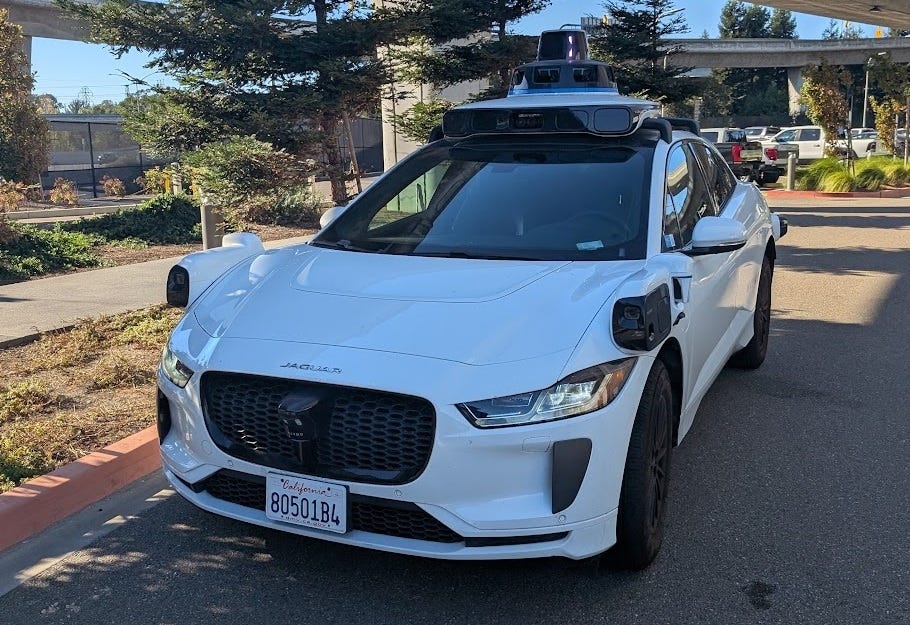
A Waymo Jaguar I-PACE at San Francisco International Airport, October 2026. Photo by the author.
Sovereignty. Technologists for Democracy, a group that has campaigned against Waymo since the spring, warns of the “mass collection of Ontarians’ data by an American company”.
I have seen this movie before. From my seat as Toronto mobility lead for Sidewalk Labs, another Alphabet subsidiary, I remember the disingenuous accusations that big American tech firms could have only one possible interest in Toronto, which was to vacuum up our precious bodily fluids—sorry, our precious data—for nefarious purposes.
On the one hand, this is foolish. The data that a Waymo vehicle might collect at, say, King and Church Street is already readily available; yet another Alphabet subsidiary, Google, makes it freely available to all. On the other, it is ignorant: the City of Toronto itself makes it standard practice to collect data far more intrusively than this, a practice to which I can never recall anyone objecting.
I find it hard to take this concern as anything other than throwing mud at a Waymo car to see what will stick. If one is actually serious about the rights and wrongs of public data collection, I would refer to my serious rejoinder from last March: Let the Spy Cars In. Constant readers will recall that there, I agreed with Premier Ford’s concern that Chinese electric vehicles can spy on their owners, but argued nonetheless Ontario should permit them to be sold here. I stand by that argument, which applies equally to this situation. It’s already the case that any connected car on Ontario’s roads collects data on the car’s movements and surroundings and sells it to commercial brokers, from whom anyone can buy it for whatever purpose. So data collection is no reason to keep out Waymo; if you think this is a fox, it is already in the henhouse.
Relatedly, it is true that a robotaxi fleet is a network of rolling cameras; it has to be, so as to operate safely. To those who think this is a problem, I say that you can’t threaten me with a good time: I am on record as thinking we need more public surveillance rather than less. But, fair enough, most people of good will disagree with me on this point. For them, as I’ve argued before, the solution they should seek is restrictions written into law. Ontario’s rules for commercial robotaxi service should say who may obtain fleet footage, for what purposes, and on what legal authority (probably a judge’s warrant), with independent audits. While we’re at it, we should also ban selling vehicle data to private operators without advance consent, and require warrants for police access to any vehicle data, whether robotaxis or personal, private vehicles.
If the government wants to pursue this agenda, I’d support it, but that discussion should not be an obstacle to Waymo’s arrival on our streets.
The Outcome Everyone Should Want
I mentioned earlier that I was Sidewalk Labs’ mobility lead in Toronto. I took that job excited by the prospect of using technology to help make transport in Toronto better: safer, more affordable, more reliable and convenient. I left it despondent, having seen a small cadre of haters—haters of technology, of Americans, of big firms, of any change to the status quo from which they benefited—choke the project of the oxygen and goodwill it needed to succeed.
Thankfully, with the passage of time, I think Toronto has come to see that giving in to the comfortable and the malcontent on that matter impoverished the city, and squandered an opportunity that will never come again. That was certainly the thesis of the hit play The Master Plan, and its reviewers seem to have agreed with the argument.
With Waymo, we have another chance to do the right thing. Here is what I think Waymo’s success in Toronto will look like.
In 2028, Torontonians, and perhaps Mississaugans, can hail a driverless ride across large parts of the city, irrespective of whether it’s summer or winter. (Mississauga? Perhaps! See the postscript to this issue.) The core ridehail drivers who were doing the work when the robotaxis arrived benefit from wage insurance, so they can more easily find other work; that insurance is paid for by the trips that displaced them. Ontario has fair and transparent rules for commercial driverless ridehail service, subject to the two conditions I argued for at the Dais: disclosure, meaning public data on collisions and on kilometres driven empty, and compensation for displaced drivers. Please see that piece for more detail; I also recommend reviewing the thoughtful agenda for the municipal and provincial governments in this regard, laid out by friend of Changing Lanes Daniel Kligerman in his newsletter, Rethink Toronto.
Victory is by no means guaranteed; the same provincialism that killed off Sidewalk Labs may yet drive Waymo away. I hope not, because Waymo’s success will be success for the whole city. I hope its residents, and its politicians, understand this.
Postscript: Waymo in Mississauga?
When Waymo published its Canada page on 16 October 2026, the text said testing would take place “across select neighbourhoods in Toronto, including Yorkville, St. Lawrence, Harbourfront, Leaside, Bedford Park, Roncesvalles Village, Parkdale, Don Mills, Rosedale, Summerhill, Yonge & Eglinton, Mimico, The Kingsway, Islington, and Humber Bay, as well as Malton, Lakeview, and Applewood in the City of Mississauga” [emphasis added].
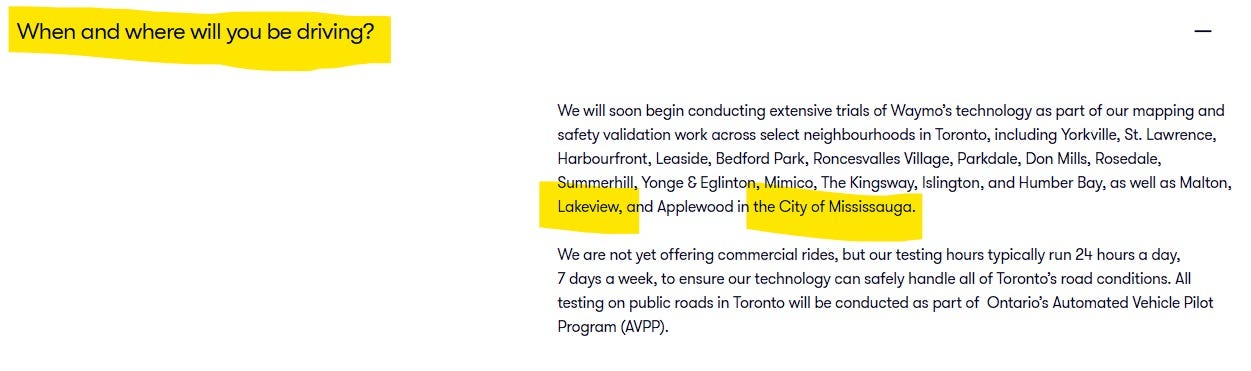
Above, screencap of the Canada page as of 16 October; below, as of 18 October. Emphases added.
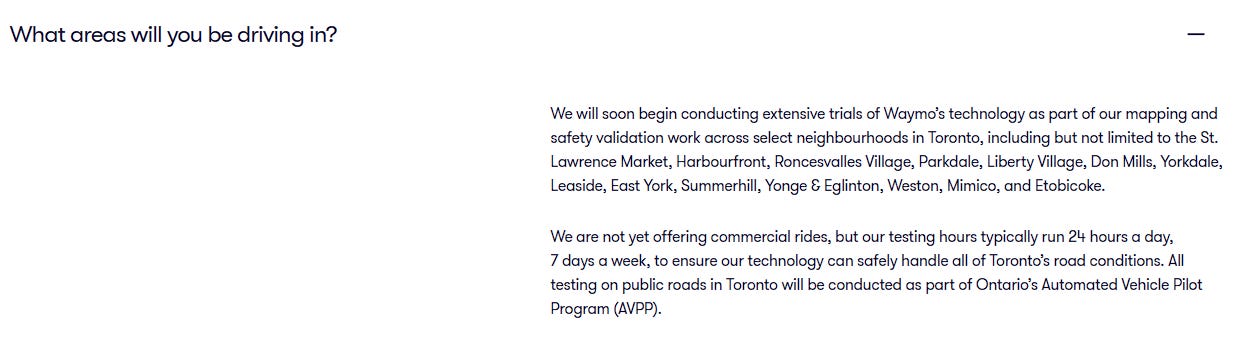
By the morning of 18 October, the page had changed. The list now reads “including but not limited to the St. Lawrence Market, Harbourfront, Roncesvalles Village, Parkdale, Liberty Village, Don Mills, Yorkdale, Leaside, East York, Summerhill, Yonge & Eglinton, Weston, Mimico, and Etobicoke”. Mississauga is gone entirely (so are Yorkville, Rosedale, and Bedford Park). The Kingsway, Islington, and Humber Bay have been folded into Etobicoke, which contains all three.
I haven’t seen any comment on this, so I can’t give reasons for it, just guesses.
One is housekeeping. The paragraph is now strictly about Toronto, so Mississauga may still be in scope, just folded into “including but not limited to”.
The other is politics. Like Toronto, Mississauga elects a new mayor later this month, and perhaps the firm didn’t want to become an issue in a market where it hadn’t done outreach to all the candidates.
As a resident of Mississauga, I am a YIMBY on this issue. Bring the Waymos on!
The Master Plan 2: Why Toronto Can’t Have Nice, Modern Things, coming soon to a theatre near you (I hope not).