


UPDATE, 29 July 2026: the report’s authors have retracted the safety analysis from their report. See this image from the report’s home page:
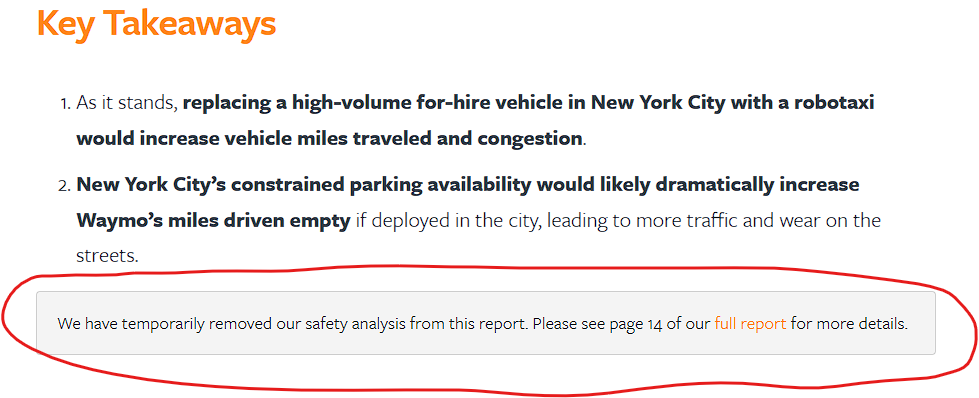
I approve of this move. Admitting one’s mistakes is a difficult virtue to practice, but necessary.
Let the analysis below stand as a suggestion of why retraction was the right move.
It’s just after 6 p.m. on 19 January 2025 in San Francisco. An empty Waymo is stopped at a red light at the intersection of Sixth and Harrison, waiting its turn in a line with other cars. A human, driving a Tesla, approaches the intersection at 98 miles per hour and plows into the line of stopped cars, striking a car and killing one of its occupants.1 That struck car, in turn, bumps a Waymo.
Eighteen months later, that incident forms one-third of the statistical case, now circulating in New York’s press, that Waymos are more dangerous than the city’s professional ride-hail drivers.
The case comes from a new report by the Sam Schwartz Transportation Research Program at Hunter College and Open Plans: How Would For-Hire Autonomous Vehicles Impact NYC? (hereafter ‘Impact NYC’). The report asks how robotaxis (“for-hire autonomous vehicles”) would affect New York City. Its conclusion, which made headlines, is that Waymo’s rate of crashes causing death or serious injury is 1.5 times that of New York’s ride-hail drivers. To quote Impact NYC directly:
Initial data shows that Waymo vehicles are involved in fewer injury-causing crashes overall, but have a significantly higher rate of crashes with a serious injury or fatality than the existing New York City for-hire fleet.
You can imagine the coverage that has followed. “Robotaxis in NYC could cause more deaths and serious injuries than the for-hire vehicles they’d replace,” ran one headline.
It’s a remarkable finding because it’s so counter-intuitive. Uber drivers are better in aggregate than Waymo’s famously-safe fleet? That’s what the report claims.
But of course that claim is so counter-intuitive because it’s wrong.
