


Two notes before we begin.
Firstly: this Wednesday, 24 June at 1200h EST, you are invited to attend the second Changing Lanes livestream! My guest this time will be the United States’ foremost authority on regulating automated driving: Professor Bryant Walker Smith of the University of South Carolina. Smith contributed to the development of the SAE’s famous ‘five levels’ of driving automation taxonomy, and earlier this year testified to Congress about how to regulate self-driving in the US. Subscribers will be notified when we go live, but you may also sign up here.
Secondly: a reminder that in two weeks—specifically, Tuesday, 16 June—the price of a subscription will go up. The current rate of US$10/month or US$100/year ends; from that date, new subscriptions will be US$13/month or US$130/year. If you want to lock in a year of access to subscriber-only content, the time to do so is now, since annual subscriptions taken today get it at today’s lower rate.
In 2021, distraction was a factor in 29% of Canada’s road deaths, up from 19% at the turn of the century. The US is about the same, once its figures are corrected for under-coding.1 The behaviour is climbing on both sides of the border.
In response, authorities are taking action. This week, on 5 June 2026, Pennsylvania’s ‘Paul Miller’s Law’ takes effect: a driver caught with a phone in hand faces, on first conviction, a fine… of $50.
Paul Miller’s Law is the newest of the handheld bans on the books in every Canadian province and 33 US states. This regime has been spreading steadily since 2007, but the problem it aims to combat is getting worse, not better.
This mild and tremulous response is vexing. We know that distracted driving kills, and we know it is on the rise. The situation calls for decisive action, but we should be thoughtful about what kind of action. Changing Lanes is a techno-optimist newsletter: if there’s a problem, we don’t expect to fix it by hoping for a change in human nature. Instead, we expect to fix it with structural change. Given this, the token fines and thin enforcement are galling. But what is more contemptible is that a structural fix already exists—one that requires neither criminal nor civil penalties, that doesn’t require us to punish anyone, that is mandated on new cars across the European Union—and that we have declined to require it.
In other words, we have decided to tolerate the deaths caused by distracted driving because fixing it would be inconvenient.
Why Drunk Driving Was Solvable…
To start to understand the matter, it’s helpful to begin by considering a parallel problem: drunk driving.
Between 1980 and 1997, US drunk-driving fatalities fell from around 21,000 a year to around 17,000. That’s a substantial decline—19 percent—and strong evidence that, if we resolve to, we can make progress on reducing road deaths stemming from a particular cause.
The drop in drunk-driving deaths was the product of a bundled series of policies. Specifically, we set per-se blood-alcohol thresholds; set minimum legal drinking ages; established zero-tolerance laws for drunken drivers under 21; and permitted the police to revoke licences at the roadside, independent of the courts.2
Enforcement was not the whole story, because drunk driving also lost a long cultural argument: Mothers Against Drunk Driving made it shameful in a way distracted driving still is not. So why has no comparable stigma attached to the phone? It’s partly because nearly every driver offends in this way, at least some of the time, and a near-universal act is hard to shame. It’s also because it cannot be reliably seen: a phone held at lap level is invisible outside of the vehicle. Even so, a stigma campaign is worth attempting; I’ve urged such approaches to solve other problems, and Families for Safe Streets is trying just such a move.3 I doubt it will be enough on its own. We will need enforcement as well.
Notice that enforcing rules against drunk driving depended on a single question: can police establish that a driver they have pulled over is over the limit? If they can, the anti-drunk-driving policy suite is sound. But if they can’t, blood-alcohol thresholds, minimum drinking ages, zero-tolerance regimes, and license revocation are useless.
Thankfully, the police do have a way to do this: the Breathalyzer, invented in 1954. Courtesy of the Breathalyzer, police can quickly and cheaply test a driver’s blood-alcohol level at the roadside, enabling the rest of the policy bundle to bite.
…But Distracted Driving Isn’t
So is there a Breathalyzer for distracted driving, a simple technology that can quickly and definitively establish a driver is not paying attention behind the wheel?
Right away, we can see that it’s a hard problem. Intoxication is a state; it persists even after a driver pulls the car over and turns off the engine. Distracted driving is an activity.
As such, it is hard to detect, because it can stop at any time. As soon as a police officer puts on their lights and sirens, the driver is no longer distracted. So the crime must be established by the traces it leaves behind, or by some record taken at the moment it is happening.
Establishing it by its traces is legally challenging. The place to look is on the distracting device itself, i.e., the driver’s phone, and we have the means to do so. The ‘textalyzer’—a device that reads recent phone activity post-crash—has been proposed in several US states and adopted in none, stalled by privacy and Fourth Amendment objections. The grounds for this were established in State v. Dunbar (Connecticut, 2016), which says the police cannot interfere with someone’s phone absent proof beyond a reasonable doubt that the driver was engaged in a call. Simply having a phone in hand is not enough.
I am dubious about the legal doctrine here; it seems to me that a policy may establish, as a reasonable standard, that holding one’s phone while driving is illegitimate, which would be grounds for a ‘search’ of that phone to establish its use. I will grant that permission for state inspection of our digital lives and devices must meet a high standard, given the privacy implications, but we seem to have set the bar so high that honouring it has given us a basically-nonfunctioning enforcement regime.
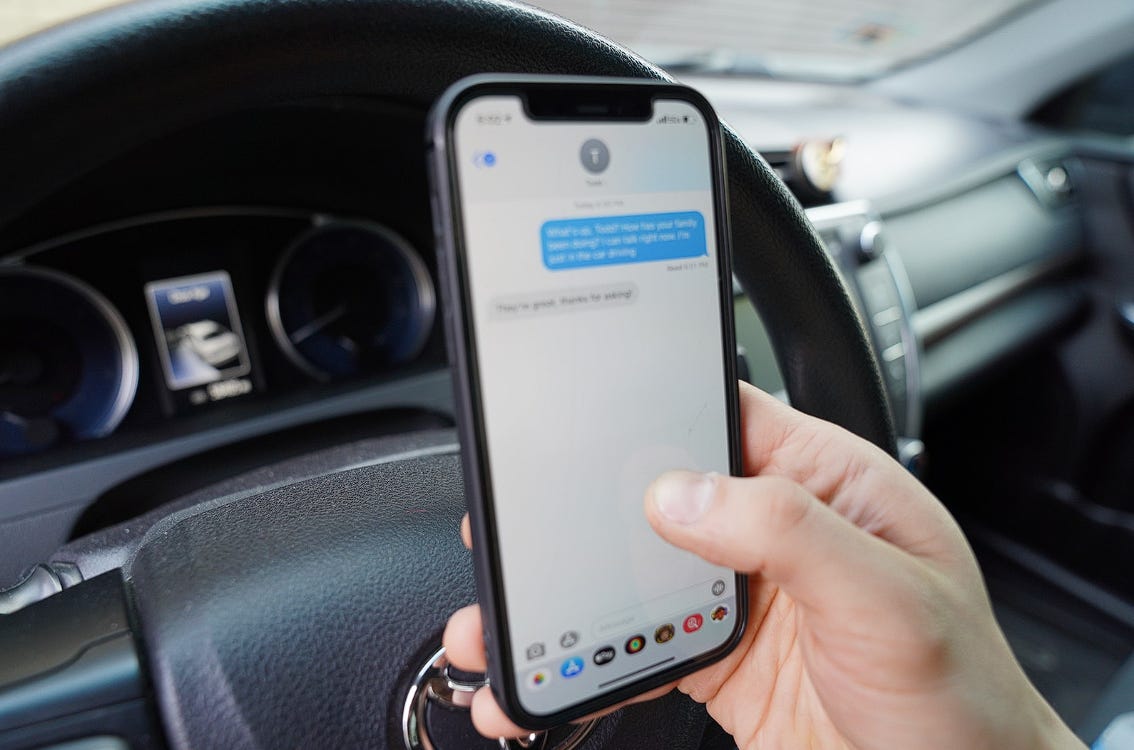
"Distracted driving" by Mike Skoropad is licensed under Creative Commons. Image courtesy of utires.com.
Set the matter aside. If we cannot establish distracted driving after the fact, we must instead establish it at the time of occurrence. The simplest way to do that would be to use some kind of device that can detect it in real time and make an immediate record.
We have such devices: cameras.
New South Wales (NSW) in Australia has operated AI-powered mobile-phone detection cameras since 2019. (Since from the ground one cannot see whether a driver has a phone in their lap, they are mounted to elevated positions near the roadway.) As a consequence, detected-illegal-use there fell from ‘one vehicle in 82’ to ‘one vehicle in 597’ in under four years, a reduction of approximately 86 percent.
Findings like these reinforce my conviction, stated more than once, that public surveillance offers great advantages that we should pursue.
But set this aside as well; I am in the minority on this point. Most voters deplore the idea of cameras being ubiquitous in public spaces, and a single jurisdiction’s results are not yet enough to lean on, though NSW road fatalities caused specifically by distraction have continued to fall.
It follows, then, that if we can’t put cameras on the roadside, we must instead…
