


One story about why flying is miserable goes like this: consumers wanted cheap fares more than anything else, so airlines gave it to them, good and hard.
Air travel today is very cheap. Back in 1980, a round trip ticket between Chicago and Dallas cost around $185, so $725 in 2026 dollars.1 A similar ticket today would be about $480, meaning the flight is 33% cheaper. Sure, your seat is smaller, and the overhead bins are all full, and the plane is more crowded… but if you want a better experience, you can still pay extra for it. What most people want is low base prices, and we’ve got them, so stop complaining already.
Another story goes like this: in the last several decades, airlines have merged into a cozy oligopoly (‘because capitalism’) and killed competition. As a result, they now extract rents from captive passengers. Four carriers control 74% of the domestic market, and use their market power to shrink seats, charge for bags, and oversell flights because consumers have nowhere else to go. The problem is consolidation and monopoly, and the solution is antitrust.
At first glance, both stories make sense. Consumer price sensitivity is certainly real, and consolidation has given airlines market power they’d never had before. Where they both fall short is the question of timing.
Airlines in the USA have had the legal freedom to charge for bags, unbundle fares, and cram seats tighter since deregulation back in 1978. Given that, why did bag fees appear in 2008 rather than 1988? Why did the ‘Basic Economy’ fare class emerge after 2012? Why did plane crowding (the percentage of occupied seats aboard a flight, which industry analysts call load factor) jump from 72% to 84% this century, rather than before?
‘Consumers want cheap fares’ and ‘airlines are greedy’ are both timeless explanations for time-specific changes. That means that something else is going on.
We know what that something else is. The features that make modern air travel so frustrating are scar tissue from three near-death experiences, all post-dating the year 2000: the business-travel shock after the terrorist attacks of 9/11, the fuel shock of the 2008 global financial crisis, and the travel-demand shock of the COVID pandemic. Each of these shocks left scar tissue on the sector. A market dynamic that I call the Iron Law of Air Travel ensures this scar tissue never heals; once a cost-cutting measure exists, consumer behaviour locks it in, because the airline that tries to compete on quality rather than price loses the fare comparison and bleeds customers.
A Tale of Three Crises
Once upon a time, namely in the USA before 1978, the Civil Aeronautics Board set fares, controlled routes, and decided which airlines could fly where. Airlines couldn’t compete on price, so they competed on service: meals, legroom, lounges, and more. This is the Golden Age of air travel; you can catch sight of it in films of the era. (This portion of the trailer for Airport ’75 gives a brief glimpse.) Fares were high enough that flying was mostly for the affluent and for business travellers whose companies covered their costs.
Then the Carter Administration deregulated the sector. Airlines could now set their own fares and routes, and new entrants flooded the market. The result was fierce price competition that drove fares down, changing air travel from an elite activity to a plebeian one. (Airplane!, a parody of earlier films like Airport ’75 but made in 1980, firmly in the deregulated era, depends in part on the audience remembering a world which had definitively ceased to exist.)
Legacy carriers, faced with competition from upstarts, responded with exquisite price discrimination, extracting enormous premiums from business travellers through mechanisms like Saturday-night-stay requirements and last-minute booking penalties. Leisure travellers might be able to delay a trip but business travellers often couldn’t, and so had no choice but to pay exorbitant fees for sudden bookings. Similarly, business travellers had no reason nor desire to stay in another city over a weekend, so business travellers also had no choice but to pay a hefty premium to forego the (entirely arbitrary) Saturday-night stay requirement. Economy passengers thus enjoyed a subsidy: they paid reasonable fares because business travellers paid five-to-ten times more for the same trip.
The shock of airplane-based terrorism on September 11, 2001 collapsed demand for air travel for several years. By 2004 demand was back… but not among business travellers. By 2004, the Internet had gone mainstream, meaning that it was easier to book flights, and to compare prices, than it had been in the preceding era of travel agencies.
This technological change played out in several ways. Corporate booking platforms gave companies visibility and control over employee travel. Airlines responded by negotiating contracts with large firms, but that squeezed rates. Most importantly, the Saturday-night-stay requirement became less effective as low-cost airlines like Southwest defected from that consensus, forcing traditional airlines to defect too. The subsidy that had made economy-fare pricing viable didn’t slowly erode, but collapsed suddenly.
With business travellers no longer cross-subsidizing economy travellers, airlines needed another way to make cheap seats profitable. Spirit Airlines pioneered the answer in 2006–07, which was ‘unbundling’. Separate the bag fee, seat selection, and other services from the base fare. Sell the bare minimum at a rock-bottom price, then charge extra for anything beyond it. This is the origin of the ‘you see $89, you pay $200’ phenomenon.
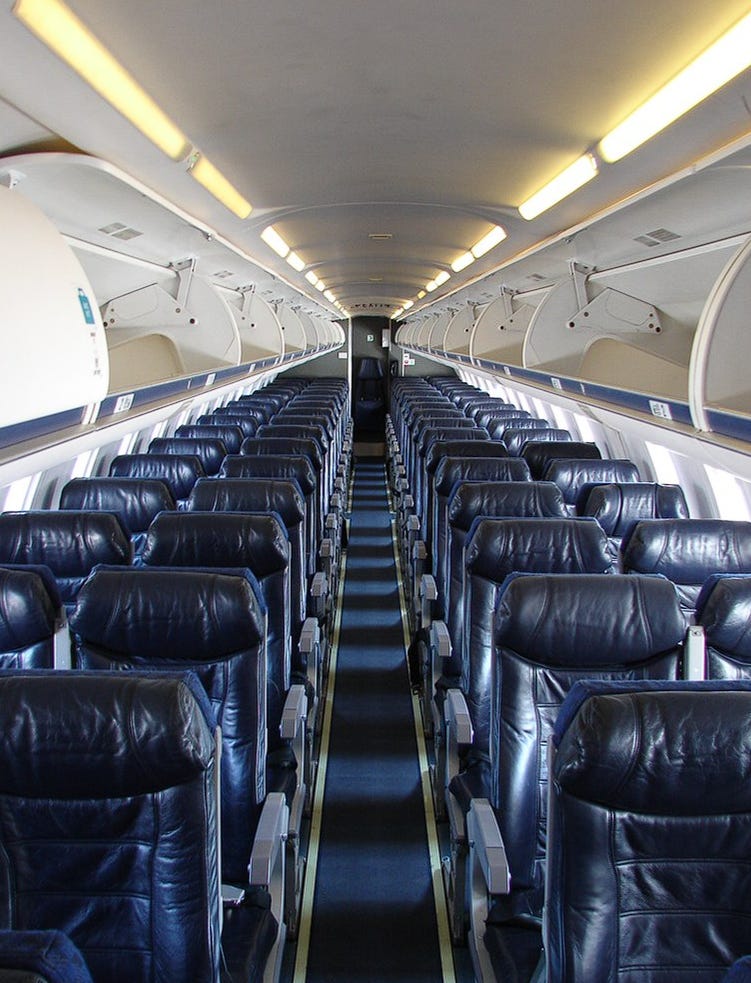
CRJ-700 interior, photo by Cory W. Watts, via Flickr (CC BY).
After the business-travel shock came the fuel shock. Fuel prices rose a massive 338% between 2003 and 2008 as an industrializing China absorbed the world’s spare oil capacity even as big institutional investors moved into commodities futures. It’s true that prices went down later in 2008 courtesy of the global financial crisis… but that crisis also depressed demand for air travel. The combination of the fuel shock and the crisis was devastating for commercial airlines. Thirteen went bankrupt in 2008 alone; more than fifty U.S. airlines filed bankruptcy between 2001 and 2013. Northwest, Continental, and US Airways all went away, leaving four major carriers standing: Delta, American, United, and Southwest.
The surviving carriers learned to match supply to demand. Empty seats are money lost, since the plane must fly even if that seat is empty, and that trip can never be sold again. So airlines strove to ensure that as few seats as possible went empty; load factors rose from 72% in 2000 to 84% by 2019.
The travel-demand shock came in 2020 with the Covid-19 pandemic. U.S. corporate travel budgets declined by more than 90% as travel everywhere ceased and companies shifted en masse to virtual meetings. With the pandemic’s end, business travel returned, but it has plateaued at 70%-to-80% of 2019 levels, which airline executives describe as permanent. Remote work taught companies they could operate successfully even if their employees took fewer business trips.
Each crisis forced airlines to cut costs and squeeze more revenue from fewer passengers. But why did these adaptations persist even after the crises passed? Why didn’t fares re-bundle, seats widen, and planes empty out once fuel prices fell and demand returned?
The answer lies in what I call the Iron Law of Air Travel.
The Iron Law
The Iron Law of Air Travel says that consumers always choose the lowest price. Given an array of options—leg room, lateral room, early boarding, more baggage allowance, more—customers will ignore all of them and take instead whatever is cheapest. There is lots of evidence to confirm this rule, but my favourite piece is that Expedia, the airfare marketplace, knows their customers and by default sorts flight results by price starting with the lowest.
There are certainly counter-examples. Just last year, my wife and I flew to Europe for our belated honeymoon, and paid extra to enjoy ‘premium economy’ in each direction, which offered a few amenities, the most important of which to us was extra legroom. We are not alone: premium economy sells on long-haul routes. It’s also the case that travelers will reliably pay more to escape a stopover or transfer; the pull of the one-seat ride is felt in air travel as much as in other modes. And of course some travellers are wealthy, and as such are price-insensitive and will reliably upgrade.
But these groups are a minority, insufficient to shift the equilibrium. The Iron Law describes the centre of mass, not every particle. And the centre of mass is that consumers expect airlines to compete on price, not on other metrics. What that means is that even as demand for air travel rises, the old world won’t come back.
The Iron Law means that airlines and consumers plan around the market they have, even if everyone involved finds it suboptimal, and no one can unilaterally defect.
Airlines might prefer to compete on quality rather than racing to the bottom on price, and passengers might prefer better service. Unfortunately, the airline that tries to offer ‘better but more expensive’ loses the price comparison and bleeds customers. Airlines that do compete on price buy aircraft accordingly, meaning their infrastructure locks in the number of passengers who can get better service, and the market assigns those prices at a high point, too high for most consumers to justify paying for what they will get. No individual actor can break the pattern without being punished.
Imagine you wanted to start an airline that broke the mould: ‘Honest Air’. Honest Air would offer bundled fares: checked bag, seat selection, Wi-fi included, the works. Further, Honest Air would build its business plans to aim at a 75% load factor, so the middle seat would usually be empty. In return, Honest Air would charge double what its competitors do, at $400 for a route where Basic Economy goes for $200. Your business plan looks reasonable at first glance. Passengers say they hate the current experience, and you’re offering something better, so they’ll pay for it. Free markets to the rescue!
But the Iron Law reigns. Your customers will search Expedia, see your $400 fare next to a $200 fare, and book the $200 fare, and crack wise about how “no matter how much each class pays, we all arrive at the destination at the same time”. Then they will complain on X about bag fees and cramped seats without changing their behaviour. Honest Air’s planes fly half-empty, it burns through its capital, and within eighteen months, it’s out of business (or pivoting to the same model as everyone else).
I’m not just spinning a tale: in 2007–08, three airlines—Eos, MAXjet, and Silverjet—tried exactly this model, and suffered this fate. The three airlines ran only premium service; bundled their fares; and offered business-class-only or premium-heavy service. And all three were dead by late 2008.
The fuel spike finished them, but their underlying problem was the Iron Law: as much as their market surveys suggested people would pay more for better service, people booked cheaper seats with competitors instead.2
Changing the Game
What would change my mind about the Iron Law? Evidence that a significant segment of consumers reliably pays premium for better economy products when cheaper alternatives exist on the same route. Not premium economy on long-haul; that’s a different market. I mean domestic short-haul where premium economy competes with regular economy. If such a segment exists at scale, the Iron Law is weaker than I think, and competitive pressure could overcome the status quo, given time. I’d also update if a new entrant succeeded with a bundled model, though the history of such attempts is not encouraging.
So if my diagnosis of the problem is correct, what can be done about it?
Changing Lanes readers will be able to guess that my preferred solution to this problem is policy change.3 The most promising intervention I can see would be to target the interface, and require all airline tickets to be advertised at a price that includes one checked bag and a selected seat. Perhaps later customers could choose to forego amenities for a price break, but the default display would be the bundled version, which would force comparison shopping to a like-to-like basis.
Airlines would game this, of course, defining the standard experience downward (excluding inflight Wi-fi, for instance, and then selling it separately to customers who want it). They’d still compete. But that’s fine by me; my goal isn’t to eliminate price competition, but to ensure consumers can compare what they’re buying. Right now, the Iron Law operates partly through interface design: consumers click the lowest number because the interface shows them the lowest number.4 Mandatory bundled-price display would change what the interface shows. It redirects consumer psychology toward total value rather than base fare alone.
The USA DOT has moved in this direction with transparency rules requiring disclosure of baggage and change fees alongside fares. But that’s a half-measure; disclosure isn’t the same as bundling. Passengers still see the low base fare first and the fees in fine print. Full-price display would go further, and I think it’s worth trying. The downside is modest, and the upside could be significant: competition shifts toward schedule, reliability, and service quality rather than who can hide the most fees. None of this would be easy, and it doesn’t guarantee a better equilibrium. But understanding how we got here at least clarifies which interventions might work.
Air travel is unpleasant, and fixing it will require changing the game, not just wishing the players would make different moves.
Respect to Jeff Fong for feedback on earlier drafts.
Unfortunately we don’t have specific price tables for a given airline from 1980, or at least I couldn’t find any. What we do have are the Airlines for America (the airline industry group) annual reports. The 1981 report shows that 1980’s domestic yield for passenger-revenue-per-mile was 11.58 cents, which multiplied by the domestic round-trip distance of Chicago to Dallas of 1,600 miles grants the $185 figure.
A possible counterexample is JSX, a ‘semi-private’ carrier operating 30-seat regional jets from private terminals, and named #1 Domestic Airline by Travel + Leisure in 2024 and 2025. But JSX succeeds precisely by offering a more economical version of the business-class experience: comfortable seats and no security lines at prices competitive with standard airlines. So JSX’s business model is to deliver premium-adjacent service at near-commercial prices; it’s competing on price. The Iron Law wins again.
I’d also accept technological disruption but I don’t see anything to hand that would help.
This is what behavioural economists call anchoring at work: the first price a consumer sees becomes a reference point against which alternatives are judged. I’ve written before about how these cognitive shortcuts—mental accounting, loss aversion, and more—shape our decisions about transportation, and everything else.
Similar to the hotel market! Consumers always choose the lowest price hotel, while resort fee is hidden!
The extra few inches in Premium Economy made all the difference on my flight back from Japan last weekend. As someone who never checks bags, one thing I don’t understand is why don’t airlines charge me to carry on? The overhead space shortage seems obviously like a pricing problem.