
A pragmatic and deeply researched guide to what it will take—logistically, politically, and economically—for self-driving cars to provide the most good for the most people.
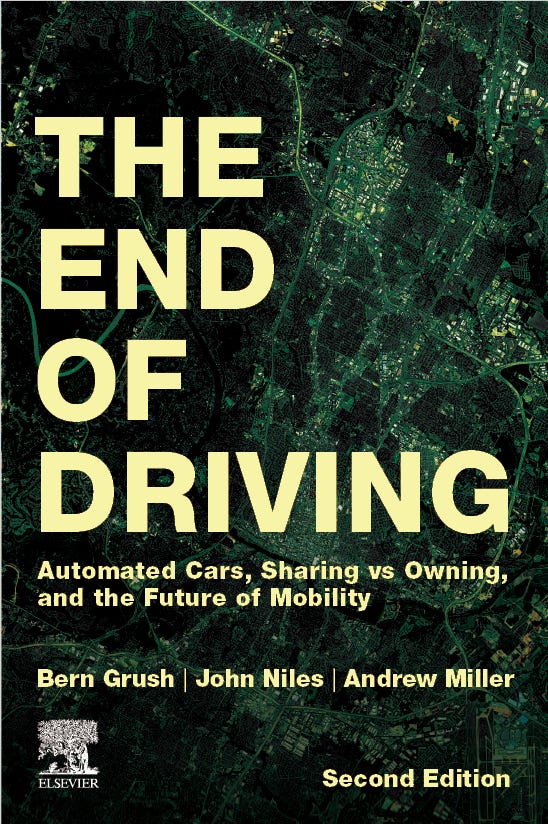
In the public imagination, self-driving cars are a solved problem just waiting to scale. But The End of Driving shows that matters are still uncertain. The End of Driving, which I co-wrote with John Niles and Bern Grush, argues that there are two starkly different possible futures for road mobility.
Along one policy path, automated vehicles (AVs), like cars today, are mostly privately owned. On this path, traffic congestion increases, as does land consumption for parking spaces. AVs end up compounding the worst aspects of today’s inefficient and unsafe mobility system
On the other path, self-driving technology enables travelers to rely on fleets of robotaxis, reducing the need for personal car ownership, especially in cities and suburbs. AVs open new possibilities for sustainable, accessible, safe mobility for people of all ages, abilities, and economic levels
While the second path is better for cities, climate, and people, it is not the default. Without clear, proactive policy intervention, private AV ownership will become typical.
This book shows what’s required to steer toward the better path.
With deep policy insight and original analysis, the authors explain why scaling AVs will require more than better software: it will demand political will, reimagined infrastructure, and new systems of governance. The End of Driving offers a blueprint for building a better future.
Key Arguments
There Are Two Futures—Only One Leads to Better Cities.
One path leads to a world of privately owned AVs, reinforcing the ongoing pattern of unsustainable consumption of land for roads and parking. The other opens the door to robotaxis, reduced car ownership, and redesigned urban spaces. The latter future is better—but it won’t happen without public-sector action to steer the market.
Public Transit Must Change or Die.
The early years of robotaxi deployment suggests that they are on a path to kill public transit as we have known it, seizing the urban market for most transit trips and sending systems into death spirals of increased subsidies and reduced service. At the same time, automated mobility offers a second path: the opportunity to reimagine public transit as a service that offers more geographic coverage and better service at less cost, using driverless buses on major routes and automated on-demand shuttles elsewhere. To avoid the first path, cities must embrace the alternative described in The End of Driving.
The Real Battleground Isn’t 100% Automation, It’s 50%.
The book argues for a more realistic milestone: when 50% of vehicle kilometers traveled (VKT) come from AVs. That threshold is where benefits and challenges scale, and where the need for governance becomes urgent.
No PUDO, No Robotaxi Revolution.
Without a coordinated system for passenger pick-up/drop-off (PUDO), robotaxis will worsen congestion, break rules, or fail to scale. Cities must invest in digital curb management now to enable high-volume fleet operations.
Remote Monitoring Isn’t Optional. It’s the Backbone.
Fully ‘autonomous’ operation is a myth. Every AV, whether fleet or personal, will need 24/7 oversight, incident response, and passenger support systems, akin to air traffic control. The implications for our infrastructure, economies, and cities are unappreciated and stark.
People Will Still Want to Drive, and the Market Will Provide.
Surveys and behavioral research show that many people will resist giving up private ownership, especially in households with children, frequent cargo moves, or long commutes. This preference gives privately-owned AVs a natural market advantage; any approach to moderating this will require a public-policy consensus to offer incentives for shared fleets, as well as restraints on private vehicle access in urban centers.