


On the evening of Thursday 5 November, I’ll be at the City of Toronto’s Open Data Jam, giving a short talk on how I produced my piece Who Drives Ridehail? If you’re in town, please register at the link above, and come say hello!
We’ve been waiting for the Cybercab for years.
Elon Musk first showed it off at Tesla’s We, Robot event in Burbank on 10 October 2024: a gold two-seat robotaxi with no steering wheel and no pedals, built to drive itself. The pitch was aimed at buyers. You’d be able to own one “before 2027”, for under $30,000 USD. You could send it out to earn fares while you slept, or run ten or twenty of them as a “shepherd”. It would charge wirelessly, with no port at all. It would cost 20 cents a mile to run and 30 to 40 cents a mile to ride.
Two years on, the Cybercab is no longer vapourware. Since 4 September 2026 you can hail one in Austin, and pay to ride in it. But it isn’t quite the car we were promised.
I talked about those promises in this newsletter’s very first issue, in September 2024, where I argued that Tesla lacked the prerequisites to succeed in robotaxis. The jury is out on that, since success will take time to prove… but I must admit that my prediction of “at least a five-year delay before revenue service” was wrong. (When it comes to making predictions about Tesla and automated driving that fail, I’m in good company.) Was I also wrong when I argued that robotaxis “are, and will remain, a tightly-regulated sector”, and that Musk had “conspicuously antagonized regulators”, which would be a stumbling block for the firm’s robotaxi ambitions? Based on the changes to the Cybercab, that claim seems more prescient.
What has changed? What is Tesla doing with the Cybercab now, how does the current approach differ from what they said they were going to do, and why are they acting this way? Not being an insider, I can only guess, but as far as I can tell, the answer is that Tesla knows that it is picking a fight with the regulator, and is hedging its bets. Whether or not it expects to lose that fight, everything about the Cybercab makes losing it cheap.
A Car Built for a Fleet
Let’s start with the promises kept.
The most important is that the Cybercab has no steering wheel nor pedals; no human driver can operate it. Musk’s view, articulated several times, is that the future of the car is driverless, and the Cybercab delivers on that commitment.
The Cybercab also has no lidar nor driving radar. Musk’s view, also articulated ad nauseam, is that humans can drive with eyes and a brain only, meaning a car can drive with cameras and a computer only. Lidar, radar, and other sensing modalities are superfluous, and as such can be removed, making the vehicle cheaper to build; as Musk likes to say, the best part is no part.
I’ve been skeptical of this since the Cybercab launch, when I wrote that dropping lidar would lower the car’s cost but also its capabilities, compromising its “situational awareness; its awareness of long-range conditions; its 3D mapping capabilities; and more”. That on its own is vexing, but one detail of the car is positively infuriating. To deploy its airbags safely and correctly in the event of a collision, the Cybercab monitors who is sitting inside it and where. To do so, it does not use cameras… but internal radar. Using radar for this purpose, rather than helping the vehicle to drive, boggles the mind: if radar is good enough to help the airbags deploy correctly, why isn’t it good enough for navigation?
But leave it aside. What promises have not been kept?
The Cybercab, we were told, would use wireless charging, i.e., induction charging, meaning it would never have to be plugged in. This was always theoretically possible, and the appeal is intuitive: having to physically charge my own Tesla means I have to keep a cable to hand, constantly plugging it in and removing it; this is much less friction than having to visit a gas station, but it’s still a chore. Against this, though, wireless charging only works if the vehicle aligns just so with the external plate that transmits the power. That’s a small problem, since presumably a driverless car could orient itself exactly as it needed to for most efficient draw; but even then, some electricity is lost as heat, and when the alignment is off, a great deal is.
Most puzzling of all, one of Tesla’s value propositions was its network of ubiquitous Superchargers, meaning Tesla drivers never suffer from range anxiety. Using induction charging rather than cabled charging meant the Cybercab would have been locked out of the network.
So perhaps it’s good that Tesla broke this promise. The Cybercab now has a NACS port, the connector used by Tesla’s Superchargers, as well as a wireless charging receiver. But without an onboard charger, it cannot take AC power (alternating current) from a home supply. It needs direct current (DC) supplied by a fast charger. A Supercharger or a suitable depot charger will do, but a garage outlet won’t. Indeed, even Tesla’s own home Wall Connector won’t. Not charging at home is easier for a fleet operator to accommodate than a private owner.
Cybercab customers were promised a few different prices. Ridehail patrons—“Cab” being right there in the name—were promised fares of 30 to 40 cents a mile. In September 2026 Austin riders were paying a median $3.33 USD a mile, roughly eight to eleven times higher. The claim of the twenty-cent mile is now “probably true” only, and not before 2030.
Meanwhile, retail customers who want their own Cybercab were promised a retail price of $30,000, a promise Musk renewed as recently as February. Will they get it? That’s impossible to say: Tesla has not offered a retail price, nor provided an opportunity to buy one. The Tesla web page offers the opportunity to buy Models 3 and Y, and the Cybertruck, as well as to reserve a new Roadster, but no Cybercab. The only sales channel Tesla has opened is a business interest form, which notably requires two names; a contact and a company.
The owner network, which would allow private owners to make their Cybercabs available on Tesla’s ridehail network, has slipped; it was promised “confidently next year” in July 2025, but in October 2026 is now expected “somewhere around Q2 next year”.
All this data points to the same conclusion: the Cybercab, as Tesla conceives of it today, is not actually a vehicle for private owners. It’s a vehicle for fleet operators; principally, Tesla itself.
That’s not just a conclusion to reach from the evidence, but a contention the firm makes openly. On its 21 October 2026 earnings call, its vice-president of engineering said the firm is “trying to get Cybercabs to customers by the end of this year”. Musk then added “the vast majority of the Cybercab stuff will be essentially Tesla-owned and transport as a service”.
It may surprise us that Tesla, which talked such a big game about private ownership, is now backing off it in favour of running a robotaxi service. Why the change of heart?
The obvious explanation is that it doesn’t think it’s ready yet to get private ownership past the regulator.
Tesla Picked a Fight
On 3 September, the day Tesla began commercial deployment in Austin, the National Highway Traffic Safety Administration (NHTSA) initiated an audit into the Cybercab.
Why an audit? It’s because American vehicle safety runs on self-certification. When, for example, BYD is finally permitted to sell its hatchback, the Seagull, in the USA, no one at NHTSA will take one apart to determine in advance if it’s appropriate for American roads. Instead, BYD will certify that, in its view, the car meets every applicable Federal Motor Vehicle Safety Standard (FMVSS). Further, BYD and any other manufacturer are enjoined not to do so if, in “exercising reasonable care”, it “has reason to know the certificate is false or misleading”.
So the audit turns on this. Tesla has declared the Cybercab meets every FMVSS. On the day of the Austin launch, NHTSA began the process of asking whether that declaration was reasonable.
At first glance, the answer is clearly no, it wasn’t reasonable. Consider FMVSS 111: “Each passenger car shall have an inside rearview mirror of unit magnification”. Or FMVSS 135: “The service brakes shall be activated by means of a foot control”. On the face of it, the Cybercab doesn’t pass, and indeed no custom automated vehicle, designed not to take human input, could. NHTSA seems to agree; its own chief counsel said in 2025 that the standards “were written for vehicles with human drivers and need to be updated for autonomous vehicles”.
I think that update is urgent and NHTSA should have done it long since. But that doesn’t change the fact that Tesla self-certified that it met all the FMVSS, and on any plain reading of those two standards, it’s hard to see how it could have. NHTSA is on record as saying that until any such updates happen, “existing standards remain in force”. This, perhaps, explains why the agency followed the announcement of its audit with a Special Order a week later: 21 requests, to be answered under oath, with civil penalties of up to roughly $139 million USD and criminal exposure of up to 15 years for false answers. The final request asks how the Cybercab complies “without any exemption under 49 CFR Part 555”. Tesla asked for an extension to 20 November, and NHTSA gave it until 30 October; at time of writing, that was yesterday. (The answers go to the regulator and have not been made public, so we do not yet know what Tesla submitted.)
About that exemption: a manufacturer who doesn’t believe its car meets the standards may, instead of certifying otherwise, ask that the model be made exempt from them. The number of vehicles so exempted is capped at 2,500 per manufacturer per year.
That, it seems to me, is why a private Cybercab isn’t available for purchase yet. Will NHTSA accept Tesla’s self-certification? Zoox, Amazon’s robotaxi company, self-certified its own custom robotaxi in July 2022 despite its lack of a steering wheel or other FMVSS-required elements. NHTSA opened an audit that found “multiple apparent noncompliances”, but ultimately closed the audit by granting a demonstration exemption; in July 2026 Zoox received a full exemption from parts of eight standards, capped at 2,500 new vehicles a year.
So while it’s at least possible that NHTSA will amend the FMVSS such that the Cybercab is street legal, the likeliest expectation is that, when the dust settles on the audit, Tesla will get an exemption, but also a cap on how many it may deploy to the streets. A fleet of robotaxis can live with that cap, adding 2,500 cars each year and every year following; but private ownership cannot, not even in the short term.
Tesla Saw This Coming
On 22 April, asked on X whether the 2,500 cap applies to the Cybercab, Lars Moravy, Tesla’s vice-president of engineering, replied “No”.

On 22 July 2026, asked on the firm’s Q2 investor call whether Tesla needed anything federal to ramp up Cybercab numbers, Moravy said that “the short answer is no... I don’t want to say we’re in lockstep, but I feel like we have a partner there”.
Six weeks later the ‘partner’ opened its audit.
By the Q3 call on 21 October, the tone had changed. The chief financial officer, Vaibhav Taneja, said that “the key thing which we’re trying to make sure is that we have all the regulatory approvals where we can start deploying the Cybercabs as fast as we can produce them”.
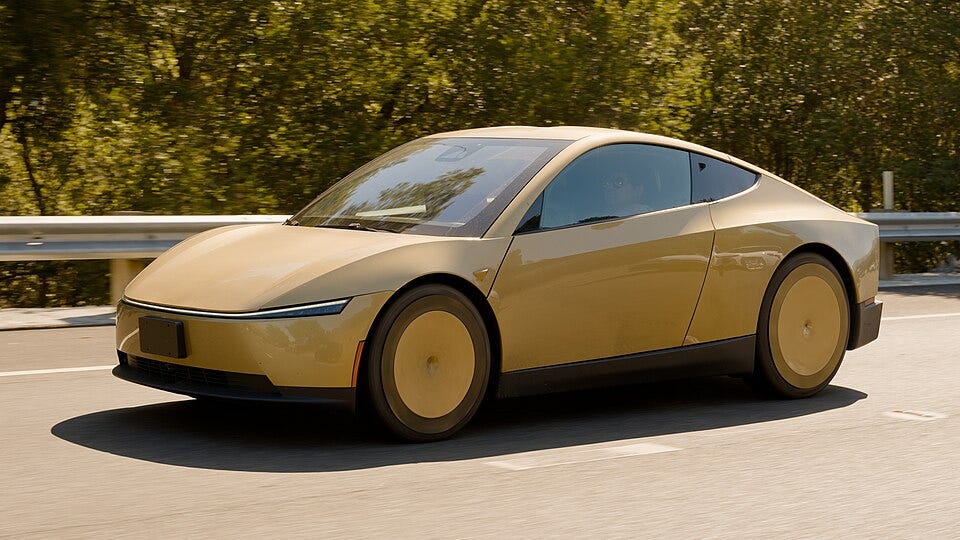
Lu, Daniel (Dllu). Tesla Cybercab on Interstate 280 near Palo Alto. September 19, 2026. Wikimedia Commons, licensed under CC BY-SA 4.0.

There are three principal paths from here, and they can overlap.
The first is a finding of compliance. That would be vindication for Tesla, with NHTSA accepting the company’s self-certification as reasonable. It’s certainly possible, but there’s no evidence one can point to that suggests it is likely.
The second is a finding of noncompliance. That could bring penalties, possibly including an order to ground Cybercabs until the standards change or Tesla obtains an exemption. Given Zoox’s soft landing, a prolonged shutdown seems less likely to me.
The third is that Tesla petitions for an exemption, either before or after the audit reaches a finding. Since 31 July, an interim final rule has let exemptions retroactively cover already-built vehicles, which would give Tesla an out; but as of 31 October, no such petition had appeared in the Federal Register. I think this is the likeliest path, though Tesla would still need NHTSA to grant the petition.
That’s because Tesla can continue to operate its robotaxi fleet even under a 2,500 vehicle cap. In the first eight months the firm has manufactured them, it has only registered a few hundred, but the pace is picking up. Timothy B. Lee counted 158 Cybercabs registered in Texas on 2 October, and another 400 added in the month since. At that rate Tesla would add about 4,800 a year, so a cap of 2,500 would start to bite within months. Still, that would only slow the fleet’s growth, not stop it. Even without the Cybercab, Tesla has been running a modest robotaxi service in six US cities using Model Y vehicles; it could continue to do so without running afoul of the FMVSS. But the Cybercab is the one part of Tesla’s fleet that is certainly driverless, as Lee notes, and that matters in its race with Waymo, which aims to have 20,000 vehicles on the road by the end of 2027.
Lee argues that Tesla’s principal advantage against Waymo is that Tesla can produce as many vehicles as it needs. If Lee is right, the cap is mostly important because it handicaps Tesla’s principal advantage. I’m skeptical that this strength is so important. As Waymo co-CEO Dmitri Dolgov told me at Progress Conference (video coming soon!) if Waymo wanted more vehicles, it could get them; not making their own vehicles is not, in Dolgov’s view, a constraint. But perhaps Musk doesn’t see things this way.
Musk certainly wants to produce more Cybercabs than he’s currently got call for. Tesla rates its current production capacity for Cybercab at greater than 125,000 a year, meaning that the 2,500 cap would cover 2% of a single year’s production. Given that sunk cost, Tesla has every reason to seek regulatory updates that would let it sell to buyers.
Such an update is in view. In May I wrote for Reason about a federal self-driving bill that had the support of the whole industry, Tesla included. Its companion legislation would raise the exemption cap to 90,000 a year, which would cover nearly three-quarters of the Texas line’s capacity.
Now that we understand all this, we can see why the Cybercab looks as it does, rather than as we had been led to expect, namely it has been optimized for Tesla’s use as a fleet car rather than a consumer’s use as a private one. If it wins the audit, it can sell these Cybercabs to anyone who might want this kind of vehicle; but if it loses, it petitions, keeps its fleet, and waits.
We’ve been waiting for the Cybercab for years. If you want to own one, you will have to keep waiting, but Tesla looks to be fine either way.