


Briefly, before we begin:
On Wednesday, 24 June at 1200h ET, on the second Changing Lanes livestream, my guest will be the foremost American authority on regulating automated driving: Professor Bryant Walker Smith of the University of South Carolina. Smith helped develop the SAE’s “five levels” of driving-automation taxonomy, and earlier this year he testified to Congress on how the United States should regulate self-driving. Subscribers will be notified when we go live; you may also sign up here.
And on Tuesday, 16 June, i.e., in five days, the subscription rate for Changing Lanes goes up, rising from the current rate of US$10/month or US$100/year to US$13/130. This means that now is the best time to change your subscription from free or monthly to annual, since switching now locks in a full year of content at the best possible rate. It’s as easy as clicking this button!
Today I’m pleased to offer readers my interview of Eric Lombardi, a candidate for the leadership of the Ontario Liberal Party, and (if he succeeds) for the office of Premier of Ontario. The material that we discuss is separated by caption, as follows; readers may wish to skip ahead to their favourite subjects.
Managing Decline or Building Abundance
Ribbon-Cutting vs. a Manufacturing System
The Housing Theory of Everything
Bringing Down Construction Costs
Rail: Speed, but Also Coverage
Road Pricing
Driving Automation
Rural Areas, Remote Areas, and the North
Energy and Nuclear
In Conclusion
The reason I am giving readers permission to skip ahead is because this piece is lengthy, about four times the length of a typical Changing Lanes piece. But I am nonetheless presenting it in full, for two audiences.
If you live in Ontario, you will find it interesting as a vision for the province’s future: one potential leader’s account of how to build a more prosperous province. If you live anywhere else, you will also find it interesting, as an example of what the abundance agenda looks like, translated into a campaign frame, and defended by someone who aims to win votes with it.
What follows is a conversation about why housing costs what it does; a theory of why Toronto builds transit at four times the cost of Paris; a case for high-speed regional rail, road pricing, and driverless cars; and a plan to make people consume more electricity rather than less.
Changing Lanes is a non-partisan newsletter, and we do not endorse any candidate of any party. But we are interested in any candidate who thinks that innovation, technology, wise policy, and good institutions can make the future better than the past. Lombardi seems to believe this, and to have thought deeply about how the abundance agenda can succeed in his particular context. I am confident that readers of this newsletter will find what he has to say interesting.
Lombardi and I spoke on 1 June 2026. The transcript of our remarks has been lightly edited for clarity.
Managing Decline or Building Abundance
Andrew Miller: It’s a pleasure to speak with Eric Lombardi, the founder of More Neighbours Toronto, Toronto’s foremost YIMBY organization. He has stepped back from that work to explore the leadership of the Ontario Liberal Party — so there’s a chance that, in a few years, he could be the next Premier of Ontario. I won’t put words in his mouth, but it seems to me that Lombardi’s interests are very abundance- and YIMBY-coded, which is the very philosophy we endorse here at Changing Lanes. So I reached out, and he graciously agreed to sit down and talk about his vision for mobility in Ontario. Eric, it’s a pleasure to speak with you. Thank you for agreeing to speak with me.
Eric Lombardi: Andrew, it’s a pleasure to be here. My exploratory will soon become a campaign, so stay tuned over the next week or two — perhaps by the time we release this, I’ll be formally in the race. [Note: Lombardi formally declared his candidacy on 9 June 2026, a week after we spoke.]

Eric Lombardi
AM: That’s breaking news. It’s no longer an exploratory campaign… it’s happening! Very exciting. Let’s talk about your vision for Ontario. I think the place to start is what I’d call the spiciest thing you say: that Ontario is managing decline. Long-time readers of Changing Lanes will know I’m against what I call genteel decline, which is what I think a lot of what happens in Toronto and Ontario amounts to. I wonder whether we mean the same thing, but I won’t tell you what I think. When it comes to how people and goods move around this province, what do you mean by decline, and what’s the alternative?
EL: What I mean by decline is just the real facts of how our economy has performed over the last 25 years. Once you remove immigration and inflation, our economy has been one of the worst-growing in the entire developed world. We’ve had enormous productivity challenges, and over this time we’ve seen increasing dysfunction in the state’s capacity to deliver the goods and services that produce a higher quality of life. The result is that living standards for ordinary people have fallen. And the biggest part of this is how much of the burden has been placed on the next generation, in the form of what I call a milestone recession: the modern economy has made it increasingly difficult for young people to hit the traditional milestones of life — finishing school, getting a good job, buying a home, starting a family. All of them are shifting further into the future. While this is a problem globally, much of it can be explained by economic trends specific to the province that have worsened those global factors.
We also need to understand how decline gets managed by politicians. It’s been bipartisan across the spectrum here in Canada: the adoption of communications-forward politics rather than outcomes-forward politics. So even as things function less well, there’s always an air of optimism — we’re doing things, we’re building things, we’re growing the economy, we’re creating jobs. But the numbers don’t hold up to the language.
Ribbon-Cuttings vs. a Manufacturing System
AM: I spent eight years with the Government of Ontario as a civil servant, and I came away with a certain cynicism. The attitude in that era — I won’t point fingers at any particular premier — seemed to be that our job was to write a cheque, so we could then hold a press release or an event and say we’re spending X tens of billions, Y hundreds of billions, on this problem. And once the press release was out, that was it. Whether the money achieved any of its goals, whether it was even the right thing — none of that mattered. What mattered was being able to say you’d done something.
EL: In politics we love to announce big cheques, and we like to talk about all the jobs we’re creating. We don’t like to talk about the jobs we’re destroying by taxing those cheques to pay for the spending. This thinking about trade-offs has become almost entirely absent from our politics, and that’s one of my motivations for running. What upsets me, specifically in infrastructure — and we’ll talk a lot about transportation today, but it’s just as true in energy — is that we think in projects, because a project is something a politician can announce. And often the projects we pursue don’t start from a technocratic ranking of what would optimize value for money; they start from what politicians want to draw on a map to please which voters, and where.
So instead of thinking about how we build as a project, I want to orient Ontario toward thinking about how we build as a manufacturing system. What are the networks we want to reach in 25 or 30 years? Then how do we standardize designs — stations, below-grade, at-grade, viaduct-based rail, BRT — so that we’re consistently building toward a target over time? That’s how the great rail infrastructure systems around the world are built. Then you prioritize which projects and extensions come next. And the lever for government isn’t which projects get pursued; it’s how heavy a foot we want to put on the gas by capitalizing that process. That’s a very different perspective on growth and transport than what we see today.
The Housing Theory of Everything
AM: I want to get into that closely. But before we do — you mentioned energy, which is one of our minor themes here at Changing Lanes, so if you want to talk nuclear or renewables, we can. Before that, though, the area you’ve been strongest on, and that we spend the least time on here, is housing. So let’s warm up with that. Something I like to say — I didn’t invent it — is that housing policy and mobility policy can’t really be separated. You can’t build housing without a plan for how the people living there will move, and you can’t build a mobility system without thinking about the jobs, homes, and commercial uses you’re trying to connect. What’s your housing vision, and how does it relate to your transport vision?
EL: To be cheeky, I’d say you actually can separate them, but you create a lot of problems for yourself, and that’s part of why we are where we are. Just because you can doesn’t mean you should. Getting ahead of transportation and infrastructure policy to enable housing is incredibly important. But let me start with the big picture, then turn to my housing agenda.
I subscribe to the Housing Theory of Everything, which many of your readers will have seen in Works in Progress, out of the UK, a few years ago — I think it was Sam Bowman [Note: it was, with John Myers and Ben Southwood]. When an increasing share of people’s income goes to rent — whether that’s paying a landlord or paying higher interest on a mortgage to afford a suitable home — they’re not saving, they’re not investing, and they’re not spending. So the economy is deprived of all the healthy activity that drives growth, competition, investment, and higher wages. When you look at what’s happened with housing over the last 25 years, and then at our slow growth and the unhappiness young people express, these things are related. If you have one dial to twist to re-platform the province for growth, it’s fixing our broken housing system.
How do you do that? There are five areas. First, the rules around permitting and land use. Ontario municipalities set land use, so even though Mississauga’s and Toronto’s zoning codes look similar on the surface, you have independent policymakers deciding what studies a multi-family project needs, what’s allowed in each designation, all the bylaws. It’s too complex. I’d provincialize the setting of rules and make municipalities the appliers of rules — “provincial residential zone two applies in these areas” — rather than reinventing the wheel 440 different times. The same is true of the application process itself: in the GTA the average time to get a building permit is over 20 months; in places like Denmark it’s closer to 60 days. That’s not a sign of a functioning system. It’s a sign of a system so complex and discretionary that, even when all the rules are followed, people still believe the outcome is being corrupted. That’s a big problem.
Second is the building code. A lot of what we build is ugly and uncanny. Our code doesn’t distinguish between a four-storey building and a 60-storey one. If we reformed it — single-egress design, European elevator standards, updated fire-code standards for the built form, the way housing gets packaged — we could produce much nicer layouts at much lower cost, especially for the new urban places we’re trying to build. This is something a lot of YIMBYs miss: beauty should be a consideration in how we grow. When we make the case for growth, we should explain why it’ll be nice and beneficial for people — not just “housing is housing, it doesn’t matter how ugly it looks.” It does.
Third is taxes. American readers may not appreciate how much tax Ontario puts on new housing; there’s nowhere like it in the world. Until recently, when governments started to address it, housing was taxed more than cigarettes or alcohol — more than any other product or service in North America, to the tune of about 30% of the cost. I’d abolish all taxes on new housing construction, whether it’s land transfer tax (a tax on the exchange of housing), development charges (an upfront tax on every new home), or HST (a sales tax). These are unproductive taxes that create a like-for-like price gap between an existing home and a new one, which effectively forces buyers to speculate that existing-home prices will keep rising to justify buying new supply.
Fourth is non-market housing, which has been an abandoned part of the mix in Canada for about 40 years. We’re starting to come back to co-housing, co-operatives, not-for-profit and public housing. All of these need to be part of the mix and can complement private-market development. We should be talking about somewhere between 10 and 20% of all new housing being non-market in some form.
And fifth — we have to do right by young people, and by those who bought in the last 10 years and might face economic insecurity if house prices fall. For young people, we need to make housing affordable again. I think we should allow smaller down payments for first-time buyers — 10% on a CMHC-insured mortgage — to lighten that burden. If you’re young and could retire before you’d pay off your mortgage, you should be able to buy with a longer amortization, say 35 or 40 years, because you expect higher income later in your career; when you remortgage, you can always move to a faster payoff. Sometimes, when you’re trying to start a family, affording the home to start it in matters more, and that can’t be ignored. I’d also have the government give zero-interest loans of up to 5% toward the down payment for families with kids under six, because home ownership is something most families should be able to access and aspire to, and it’s good for kids and for society. And I’d give targeted renter relief to people under 35 and to families with kids under six, so they can save for that investment. We have to make it easier for young people to buy that first home earlier, if we want them to be able to think about starting families earlier too.
Then we have to do something for those who bought in, say, 2020 and might be out of equity, or might not have enough saved if they need to move for a job. You don’t want them trapped. We need to prevent downward mobility so people have economic confidence going forward. And if, as Premier, I’m going to say we need lower home prices for housing to be affordable — which no politician in this country seems willing to say — then I also need to be willing to say to people who couldn’t wait for government to make the right choices, and who now find themselves out of equity or in a debt trap: we have solutions for you, you have a great future, we’ve got your back.
Bringing Down Construction Costs
AM: I didn’t interrupt you there, because I wanted readers to see just how in the weeds you are on housing. You’re not a fly-by-night candidate on this; you’ve thought very deeply, and you’ve got a strong program. But given all that, what’s your thinking on mobility? We’re going to create a lot more infill housing and smart new communities — tell me how we’re going to move all the people who live in them.
EL: There are a couple of problems to solve. The first is how we build. Ontario has become uniquely inept at building infrastructure, both on time and at globally competitive cost. I know some of these challenges exist in the United States, and more broadly across the Anglosphere —
AM: Let me interrupt to say that I know you’re very influenced by the work of Alon Levy and the Transit Costs Project. Some Changing Lanes readers will know their work. This ineptitude is new. There was a time in my lifetime when Ontario, and Toronto, were some of the best builders in the Anglosphere on a cost-per-kilometre basis for new rapid transit. In your view, what changed? What’s the problem, and how do we fix it?
EL: Number one, we shifted from largely public-led infrastructure development to consortium-based public-private partnerships. When the TTC managed delivery of the Sheppard subway, or the Yonge North extension, we were closer to $300–400 million per kilometre — and we had nice stations that people thought were overdone and a waste of money. If we could get back to that inflation-adjusted value, it would be a miracle, because with the Ontario Line — and even the Eglinton LRT, which isn’t really rapid transit — we’re closer to $800 million, and over a billion dollars per kilometre, a million dollars a metre, to build now. That’s crazy. Politicians wanted to feel they could better manage costs by allocating risk to a third party, and at the time there was a sense that could work. But governments failed to recognize that you have to think about the private sector in terms of monopoly and competition dynamics. Where you want to use the private sector is for commodity services that can be procured competitively, because many providers can bid. What you want to keep in the public sector is monopoly expertise — which is harder to identify, and which you want to endure so it can learn over time. We broke that model.
We also uploaded responsibility for infrastructure to Metrolinx, which is also the owner and operator of GO bus and rail. My understanding is that Ontario would now be inadmissible to the EU, because we have an infrastructure builder that is both the operator and the builder. And we’ve seen, with arrangements like Deutsche Bahn on GO electrification, that it doesn’t work. So I’d reform Metrolinx, including separating GO operations from the infrastructure-development side.
AM: To put my cards on the table, Eric: I was in the Government of Ontario when the GTTA, as it was then called, was founded, and later when it merged with GO Transit. It’s not my world anymore, but I was there, and I’d say it never could have worked to combine a long-range planning function with an operator. GO Transit are operators; they had their own planning department, and they didn’t want to think about what was happening in other areas. And with the Deutsche Bahn situation, it’s clear they think running a diesel hub-and-spoke service for the morning and evening peaks out of Union Station is a perfectly fine mission, and why are you wasting their time asking for anything else? That blunted whatever force the former GTTA could have had as a long-range planner and as a way of prioritizing project lists. So there’s a great deal of merit to what you say.
EL: The first thing is to restore the healthy function of our institutions, because we’re spending four times, on a unit-cost basis, what others spend. Line 16 in Paris — fully underground, fully automated, built for the Olympics — came in at the equivalent of about $250 million per kilometre. We’re building the Ontario Line at $1.1 billion per kilometre, and $1.7 billion once you bundle in all the operational and financing pieces. That means we build far less than we should. Until we fix that, it’ll be very hard to dig ourselves out of congestion, because we need to build rail in the GTA the way China has built it in some of its major cities — we’re so far behind, having basically stopped for 50 years, and now everyone’s congested.
So first, fix how we build, so we can build more. Then, how do you approach building more in general? Number one, we need long-term plans for what we’re building, both for interconnectivity across the province — and I’m not sure you’ve had a chance to look at my high-speed rail proposal, which we can talk about — and for Toronto, the GTHA, Hamilton, Niagara, Windsor, London, Ottawa, Kingston, and even small centres. What’s the vision we’re building toward? How much transit will we build over the next 25 years? Once you have that vision — and even if I’m going to draw some lines on a map, it ultimately needs to be owned by an independent institution making prioritization decisions — you set up a manufacturing process to build it out. So instead of a politician like me cutting a ribbon at every announcement, it’s: our budget allocates $10 billion a year for rail transit expansion in Ontario, every year, in perpetuity, so we can build out the plan. That’s not a glamorous announcement, but it will get us far more transit if we think like a process.
AM: It’s absolutely true. The lesson from Alon Levy is that we need more state capacity — fewer consultants managing consultants. I’ll say that I’ve also been a consultant in that world, and I’ve seen the inefficiency that makes you shake your head. This isn’t a system anyone would have designed or chosen; it’s one we’ve fallen into. But let’s talk about rail.
Rail: Speed, but Also Coverage
AM: In some circles I’m the most hated man in Canada, because I’ve expressed strong skepticism about Project Alto — high-speed rail from Toronto to Quebec City, by way of Trois-Rivières, Montreal, Ottawa, and, God save us, Peterborough. One reason I think that project is ill-founded is that, to have strong high-speed rail between major centres, you need strong regional rail feeding those hubs; otherwise you’re just replicating, at great expense, the air travel we already have. So I was intrigued to read your proposal, because you seem to be proposing that Ontario, on the provincial side, build out that regional rail network — not just commuter rail into Union Station, but something much grander. Say more about your vision for Ontario rail.
EL: I’ll plug it: if you go to ericforolp.ca/HSR, you can explore the proposal. Let me share it here so you can see it.
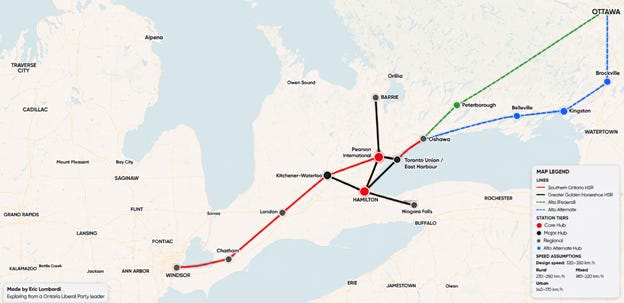
I put this together because our premier, Doug Ford, has proposed spending upwards of $100 billion to tunnel four extra lanes under Highway 401 — already the widest highway segment in North America, I believe. I wanted to ask: what could we build with that kind of money if we put it into high-speed rail and made reasonable cost assumptions? So here’s an overview — the travel times you’d expect between destinations, and the cost assumptions for stations and for each segment. An expensive segment like Pearson to Toronto runs $170 million per kilometre, because it’s either viaduct or, in places, underground; over flat land in southwestern Ontario, it’s closer to $75 million. For reference, Project Alto assumes $60–90 million per kilometre, at least in its public announcements. You’ll also see the speed assumptions — a top speed of 320 to 350 kilometres an hour, which again aligns with Alto. The assumptions are all in the “why” section, along with the station costs I’d expect. Otherwise, you can explore the map. Anything shown as a dotted line isn’t included in my cost assumptions; everything else is. So for the segment coming through Peterborough to Toronto, I’ve actually added a stop at Oshawa — I’ll get to why — and I’ve assumed all the additional costs from Oshawa to Toronto and across the rest of southern Ontario.
Two things need to happen with Project Alto. First, we shouldn’t be talking only about the Quebec City–to–Toronto segment, because then we’re back to treating it as a project: we’ve hired a consortium, and that consortium now says it’ll be six years before shovels are in the ground. What we should pursue is the network we want over the next 25 years, and then get started fastest on the fastest segment. Look at how Spain built its high-speed rail: they didn’t start with Barcelona–Madrid, because it was more complex. They started with a simpler segment — Sevilla–Madrid, I believe — so they could learn and keep building toward the longer-term network. Second, you need to continue it to Windsor. I know some business cases suggest that doesn’t make sense, but over a hundred years of provincial economic development, it absolutely does.
The real value of a network like this is connecting the Greater Golden Horseshoe into one contiguous mega-region, from an economic and labour-mobility perspective. Right now, if you work in Kitchener–Waterloo, it’s an hour’s drive to Hamilton — some people do it, but it’s rare for these two centres, with about a million people around each, to participate in each other’s labour markets. With a connection, you could get between them in about 20 minutes, and that opens a huge world of opportunity. Same for Oshawa to the Pearson economic zone, the second-largest employment zone in the entire country. And the Toronto–Pearson connection matters because it links people to the airport, and might resolve some of our other Toronto debates. So the logic is: you can go from Ottawa to a tourist destination like Niagara Falls; from London, be sipping wine in Niagara-on-the-Lake in an hour and a half; live in Barrie and commute to Hamilton in reasonable time. Everyone in the region can reach far more employers, which means they can bargain for better jobs without the cost of moving — and employers can locate in Hamilton, Kitchener, or Oshawa and still attract talent from across the region. The whole prospect of building and investing in Ontario gets better.
AM: This plan appeals to me, again, because of my heterodoxy on rail. I would much rather have a good, fast, reliable connection between Toronto and Kitchener–Waterloo than to Montreal — because I already have a way to get to Montreal or Ottawa quickly: I take a plane. There’s no quick way to get from Waterloo to Toronto at 7:30 in the morning for a 9 a.m. meeting. You either drive — and you’re really rolling the dice — or you don’t go. It’s uncertain and unreliable, and there’s no alternative, because GO service doesn’t help. This would give the people of Ontario something they don’t have right now.
EL: I’ve heard the objection: doesn’t GO Regional Express Rail solve some of this? It’s not solving the same problem. High-speed rail makes the destination-to-destination speeds incredibly quick; what you want alongside it is strong local transit connected to it, so accessibility around each place is better too. Everywhere we put a major high-speed line, we should also be thinking about the local rapid-transit networks. Then it stops making sense to take the 400 down to the 403 from Barrie to Hamilton — you’d never do it, because it’ll always be faster and cheaper to take the train, then a bus, then maybe an Uber for the last mile. This unclogs so many of our roads, which is a huge problem in Ontario, and it creates incentives for investment and all the other things that make people’s lives more convenient.
I’ll make one more point: I’ve proposed an alternative to Project Alto here, too. What we want is to connect more of the province itself. The existing 401 corridor, which also carries part of the VIA line, has several smaller centres you can run regional service to. We should have the mindset that we’ll run both regional and express services on this network. Then it becomes possible to work in Ottawa and live in Kingston, because you only need to go in every two or three days. Interconnecting this region will probably see more traffic than a line from, say, Windsor to Montreal — and I don’t think that logic exists right now in how we think about these projects.
AM: My view — that regional rail matters more than intercity high-speed rail, that the one depends on the other — hasn’t been popular. But your plan is exactly what I’ve been arguing for; it’s very exciting. Let me add, since you raised it, that this is entirely complementary to GO electrification, which turns the GO system from a commuter rail into more of a “surface subway” — I don’t love the term, but it’s the one people use — with much shorter headways and more in-between stations, without increasing travel time, which allows for a lot more infill development. GO electrification is, I’m obliged to quip, off the rails: badly overdue and expensive. What’s your diagnosis of the problem, and how would you fix it?
EL: The biggest problem in Ontario is the same across almost every sector: a distinct lack of curiosity, from our government and our leaders, about the problems they’re tasked with solving. A month or two ago, both Prabmeet Sarkaria, our Minister of Transportation, and Doug Ford were asked about the tripling of transit infrastructure costs in Ontario, and it was, “Yeah — COVID and inflation.” You’ve been responsible for this for years, and you haven’t spent any time thinking about why these things don’t work? Here’s the problem: Metrolinx doesn’t have a true independent mandate. Most projects are contrived in ministry offices first, before they go to that supposedly separate institution. When you don’t have a mandate for institutional independence to actually make decisions, you get a lot of indecision — what I call decision-based evidence-making. And that ends up as squandered cost and time. So there has to be political will and pressure to make decisions, and to push decision-making down to independent institutions so they can move faster.
AM: I have to be circumspect, so I won’t go into detail, but from someone who was on the inside: your diagnosis is correct.
EL: One of the funny things about becoming an advocate — first with More Neighbours Toronto, and then chairing Build Toronto, the growth-oriented arm of the Build Canada movement here — is that people who are part of these systems come forward. I’ve talked to consultants and public servants. Even the consultants say, “People blame us for the costs, but we’d rather be doing twice as much; half of what we do is bureaucratic compliance nonsense, and we don’t get to do the things we want to focus on.” With More Neighbours, people would come to me from the Ministry of Municipal Affairs and Housing, or from the City of Toronto: “Can you advocate for this? It drives me nuts, but I can’t put my name to it.” I see my campaign as a platform for everyone who sees the dysfunction and knows the solutions, but who hasn’t seen anyone willing to spend the political capital to make the change. I’m running to do exactly that.
AM: So GO electrification is part of a root-and-branch reform of Metrolinx.
Road Pricing
AM: Let’s move from transit to another matter: road pricing. I’m on record calling it the number one policy no one wants to implement but everyone loves once it’s in effect. I avoid “congestion pricing”; I don’t even like “decongestion pricing”; I prefer “road pricing.” What’s your view?
EL: When I chaired Build Toronto, we published a memo on congestion pricing. For a while I thought I might avoid going on the record in support of congestion pricing. Then I realized the cat was out of the bag and I’d be attacked with it anyway, so I might as well defend a good idea. What we should focus on is the outcome people want: to be able to drive places reliably. If you brought in a pricing regime that still left people stuck in traffic, you’d get a lot of anger. But done properly, you won’t get all the traffic. So I’d employ congestion pricing in the GTHA, on our highways, to the extent needed to maintain a minimum speed of 50 kilometres an hour. That makes the highways their highest and best use at the times people need them. I recognize there are people who rely on driving for their jobs and their work, and lots of lower-income Ontarians who don’t have much choice but to drive — and there are things we can do for them. But what gets missed is that people don’t just value their money; they value their time, and we put no priority on that. A business paying a trucker $30 to $50 an hour, who’s going to spend an extra hour crossing the GTA, would have needed to pay maybe $20 to get there twice as fast. The economics work for those users too: they get to do more, move more.
Everywhere congestion pricing has been tried, it has worked, and everywhere it’s been tried, people have been loath to take it away. There’s a challenge here because of how people feel about the 407. The price shock on the 407 has made a lot of people angry, because it’s become a privileged highway. But here’s what people don’t appreciate: if we bring in congestion pricing that’s much lower than the 407 on our other highways, the 407 won’t be able to charge its steep prices to lure people off the rest of the network — so even the 407 will be forced to compete and get more competitive. What we should also learn from the 407 is that there’s private demand to own and operate highways. So for projects like the Bradford Bypass or the 413 — which have attracted a lot of controversy about whether they’re worth the government spending money on — I think the province should do the pre-permitting and set the design standards, but if the CPP or a pension fund wants to own and build a competitor to the 407, I’d love nothing more than for them to have the right to do that.
AM: I’ve written about this too, and I’m entirely in favour of managed lanes of the sort you’re describing. You just must build into the contract what you said: that the purpose is to set rates as low as possible while keeping the highway moving. If it’s just revenue collection, it leads to perverse incentives. But if the goal is to keep the lanes moving — you didn’t say it, but I assume this charge would be dynamic. At 3 a.m. on a Monday it’s low or zero, because there’s no demand; at 3 p.m. on a Thursday, as rush hour begins, it’s quite different. It reflects local conditions.
EL: Yes. The price should only reflect what’s required to keep the road moving at a minimum of 50 kilometres an hour. That’s it. People ask whether you’d use the money to reinvest in transit — yes, broadly, as part of the pool, but the goal isn’t to generate revenue for transit. The goal is mobility: making sure people can rely on the speed of the highway network.
AM: It’s not a revenue centre; it’s a transport system that needs to be managed to be most efficient as a transport system. We’re all technocratic wonks here, so we’re 100% on board with road pricing as a tool to move people and goods most efficiently.
Driving Automation
AM: Let’s talk about automation — probably the topic my readers are most interested in. We’ve flirted with automated vehicles in Toronto. We’ve got Gatik, quietly running automated trucks for Loblaw in parts of the city. We’ve got Waabi, which isn’t really doing anything here but was founded here, with big plans for Texas and elsewhere. Magna ran a pilot that was embarrassing and didn’t succeed. We had delivery robots briefly in the Distillery District before we kicked them out — it’s never been clear why, other than that they were different from the status quo and therefore mistrusted. But you lived in San Francisco while Waymo was building up, so you have a completely different perspective. What’s your take on automated vehicles, and what role would you like them to play in Ontario’s mobility system?
EL: Let me take a step back. With generalist, autonomous robotics — not just vehicles; I’ll use “robotics” — it’s almost like 1895: we’re seeing the combustion engine at the World’s Fair, but no one thinks they’re selling their horse and buggy any time soon. By 1915 there’s a mass trend toward the automobile. That’s where we are with robotics generally. And I don’t think there’s a jurisdiction with more of a right to win in this space than Ontario over the next 30 to 50 years. If we operate from fear, we’ll miss an enormous opportunity. Why? We have five or six factors in our favour.
First, we genuinely have a major centre of AI in this province. A decade ago, on the Deloitte Fast 500 fastest-growing companies in North America, Canada had about 10%, matching our share of the population. This past year we had 23%, and over 15% of the total were in Ontario — because the sector is here.
Second, we have a financial capital that augments it; New York and San Francisco can claim that too, but we have other things they don’t.
We have a resource supply chain in Northern Ontario — critical minerals and more — that feeds the physical supply chain for automotive, machinery, and mechanical engineering.
We have an automotive industry far larger than almost any competitor’s.
And we have a clean electricity grid; if we get electricity, state capacity, and industrial policy right, it could be the most competitive energy sector in North America by far.
All of this means that if we understand what it takes to produce robotic systems — vehicles and machines — for export, Ontario could be the Western leader. And we have maybe five years to capture the opportunity.
So Ontario needs to change how it permits the use of autonomous machines — vehicles, robotics; heck, I think it would be charming to have park robots that maintained our public spaces better. We need to be deliberate about permitting the ones already operating, as most of the world does, and we should be publicly clear that we’re willing to procure generalist robotics for other uses in our society. We need to move our regulatory system from “no, with exceptions” to “yes, with exceptions.” That’s the grand goal of how I view robotics, in vehicles and everywhere else.
AM: Recently, Mayor Chow of Toronto, her press secretary remarked that Waymo is only welcome in the city to the extent it won’t contribute to Uber drivers losing their jobs. So the attitude is guilty until proven innocent: this technology is dangerous, and until we can defang it of any threat to anyone, it’s not welcome. To me this is a quintessentially Canadian attitude: we prefer not to take risks, not to do anything that could, as Eli Dourado likes to say, make anyone uncomfortable or cost anyone a job. How do you challenge that broader fear of the future that seems so common here?
EL: If we meet the future with too much fear, we’ll never realize the opportunities it offers, or the jobs it could create. Whenever I hear this, I remind people that in 1850, 95% of us were farmers. Do you want to go back and work the fields? No. We now have a far greater diversity of more rewarding, higher-value, higher-productivity jobs, because we freed ourselves from low-value labour. That didn’t mean we ran out of food; it meant we got better at producing it with less human input, so we can consume more, and our material well-being goes up. So when we say we can’t say yes to Waymo, what that means is that fewer people can get around the city, because Uber has to pay its drivers to drive. With autonomous vehicles, the cost of mobility comes down a lot — which means more choice, more commerce, all the things that add to our lives.
In economics there’s a great example from the semiconductor industry: the Jevons Paradox. In the 1990s, as the cost of manufacturing semiconductors fell dramatically, there was a panic that everyone would eat each other’s lunch and demand would run out. But as the cost of compute fell, the demand for compute rose even faster — and the result was more jobs and more economic activity. When we have this mindset of protecting the past, we miss the future, and we miss how lives and material well-being actually improve. It’s a small-minded, here-and-now approach. Canada wasn’t always like this. We used to believe in progress, in development, in the future. Now we believe in putting up every barrier we can so that nobody is upset by change. That has to change.
AM: I talk a lot to American audiences, and they ask, “What about the people who lose their jobs?” And I want to say: that’s why you need a strong social safety net, so that a person’s worth, dignity, security, and future aren’t bound up in a particular job, and they can transition. Then I remember I’m talking to Americans, and I bite my tongue. But in Canada we have a strong social safety net. So — I won’t put words in your mouth — I believe there’s enough prosperity to be gained that we can tax the winners to make the losers whole, and that it’s a better deal than trying to keep the future out. If you try to protect what you have, you lose it; if you try to build something more, you gain even more besides, especially for those left behind.
EL: What people often don’t appreciate — and I’m a true liberal; I believe deeply in competition in a highly entrepreneurial economy, so that you generate wealth you can tax fairly to provide a level of human welfare befitting an advanced society — is why competition matters here. In uncompetitive markets, the incremental value of the investment and innovation you’d need to hire someone for isn’t as great, because you can bet your competitors won’t make the same investment. So when capacity opens up and you can lower your costs with AI, you don’t need to repurpose the people you had. But in competitive sectors, the extra value you get by automating a less valuable process means you can spend it where human labour creates the next increment of value, ahead of your competitors. So if you want to avoid mass layoffs and turmoil from AI, the first thing you need is a competitive economy that requires labour to take advantage of these benefits and get ahead. That means almost everything we produce in Ontario — a good or a service — gets better for the same cost, without killing jobs. That has to be understood, and I don’t think it’s appreciated enough.
Rural Areas, Remote Areas, and the North
AM: You’re running for Premier of Ontario — not of Toronto, not of the Golden Horseshoe. It’s easy to talk about mobility in the context of the Greater Golden Horseshoe, or even southern Ontario. But what’s your mobility vision for Northern Ontario? You’ve spoken about the Ring of Fire and critical minerals — how are Northern Ontarians going to get around in the future, if you have your way?
EL: A couple of things. Northern and rural Ontario never really recovered robust transit service after Greyhound shut down and subsidies for rural bus operations declined. In the long term, my high-speed rail network — connecting places like Kitchener, and building hubs like London and Windsor — would let us better serve the regions around them, and create more demand from the rest of the country and Ontario to come visit our beautiful lakefront and tourist towns. Then there’s the legacy rail network, currently owned by CN and CP. I think one of the greatest crimes in our history was selling off the land under those corridors, which has limited our ability to decide what public uses they serve. We’ve just started restoring the Northlander service to Timmins. I’d like us to look at running rail through Northern Ontario — say from North Bay to Sudbury, connected even to Thunder Bay. It wouldn’t be fast initially, but there are overnight and daytime services some people would certainly take. People don’t appreciate how many rail lines still exist to serve the mining industry up north. So there’s an opportunity to run service networks to these places — as long as we figure out what happens once you arrive locally. For some of these smaller Northern centres, it’s also about helping them diversify out of the boom-and-bust cycle and attract more kinds of people who want to live and work there, and connectivity matters for that.
Here’s the controversial part. We need to be deliberate about identifying the corridors we want to be public, or at least to have public priority on, that CN and CP own today. To get them to the table, we’ll need to be much bolder. I’ve worked in M&A for years, and sometimes you have to put a bold line on the table and recognize that you hold more cards than you think. So if CN and CP won’t come to the table on amicable use and prioritization — with consistent expectations and standards — for the passenger services I’d like to restore, then we’ll use, or threaten to use, the power of eminent domain. They’ll have the choice: an amicable agreement where they keep ownership, or potentially lose it entirely and go figure out with their investors what matters to them. Unless we’re willing to go there, they have no reason to work with us. So I’m willing to go quite far to make sure these corridors — which are ultimately a public good for trade — can do what our outcomes require.
AM: I’ve worked in a small way with the Canadian Class I railways, CN and CPKC — Canadian Pacific Kansas City, or whatever they’ve rebranded themselves to. Their attitude is, “Oh, your country was founded in 1867? We’re older than that. Back off, punk.” So you’ll need to bring a similar swagger to those negotiations to succeed. And there’s a lot to what you say. As I’ve written before, you really can’t run freight and passenger rail on the same corridor; they’re at odds. A central problem of mobility is that different uses on the same infrastructure always creates friction. There are ways to resolve it, but the easiest is different uses on different infrastructure. There aren’t many corridors where you can run passenger rail on abandoned rights-of-way; the first-best solution is to acquire the corridor, get it up to a higher-speed standard, and run it.
EL: For Northern Ontario, I don’t have all the answers about the viability of sharing the freight corridors. It’s not the ideal long-term solution, but we want the right to build on them, so that where we need separated sections to manage traffic, we can. These are long distances, and rebuilding everything wouldn’t be viable at the cost, so sometimes you accept the trade-offs. If we value keeping the North connected, this is one way to do it, alongside additional passenger service.
One more thing: our Northern highways are quite dangerous, because most are winding, with one lane in each direction. There are about 1,700 kilometres of the Trans-Canada like that, and you see dramatic numbers of deaths in winter, and closures that last a long time, with a lot of freight on the corridor. We’ve debated twinning the entire corridor for a long time, which is expensive, and there’s merit in it. But the first thing is to make it a national goal — a long-term program — and to recognize that on some segments, other options make sense, like “two-plus-one” designs with alternating passing lanes and some separation, so winter driving is far less dangerous. Funny enough, even though that’s only one less lane, it costs about five times less. So you can deliver better connectivity and safer driving for Northern Ontario faster and far more cheaply than going for perfect. We need to work with the federal government on that.
Energy and Nuclear
AM: Before we wrap up, I can’t resist throwing you one more question. Don’t give me the full pitch, but what’s the short version of your vision for Ontario’s energy economy?
EL: We should be producing — and consuming — the most electricity per capita anywhere in the world. The way to get there is to think about energy development as a system too. I’m very inspired by how the French built their nuclear advantage: they set nuclear incentives, identified plenty of future sites, did the permitting and environmental review, chose one reactor design, and copied and pasted it to bring down the capital cost. I’d have the province take responsibility for the capital cost of baseload power, which should be nuclear and hydro, and let the private sector handle variable demand — renewables and battery storage, which have a pricing mechanism built in. I’d bring the permitting for all of this up to the provincial level. Right now, to permit a battery-storage site you go through the municipal process, and everyone reinvents the wheel. I want one provincial system for rapid permitting, with pre-identified sites, so the private sector has a clear signal of where it can move, and quickly — which also reduces risk. That’s the generation side.
Then there’s consumption. We spend too much time telling people to save energy and not enough telling them to consume more. In a city — Ottawa, where I am today, or Toronto, where I live, or many others — about 90% of emissions come from heating buildings and moving people and goods. The alternatives are electric heating and cooling, and electric mobility, and both need a lot more electricity. If you own a home built in the 1980s, you might have only a 100-amp connection. Say you want an electric vehicle, a heat pump instead of your furnace, and to convert it into a multiplex — you’ll likely need a 400-amp connection. If the transformer on your street isn’t upgraded, the utility says, “You’re making us do this upgrade; give us $100,000 so we can provide that power,” and your neighbours won’t have to pay for the incremental upgrade — they’ll just apply and pay the $5,000–10,000 for their own increased connection. I’d like a clear mechanism to amortize those infrastructure upgrades over time through higher consumption, so our utilities have a clear incentive: when they upgrade a neighbourhood, they tell people, “Your neighbourhood has been upgraded — and here’s how you can consume more electricity. You’re ready, and here’s how.” We should be conditioning people to think about increasing consumption, not the other way around.
The last piece is managing the transmission infrastructure itself. If you’ve followed Ontario politics, the energy sector has talked about the “smart grid” for as long as I’ve been alive — and it’s still not that smart. That means we use a lot of grid infrastructure at very low utilization, because we don’t know its overall health. Going forward, the Ontario Energy Board needs a mandate to put smart monitoring on all of it, so we can move a transformer from, say, 30% capacity to 60%. Then we’ll know where the points of failure are and where the priorities for upgrades are, and we can sweat the assets we already have, which brings down the cost of what we’ve already built. There are a lot of components to electricity, but it all matters, because electricity will be the most important economic and environmental input of the future by far — and it’s an area where Ontario has a tremendous potential comparative advantage. We can’t miss the boat on getting it right.
In Conclusion
AM: A future of abundant electricity, abundant mobility, and abundant housing — I’m all for it. Our time has to come to a close, so let me throw you a more fanciful question. Say you somehow become premier tomorrow, and you get to do one mobility or transport thing in your first year. What is it? To give you time to think, I’ll tell you mine: I’d come up with some neutral way to classify what a higher-order transit system is, and then classify every higher-order transit stop, and then say that if you’re constructing a building such that the front door is 300 metres or less from an access point to that station, there are no more height limits — by fiat of the province. Let the market decide how much housing there should be next to a higher-order transit stop. Admittedly fanciful, but what’s yours?
EL: It’s funny, because you mentioned land use — and if it weren’t transport-specific, that would probably be my answer too. But for me it’s not glamorous: it’s the institutional reform to change how we build. If you get that right, and can build at globally competitive cost and to higher standards, it doesn’t much matter what you decide to build next. If you don’t fix that fundamental problem, nothing else matters. So I want the institutional reform. Get how we build right, and “what we build” just means building more.
AM: In other words — abundance. Building abundantly. That’s an exit line if ever I heard one. Eric Lombardi, thank you very much for your time today.
EL: Thank you. And for everyone listening and reading: stay tuned to my campaign. If you’re in Ontario, sign up as a member of the Ontario Liberal Party — it’s free, and you can vote in November. And when the campaign launches, if you’re open to it, consider a donation, because what I’m doing here is challenging, and it isn’t free.
Thank you so much for your time, Andrew. It was a pleasure.