


A quick note: if you are reading this on the morning it is first published, i.e., Tuesday, 2 December, I hope you will join me at 1:00 PM ET (10:00 AM PT) for a live conversation with Jeff Fong of Urban Proxima about my co-authored book, The End of Driving, right here on Substack, courtesy of Substack Live. In our talk, Jeff and I will explore the policy choices that will determine whether automated vehicles improve, or worsen, our cities and our transportation networks. It should be a fun and interesting conversation!
If you’re already a subscriber, you’ll be notified when we go live, but I encourage you, if interested, to sign up here.
Earlier this year, I was at the Progress Conference, listening to Boom Supersonic founder Blake Scholl chat with Tyler Cowen about why modern systems feel so broken. The subject was a natural one for Scholl, who is one of my heroes: as the founder of Boom Supersonic, he’s done more than anyone to make supersonic intercity air travel, left dormant for decades, become a live possibility again. His life’s work has been to take a system that everyone takes to be permanently broken—the decades-long absence of supersonic commercial flight—and demonstrate that it can be fixed, with the right approach.
The broken system that “drives [him] the craziest”, aside from slow air travel, was traffic. Americans waste more than a working month every year sitting in congestion, he said, and everyone accepts this as normal. Building more roads won’t help, because of the well-known problem of induced demand. Some describe this as giving away road access for free, but Scholl said there’s a more precise way to put this: “The real problem is a lack of a price system”.
And then came the line that made my phone light up:
“I get flamed on Twitter for this, but I think every road should be a toll road.”

Is Scholl right?
If he’s correct, cities are leaving enormous value uncaptured; they’re incurring immense losses in productivity, wasted time, and foregone revenue. But if he’s wrong, we need to understand why, because the economic logic behind congestion pricing is powerful.
Here’s what I’ll argue: Scholl is right about the economics. Every road should indeed face a price equal to its marginal social cost.
Having said that, we must acknowledge that in most cases, the social cost of using a road is nil. That means that most roads most of the time should remain free. And even where pricing makes economic sense, the historical record says that the only road-pricing systems that actually succeed are modest, opportunistic, carefully constrained by political reality, and paired with visible benefits that justify the charge.
So Scholl is right about what policy makes the most sense. But, sadly, the economically-optimal world and the politically-feasible world overlap far less than we might prefer.
The Economic Case Is Airtight
The theory behind congestion pricing traces back to William Vickrey’s work in the 1960s.1 His insight was that congestion, regarded economically, is the result of resource misallocation. When you enter an already-jammed road, you slow down every other driver. That delay costs them time and money. You impose that cost without paying for it, and so—predictably—the system gets overused. The economic solution follows directly from the diagnosis: charge drivers the marginal social cost of their trip, and suddenly everyone has an incentive to travel only when the value to them exceeds the harm to others.
That one change, Vickrey argued, would produce elegant results. Roads would be allocated to the drivers who value them most highly. Travellers would face the true cost of their choices, leading to efficient decisions about when to drive, when to take transit, and when to simply stay home. The prices themselves, presuming they are dynamic and change to reflect demand, reveal which corridors actually need more capacity, replacing political theatre with actual signals. And the public would fund new infrastructure based on what users demonstrably value, not what planners hope they might want.
The evidence backs up the theory. When Stockholm implemented its congestion tax in 2006, traffic in the charged zone dropped 15 per cent immediately. London’s scheme, launched in 2003, produced 15 to 20 per cent reductions in the central zone. Singapore’s original Area Licensing Scheme in 1975 cut traffic by 44 per cent in the restricted area.
The most recent high-profile exercise in road pricing is New York’s, and its results fit the same pattern.2
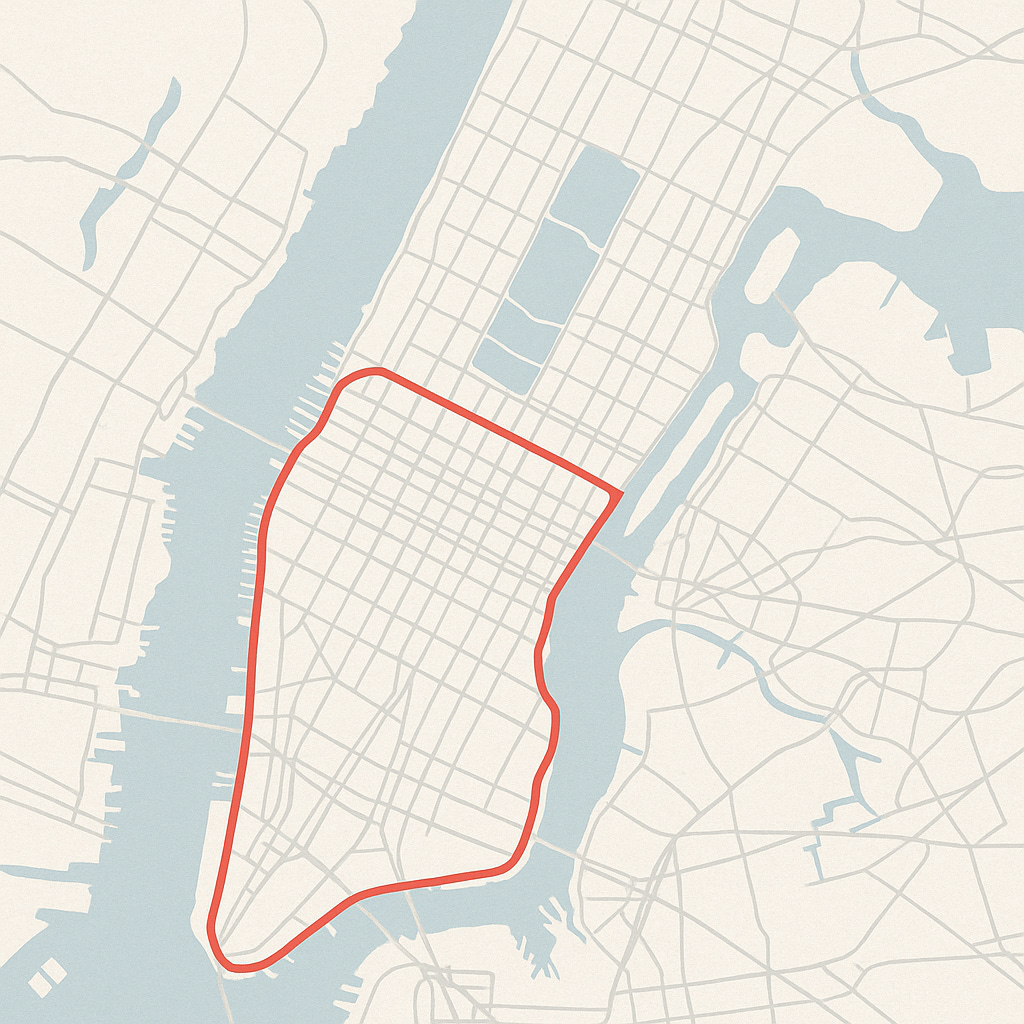
Artist’s rendition, approximately, of the New York City congestion zone.
In the first six months of operation, vehicle entries into the congestion relief zone fell 13 to 14 per cent. Average speeds in that zone have increased 11 to 20 per cent, with some river crossings moving 30 to 40 per cent faster. Crashes and injuries are down while transit ridership has hit post-pandemic highs. Business activity is up, with retail sales running $900 million higher than the previous year. The programme is generating revenue on track for $500 million in 2025, all of which will be given to the MTA to fund transit improvements: subway upgrades, station accessibility improvements, and more.
It’s easy to look at this and conclude, as Scholl does, that we should charge for road use everywhere.
But we don’t, and that’s good… for several reasons. One is economic, the other is political.
We can get the economic one out of the way easily. Vickrey’s observation was that governments get optimal outcomes when they charge the marginal social cost of a trip.
Sometimes that cost is zero.
Recall that in Vickrey’s formulation, when you drive on a busy road, you are making it slightly busier for everyone else, imposing costs. By the same token, when you drive on an empty road, or a free-flowing one, you aren’t impeding anyone else, nor are you being impeded. No one is bearing any costs, meaning that the marginal social cost of your trip is negligible.
It’s easy to forget, but most roads in North America are like this, most of the time. There are some that aren’t, courtesy of high demand during peak periods (‘rush hour’) or small lane provision (most urban streets); these road segments are a small fraction of the overall network but loom large in everyone’s experience because we use them so often. On this view, congestion is a signal of scarcity, and should be charged for; but lack of congestion is a signal of surplus, and thus should be left free to use.
But economics is not even half of the story. Politics is the bigger part, as New York’s history with congestion pricing shows.
The Political Case Is Leaky
The New York state legislature approved congestion pricing for Manhattan in 2019. It took five years of review, under the National Environmental Policy Act and other federal requirements, but the legal box-checking was complete, which had the added benefit of establishing just how useful congestion pricing would be: the analysis concluded that the programme would generate hundreds of millions of dollars, annually, in travel time savings alone, even before counting emissions reductions or transit improvements. The launch date was set for 30 June 2024.
Then, on 5 June 2024, just 25 days before launch, Governor Kathy Hochul killed it.
In a video statement, she said she had “come to the difficult decision” that the programme “risks too many unintended consequences” and directed the MTA to “indefinitely pause the program”. With an election looming in November, suburban House Democrats from Long Island and Westchester feared voter backlash. They needed political cover, and Hochul gave it to them.
The programme sat dead for five months.
What saved it? Ironically, that same election. Donald Trump won the presidency on 5 November 2024, and during the campaign he had promised to “TERMINATE Congestion Pricing in my FIRST WEEK back in office.” His threats created an extraordinary reversal of political incentives. The same toll that suburban Democrats had opposed as a burden on their constituents instantly became something worth defending: not because the economics had changed, but because letting Trump kill it would hand him a win.
On 14 November—just nine days after Trump’s electoral victory—Hochul reversed course. At a press conference, flanked by transit advocates, she announced the programme would launch after all, covering her previous objections with a fig leaf of a reduced toll: $9 instead of $15. New York now had three months to get it operational before Trump’s inauguration, or the programme might be killed permanently.
It launched at midnight on 5 January 2025, two weeks before Trump took office.
Despite the economic theory being well-founded, and subsequently demonstrated in practice; despite five years of prep work and procedure-following; it was struck down at the second-last minutes, to protect a handful of incumbents. It was revived at the last minute only because it got caught up in an even bigger culture war. (The Trump administration is still attempting to revoke federal license to administer the charge, which is tangled in ongoing litigation.) And spectacular operational success hasn’t made it politically secure.
Why should this be? The Scholl–Cowen exchange at the Progress Conference gives us the answer, by revealing the structural problem in miniature.
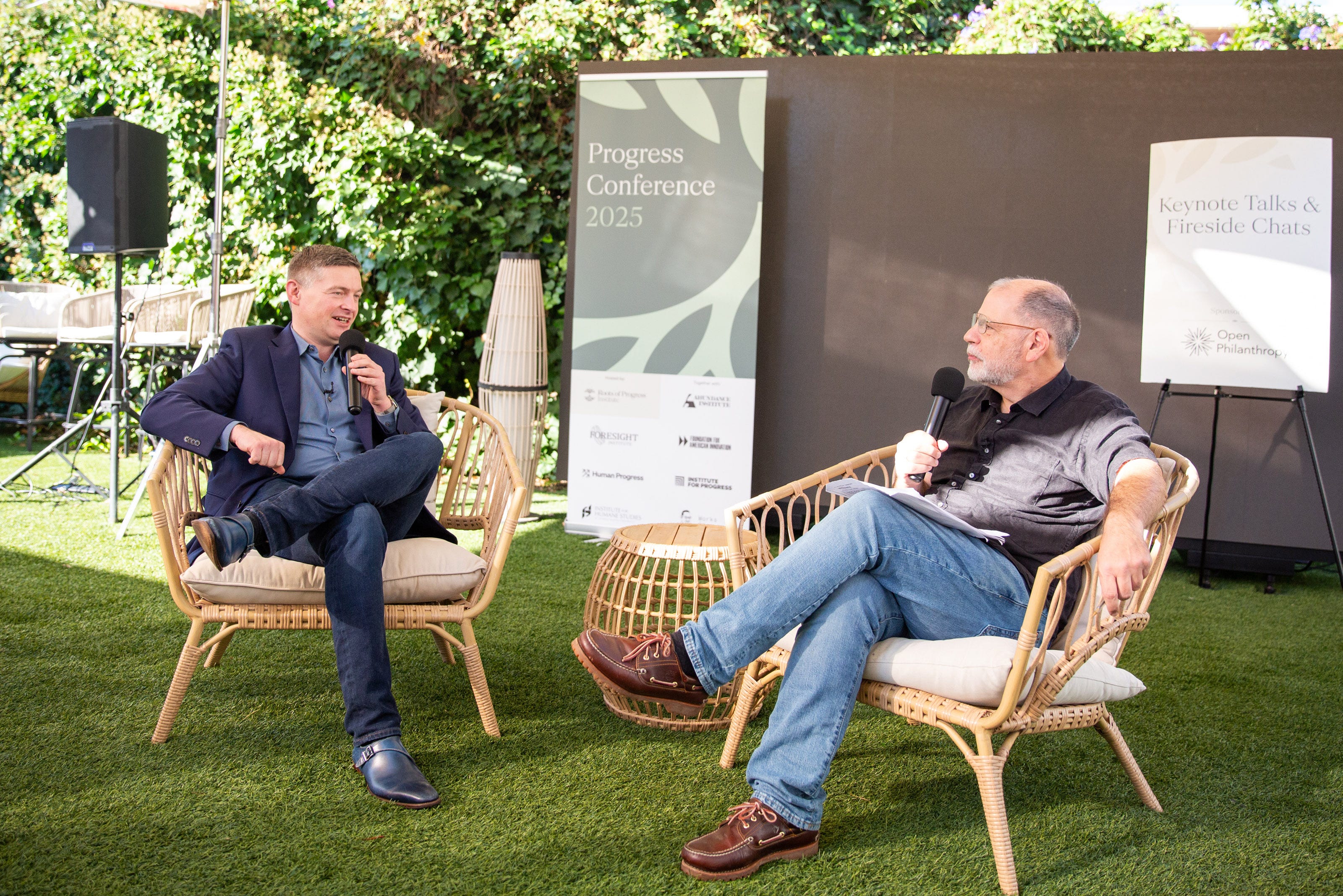
Boom Supersonic CEO Blake Scholl (left) talking road pricing with Tyler Cowen. Photo credit: The Roots of Progress Institute.
Scholl argued that road pricing was right on the merits. He’s correct about that: pricing works, the technology exists, the benefits are enormous. Cowen pushed back, but not on the economics. He instead noted that “the United States is not Singapore.” You might think that by this he meant that the government isn’t sophisticated enough to implement the sensors and digital systems to manage road pricing, which Scholl (correctly, I think) disputed. But that wasn’t where Cowen was headed.
“I get these [speeding] tickets from DC,” he said, because he was driving at a safe speed of 37 miles per hour in a zone marked as 25. “I get this weird ticket in the mail and I’m baffled. Shouldn’t I have the same concern with tolls… I don’t trust the government in the District [not] to screw me over because I’m from Virginia”. Cowen’s point was that, as an external party with no vote in the District, the District is happy to exploit him and other out-of-towners with an enforcement regime aimed at maximizing revenue, not safety. Scholl pointed out that Amazon is able to use cameras and digital systems to maximize both value and fairness, but Cowen would not have it.
“I trust Amazon,” he said, “and I don’t trust the District of Columbia”.
This is the political problem in miniature. Scholl sees a technical solution that should win over skeptics through obvious efficiency. Cowen articulates why it doesn’t: the same technology that makes universal tolling feasible can also be used as a means of arbitrary enforcement and wealth extraction.
What Actually Works
When we look at places that have succeeded in implementing road pricing, we see that two elements were essential to their success: pairing tolls with visible transport improvements, and seizing political moments.3
Voters will see being charged, i.e., paying for what used to be free, as a ‘tax grab’; exploitative banditry that achieves no good, rather like Cowen described the District of Columbia’s speeding-ticket regime. As such, they will oppose the charge vociferously. I will go out on a limb and suggest that New York City is a jurisdiction where most residents have little faith in government to be a force for good—what political scientists call a ‘low-trust environment’—and as such New Yorkers’ initial mistrust wasn’t especially surprising. Note, however, that the charge was equally unpopular in ‘high-trust’ Singapore and Stockholm before implementation. Voters, it seems, will always regard a new charge as a ‘tax grab’, no matter where they live.
New York found a way around this, by piling all $15 billion in revenue from congestion pricing into transit improvements. And the other jurisdictions that use cordon pricing all did something similar: Stockholm initially used its revenue to expand its metro (later, to appease a new centre-right government, its road system). London and Singapore used the new revenue to invest in buses and rapid transit respectively.
The second thing that seems to be required is recognizing that the stars must come right to make this happen, which means the opportunity must be seized when it arrives. New York spent years getting ready for congestion pricing through conventional politics, and it was still killed just before implementation… until Trump’s election meant that proceeding would make him take a loss.
Other charges have similar stories. Stockholm’s congestion tax emerged because the Green Party conditioned its support for a coalition government on running a pricing trial, despite the fact that the mainstream party, the Social Democrats, had explicitly promised not to introduce road pricing. Their need to placate a coalition partner got the experiment to happen… but it ended, and a subsequent referendum was necessary to make it permanent.4 London succeeded because Ken Livingstone, as the city’s first directly-elected mayor, had unique moral authority, as well as willingness to spend his political capital on a congestion charge. Gothenburg’s scheme came about because the national government announced it would prioritize infrastructure projects with local co-financing, creating a fiscal incentive that overcame resistance.
And of course Singapore implemented its system under authoritarian government, facing none of the democratic veto points that constrain pricing elsewhere.
Each of these cases required unusual circumstances that overcame the friction of regular democratic politics. These unusual catalysts are structurally necessary to overcome the disadvantage that any solution to a collective-action problem faces in democratic systems:
Normal political incentives reward immediate, concrete, intuitive appeals
Congestion pricing requires analytical reasoning about counterfactuals and shared obligations
Only extraordinary circumstances—coalition negotiations, unique institutional authority, partisan polarization—create conditions where analytical arguments can prevail against the average voter’s intuitive resistance.
Scholl Is Right, But Being Right Isn’t Enough
So Scholl is right: every road should face a price equal to its marginal social cost. For a quiet residential street on Sunday morning, the marginal social cost is zero, so the economically correct price is zero. Same for an uncongested rural highway at midday. For a downtown corridor at rush hour where every additional car creates delays for hundreds of others, the marginal cost is substantial, and the price should reflect that.
The real-world implementation of this is that the busiest downtown areas get cordon pricing, with prices fixed high enough to roughly reflect the marginal cost of travel, and the proceeds recycled transparently into visible transit or road improvements. Cordons expand intelligently, to consistently congested areas, and only when circumstances—crisis, partisan dynamics, unique leadership, or fiscal pressure—create windows that normal politics would keep closed.
This world is far more modest, and less elegant, than Scholl’s vision. But cities are run by people practicing democratic politics, and voters want elegance less than systems that work, and visible benefits that justify the costs. New York managed to thread that needle, and it’s working brilliantly. And all it took was 25 years of advocacy, five years of federal review, complete technical readiness, an accidental partisan catalyst, and ongoing legal defense.
That’s exactly how hard this is, even when you get everything right.
Hat tip to Salim Furth (not on Substack) at the Mercatus Center for bringing Vickrey’s work to my attention.
If you’re curious: the programme charges a $9 toll during peak hours for most passenger vehicles entering Manhattan south of 60th Street. Peak hours run from 0500h to 2100h on weekdays and 0900h to 2100h on weekends; outside of those times, tolls are 75 per cent lower. The zone excludes the FDR Drive and West Side Highway, and drivers already paying tunnel tolls receive partial credits. The system uses electronic toll collection via E-ZPass or license plate recognition, with no physical toll booths.
The patterns described in this section draw heavily from Lewis Lehe’s comprehensive review of downtown congestion pricing schemes: Lehe, L. (2019). Downtown congestion pricing in practice. Transportation Research Part C: Emerging Technologies, 100, 200–223. https://doi.org/10.1016/j.trc.2019.01.020. Credit, again, to Salim Furth for bringing this article to my attention.
Stockholm’s congestion charge was initially imposed as a seven-month trial from January to July 2006. After the trial ended, traffic returned to near pre-trial levels. A referendum was held in September 2006, in which Stockholm residents narrowly approved making the charge permanent (53 per cent in favour). The new centre-right national government, despite the mixed referendum results, decided to implement the charge permanently starting in August 2007, with revenues redirected from transit to road construction as a political compromise.
I wonder about the political economy of the shift to EVs, which don’t pay gas tax, as an opportunity for transition. In Colorado, where 1/3 of new cars are EVs, and market share continues steadily growing, I could imagine a winning position like: “to charge EVs we need a new solution, so we’ll replace the state gas tax with state congestion pricing, making the system more fair and more efficient at the same time.”
(Also notable in CO is the relative impact of “rural” congestion as seasonal travel to the many mountain resorts creates horrible traffic outside of the major cities)