



This week’s issue is a collaboration with Mike Riggs, who is the developmental editor at the Roots of Progress Institute and a longtime policy journalist.
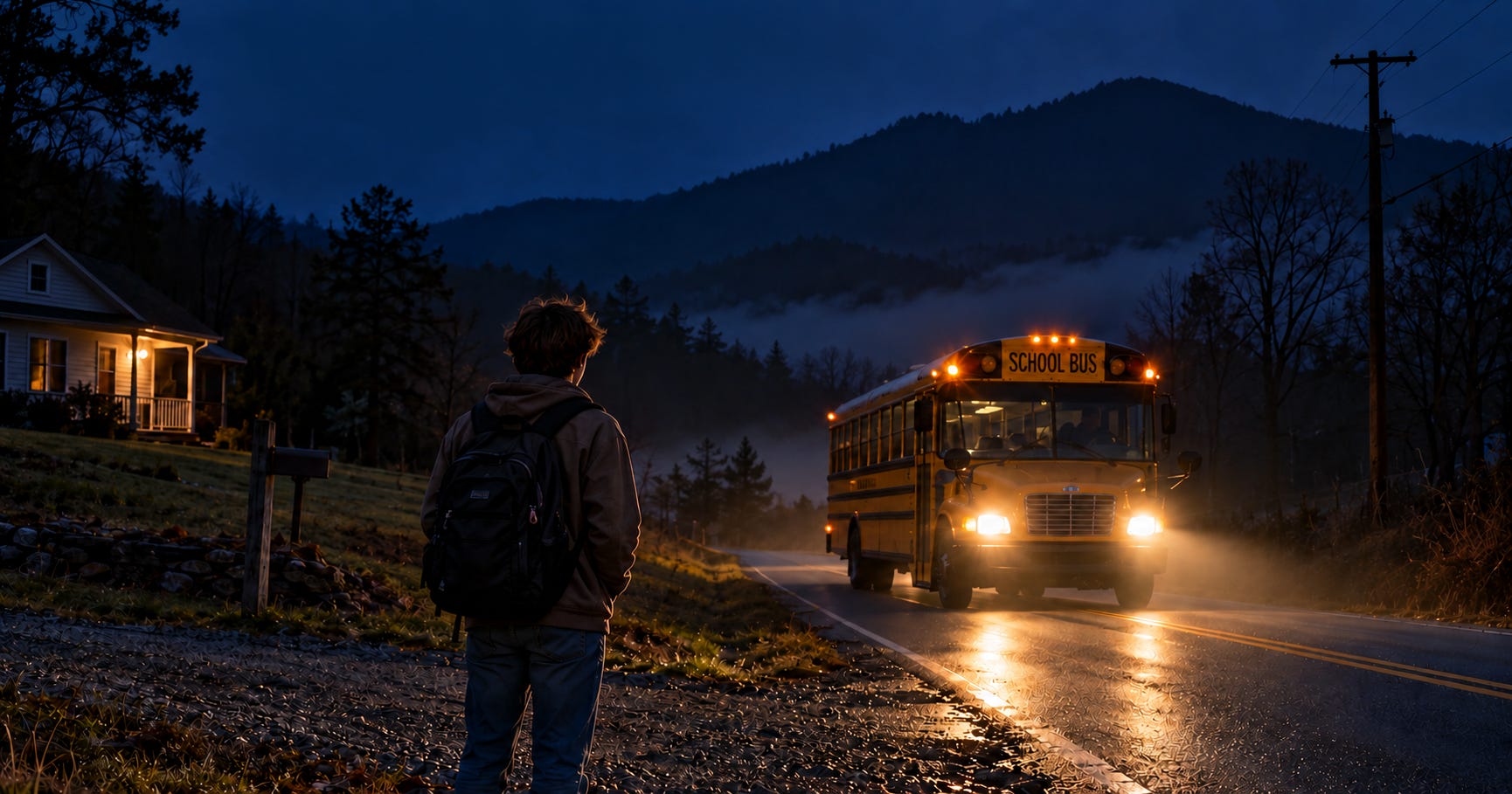
In 2023, the first high schooler to board a bus in Madison County, North Carolina, did so at 4:51 AM. Their bus didn’t reach school until 8:04 AM, three hours and 13 minutes later.
Who would design a system this way? No one would, if they had alternatives. But Madison County, like many districts across North Carolina and indeed North America, doesn’t have better options. Every bus route needs a driver, and almost no jurisdiction has enough of them.
Driverless vehicles could change that.
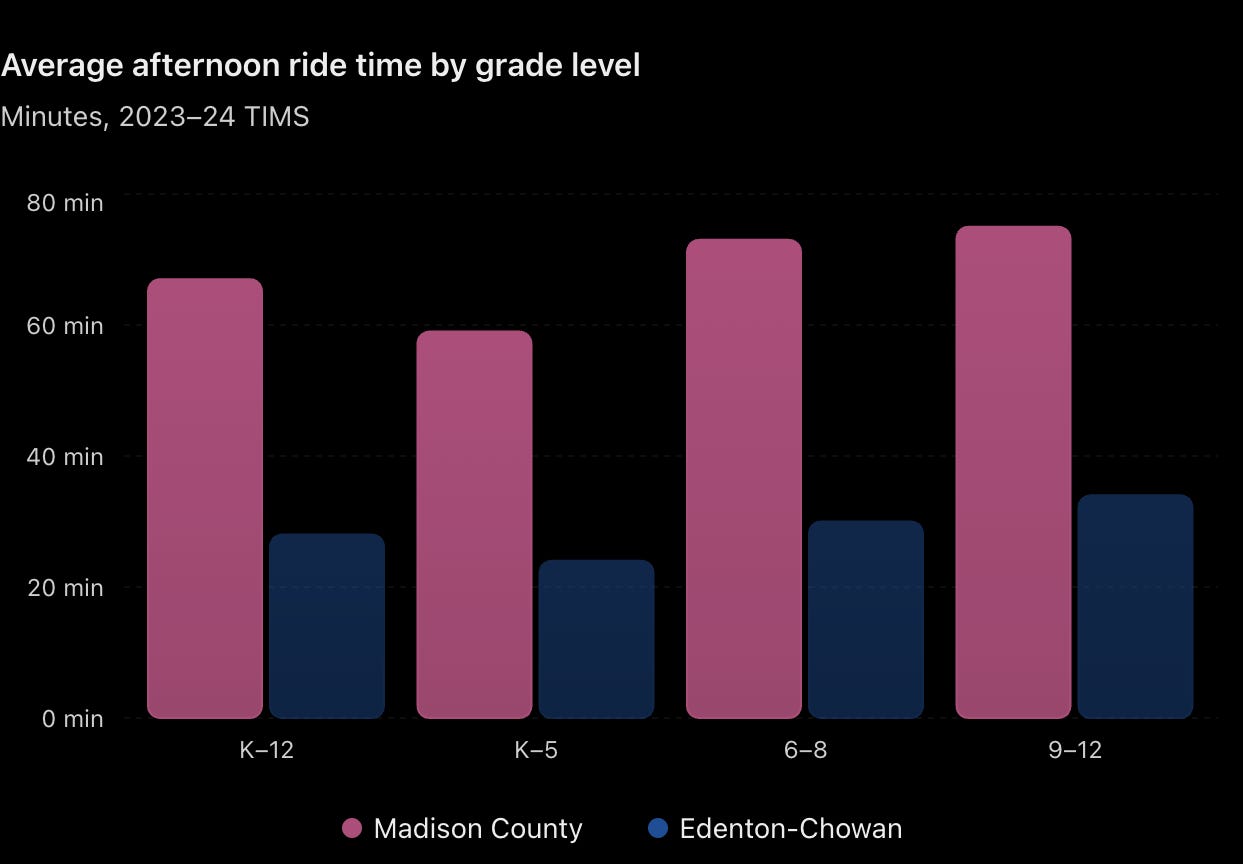
In Edenton-Chowan Schools, on North Carolina’s Albemarle Sound, the average bus for K-12 students in 2023–24 drove about 33 miles each way; the average morning ride took 32 minutes, and the average afternoon ride took 28 minutes. Even at the margins, the ride times were tolerable: The first student in the district to board a bus in the 2023–24 school year did so at 6:06 AM, and their bus arrived at school an hour later. The last student to arrive home left school at 3:45 PM and stepped off the bus at 4:44 PM.1
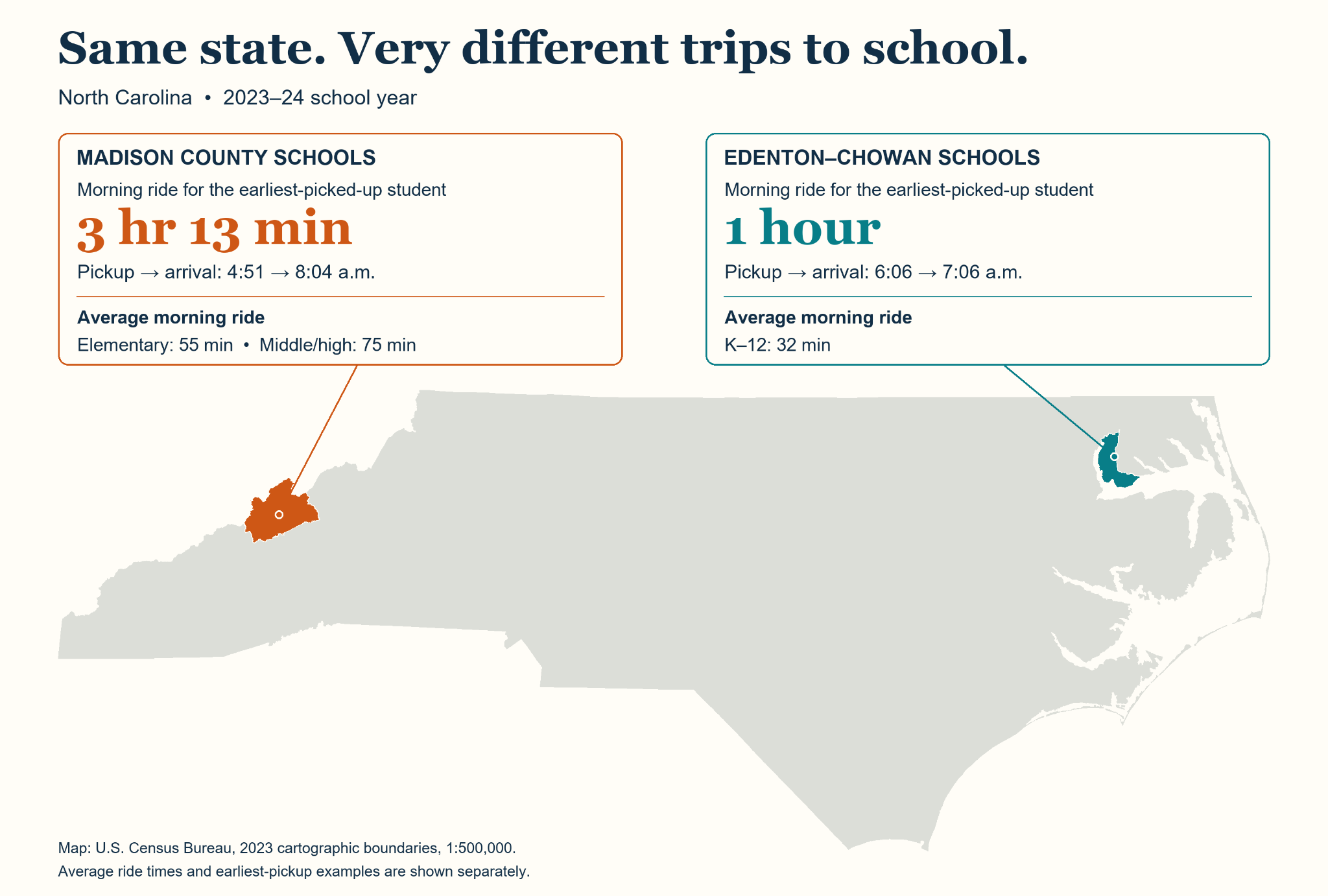
Other students in the state aren’t so fortunate. The average Madison County bus in 2023–24 drove 54.3 miles in the morning and 55.6 miles in the afternoon. Elementary school students averaged 55 minutes each way, while middle and high school students averaged 75 minutes. The first elementary student boarding a Madison County bus that year got on at 5:31 AM and arrived at school at 7:55 AM; the last elementary student to get home departed school at 3 PM and stepped off the bus at 5:28 PM. The earliest middle schooler and high schooler had it even worse: They boarded at 4:52 AM and 4:51 AM, respectively, and arrived at school at 8:15 AM and 8:04 AM. They left school at 2:55 PM and 3:05 PM, and arrived home at 6:14 PM and 6:16 PM.2
In other words, some kids in Madison County spend as much time on the bus each day as they do learning in school.
Under North Carolina law, every public school system in the state must plan, track, and report its school bus routes. Routing specialists in each county use sophisticated software to assign students and buses and work closely with experts at North Carolina State University’s Institute for Transportation Research and Education, the UNC Charlotte Urban Institute, and the N.C. Department of Public Instruction to optimize routes.
So the divergence in trip times between Edenton-Chowan students and Madison County students isn’t due to indifference, or a lack of tools or expertise. It’s for a different reason, one that, fortunately, driverless vehicles might fix: our legacy school transportation system depends on human school bus drivers, and human school bus drivers are becoming an endangered species.
The perennial human driver shortage
Every school in America struggles to recruit and retain bus drivers.
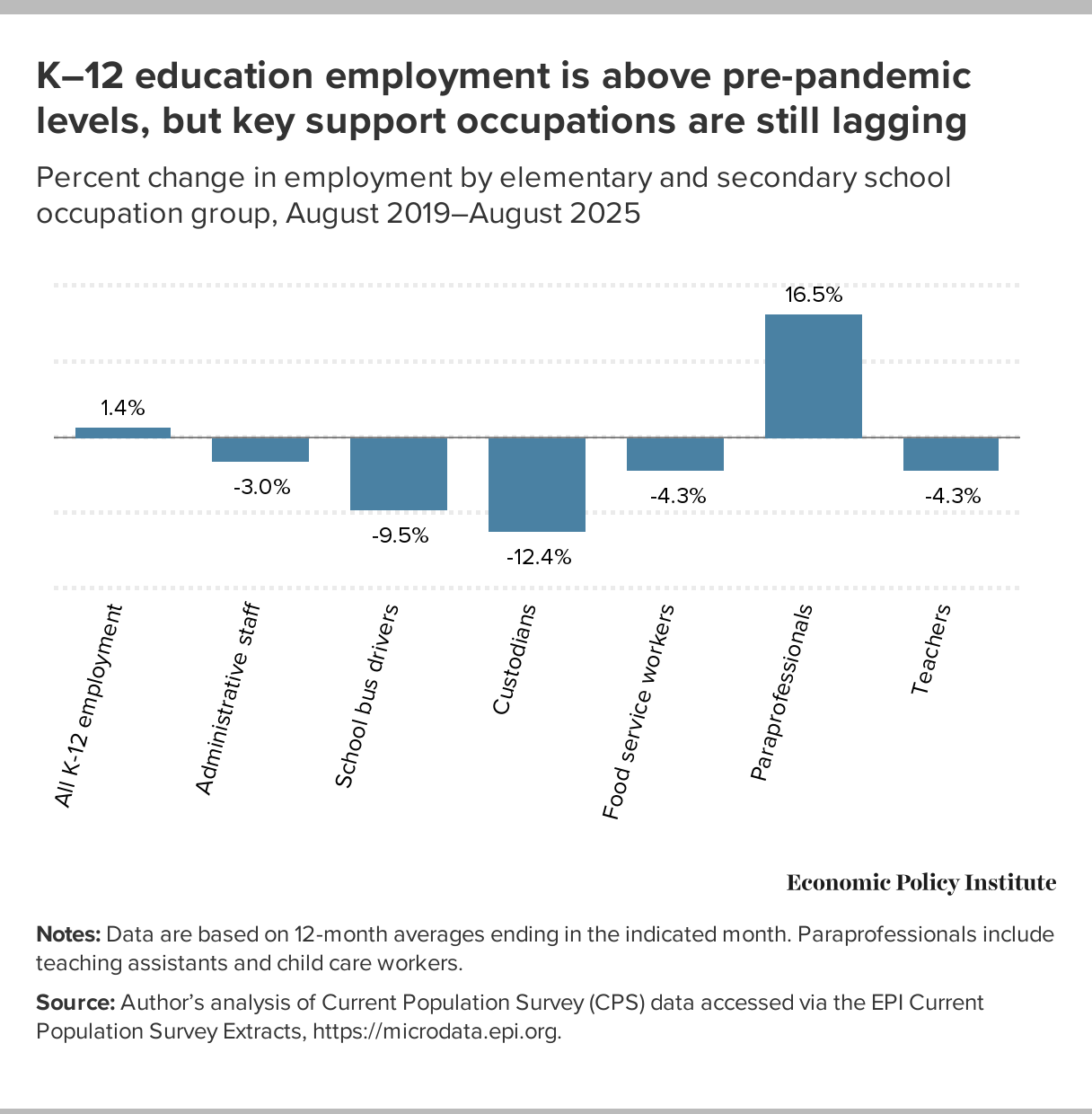
From EPI’s The school bus driver shortage has improved slightly but continues to stress K–12 public education.
That may sound sweeping, but surveys of school transportation administrators over the past 10 years have confirmed it. One recent survey, conducted in February 2026 by Zonar, a bus fleet-tracking technology company, and School Transportation News, a trade publication read by school transport administrators, found that 75 percent of respondents named driver hiring and retention as their top challenge. This compares to budget constraints at 52 percent, rising operational costs at 42 percent, and aging fleet and maintenance issues at 30 percent. Notably, only 11 percent of respondents named “inefficient routing and scheduling” as a top challenge, which suggests that most schools know what resources are available to them; they simply don’t have enough.
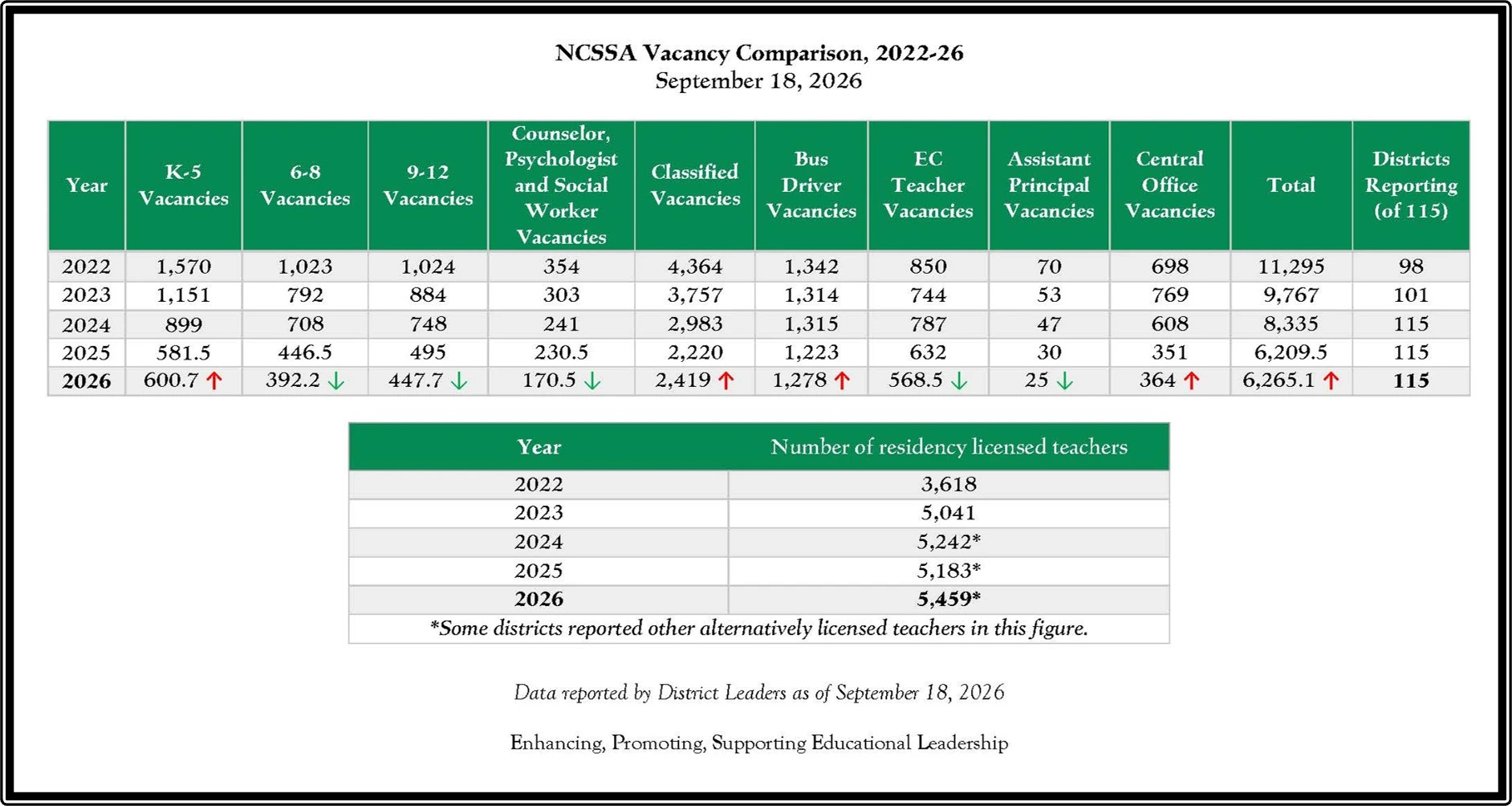
As of September 2026, North Carolina had 1,278 bus driver vacancies across 115 school districts, according to a survey of N.C. school superintendents. This is a vacancy increase of 55 positions relative to last year:
The driver shortage is partly a credential issue: While a commercial driver’s license (CDL) costs less than $200 in North Carolina, the Federal Motor Carrier Safety Administration (FMCSA) requires CDL applicants in every state to complete Entry-Level Driver Training to obtain their first Class B commercial license. If they already have a Class B CDL, they must take the course to add the passenger and school bus endorsements. Community colleges offer this training for roughly $900 to $1,200, while private training centers charge between $3,000 and $4,000.
To attract drivers, the North Carolina Division of Motor Vehicles provides this FMCSA training for free to applicants sponsored by a school district. Additionally, many districts pay applicants an hourly wage while they take the course.
These are nice gestures, but insufficient. That’s because driver trainers are also generally in short supply. But even where that’s not the case, public schools still must contend with the reality that school bus driving is not the most lucrative use of a CDL-B:
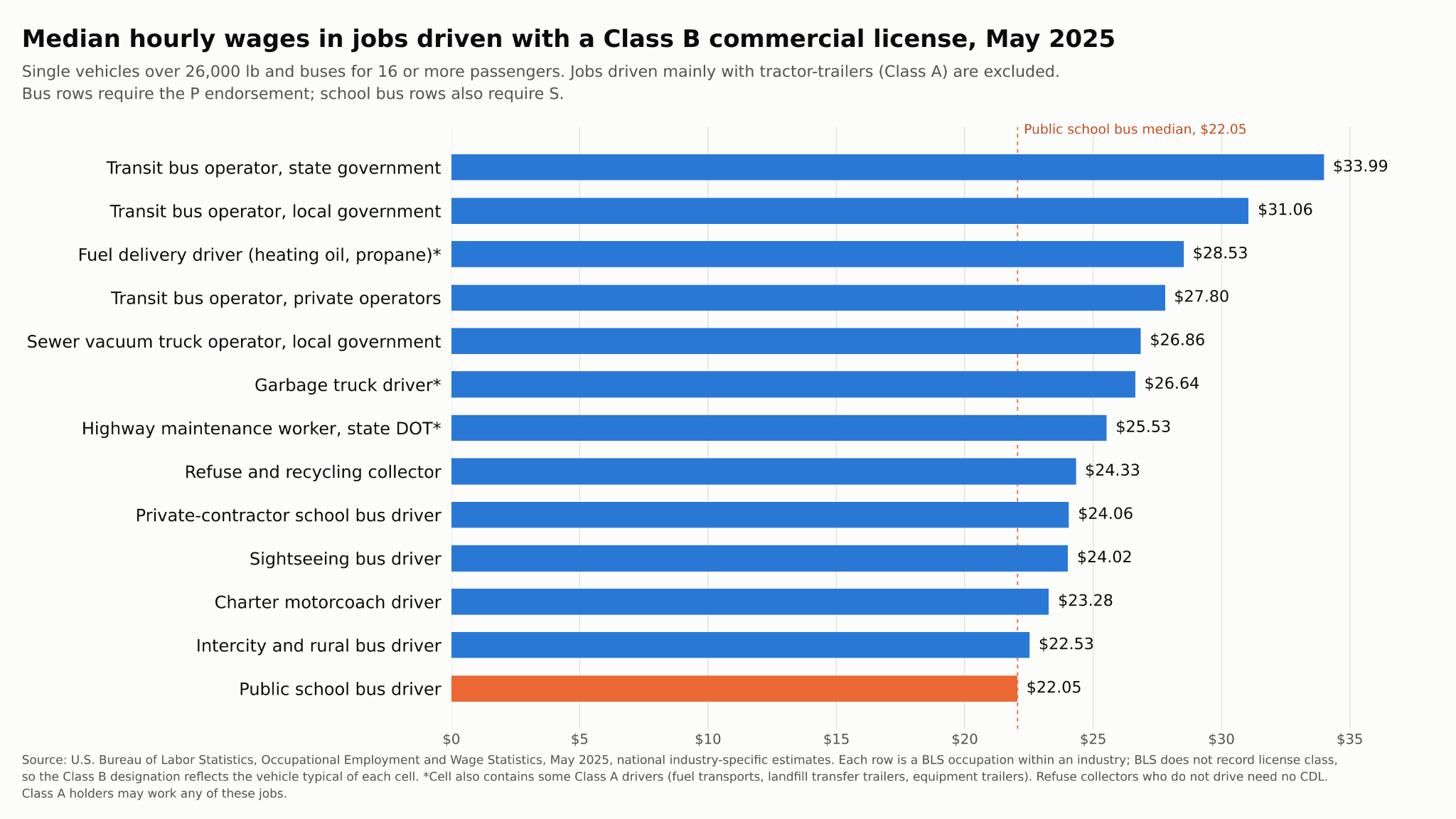
And the hourly rate doesn’t tell the whole story. Federal Occupational Employment and Wage Statistics suggest school bus drivers earn roughly $45,864 per year, but that figure comes from multiplying the median hourly wage by 2,080 hours (40 hours per week × 52 weeks per year). But school bus drivers work roughly 32 hours per week for 36 to 40 weeks per year. Most other CDL-B jobs offer full-time, year-round employment.
On hourly wages alone, a school bus driver has strong incentives to take their new credential and change employers as soon as possible. Schools have very little leverage to keep drivers once they’ve obtained their license. Some North Carolina districts ask applicants to pay their own licensing fees and then reimburse them after six months, but state licensing fees run hundreds of dollars versus thousands for federally mandated training, and the N.C. Division of Motor Vehicles has no mechanism to claw back training costs.
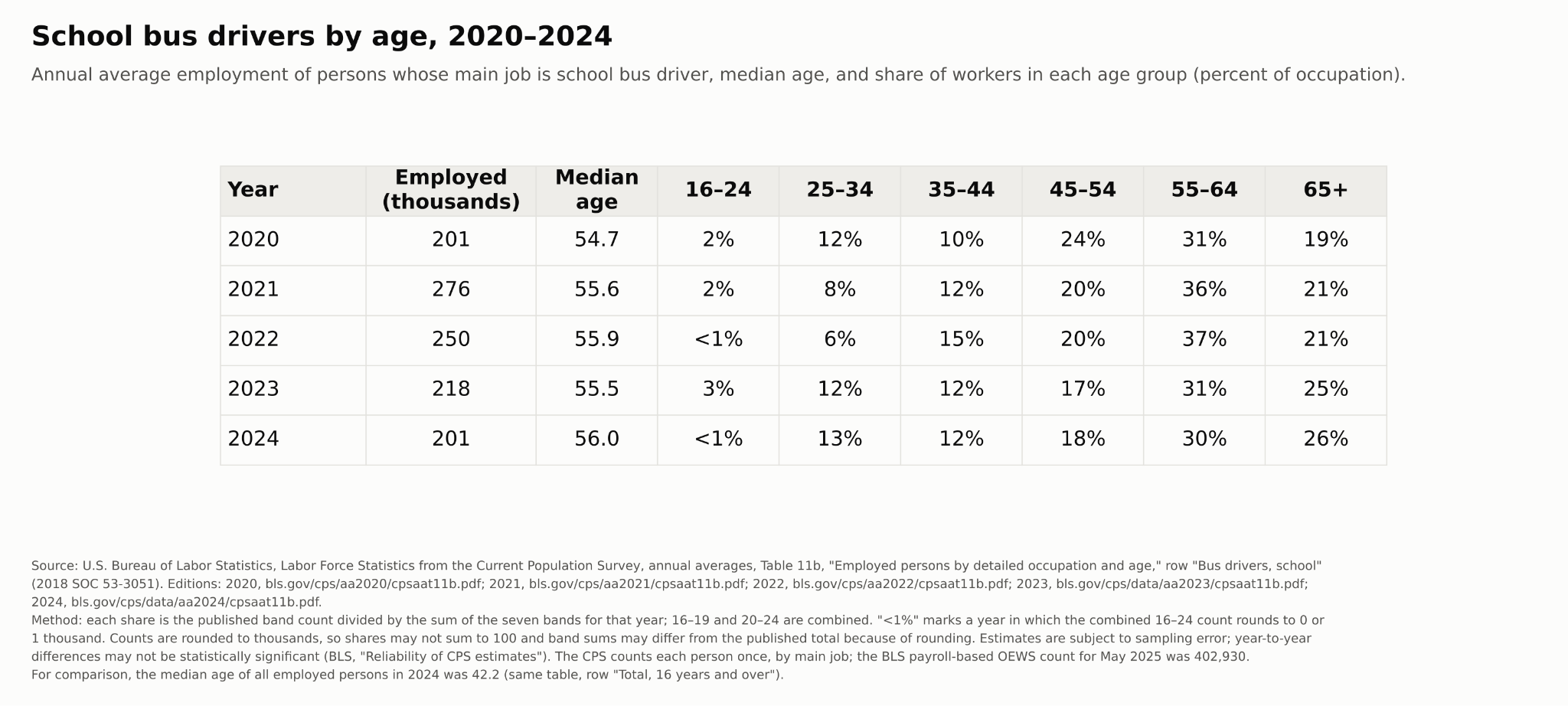
Whatever the market-clearing price is for bus drivers, most school districts can’t pay it. Meanwhile, the driver population is getting older:
Because drivers are hard to find, school districts often do more with less by consolidating routes. Solving the problem in this way breeds further difficulties. Consolidating routes adds more stops, and additional stops generally add more time. This holds for short and long routes, and some of those routes can be long indeed. One reason average trip times differ between Madison and Chowan County is that the former covers 449 square miles of mountains, while the latter covers 173 mostly flat square miles. In an ideal world, a school bus could reach rider capacity by stopping at a handful of community stops, but in rural areas that’s often impossible.3
North Carolina faces this problem acutely: seven school districts in 2023-2024 provided individual “door stops” for more than 80 percent of their riders; 20 districts had door stops for 70 to 79 percent of riders; 10 districts had door stops for 60 to 69 percent, and 23 districts had door stops for 50 to 59 percent of riders. Edenton-Chowan, for instance, had a 65 percent door-stop rate; mountainous Madison County had a 75 percent door-stop rate. While the former has shorter ride times than the latter, both districts feature longer ride times than truly dense urban districts like Wake County (8 percent door stops, 18-minute median ride time) and Cumberland County (12 percent door stops, 19-minute median ride time). This is also why subdivisions and walkable single-family neighborhoods can be especially efficient for public school bus routes. This dimension of the problem can add class politics—in some districts, distance to school proxies household income—to an already difficult logistics problem.
The case for AVs
Enter the self-driving school bus.
In theory, automated vehicles (AVs) are exactly the tool we need to reduce student ride times because they would let schools serve more routes than they have drivers. This new capacity could allow schools to deconsolidate their most time-intensive routes; routes that are long not only (or even always) because of miles traveled, but also because they carry numerous, widely dispersed students and every stop eats time.
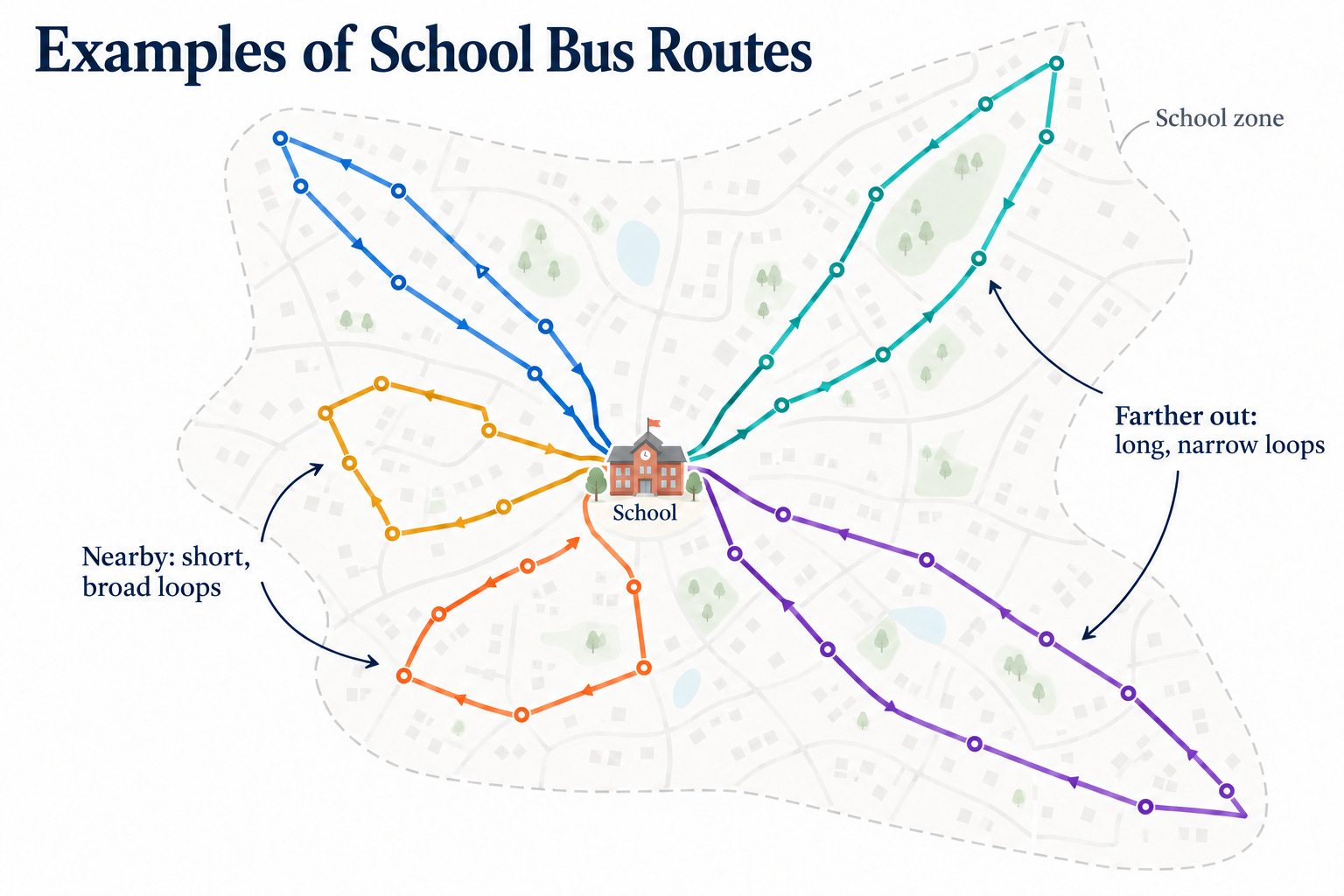
School buses start their routes at the schools they serve and drive out in loops that radiate from the school, like the petals of a flower. One common routing strategy gives nearby neighborhoods short, broad loops, while areas near the edge of the school zone are served by longer, narrower loops shaped like spearheads. In the latter case, the bus travels from the school toward the district edge, picking up students before it reaches its farthest stop. Upon reaching that stop, it returns to the school, picking up more students on the way back. On a spearhead route, the kid who lives farthest from school doesn’t spend the most time on the bus; that fate belongs to the kid picked up first.
AVs could be used to transport the students who currently board early and spend half an hour or more time in the morning traveling away from school, with the most distant students still served by the bus; or AVs could make something like a straight shot out to the furthest reaches of the district, pick up only the eight or 10 kids who live in deep orbit, and then hustle back. We don’t pursue these options today because of cost: as one of your authors has written before, every extra vehicle needs another paid adult behind the wheel, and a full-size bus needs one with a commercial license. But AVs used this way, as a complement to the existing system, could reduce ride time for all students.
The idea has potential but is rife with challenges. The first is persuading nervous parents that the right person to drive their child around isn’t a person at all, but a robot.
Are AVs safe on the road?
Start with an underappreciated fact: the human-operated school bus is a remarkably safe mode of transport. Back in 2002, the National Highway Traffic Safety Administration (NHTSA) declared that “American students are nearly eight times safer riding in a school bus than with their own parents and guardians in cars.” Although NHTSA no longer publishes passenger-deaths-per-vehicle-mile data for school buses, a July 2026 report from the federal Department of Transportation reaffirms that school buses are remarkably safe for children. Between 2015 and 2024, there were 90 “vehicles used as school buses” in crashes that killed at least one occupant. Those crashes killed 119 people on board, 39 of them school-age children (18 or younger). At the risk of sounding cavalier, we should read that as ‘only 90’ and ‘only 39,’ given that roughly 20 million American children ride the school bus each day, collectively taking 7 billion trips annually. Put another way: imagine a child who rode the bus to and from school every day from kindergarten through senior year of high school (about 4,700 trips). The chance that this child would be killed on the bus is something like 1 out of 380,000.
Are AVs that safe? Unfortunately, we don’t have a like-for-like dataset for direct comparison. But we do know that Waymo’s per-mile safety record is remarkably good and its vehicles are much safer than human-operated personal vehicles. At first glance, the two look to be in the same range: Waymo reports about 80 percent fewer injury crashes than human drivers in the cities where it operates, while NHTSA puts the bus at roughly eight times safer than the family car.
At second glance, we should consider the unique hazards students face when they ride the bus, such as crossing a lane of oncoming traffic to board. To mitigate the risk of an inattentive driver plowing into a stopped bus, or running down a child crossing the road to board, buses are designed from the ground up to capture other drivers’ attention; indeed, behaving well around school buses is currently an area where Waymo underperforms humans. Given that, can an AV handle the special difficulties school-bus runs impose?
It’s possible. We could, for instance, paint the AVs school-bus yellow and outfit them with flashing lights. Making them as big and robust as buses would defeat the point of using them to deconsolidate routes, so that safety angle is out; but their smaller size opens other angles, because an AV could avoid some of the risks buses must take. School buses collect students on major roadways because they are too large to pull into most driveways and because backing up is time-consuming and hazardous. An AV could pull into a driveway instead of having students board in the road.4 It could then easily turn around and, if it makes sense, go back the way it came. Bus routes feature as few left turns as possible; an AV could make the turns a bus avoids and take more-direct paths.
Are AVs safe inside?
One of us lives in a rural area and has a child starting kindergarten in fall 2027. That author (Mike) doesn’t mind a robot driving his son to and from school, but he worries about his son’s seatmates. Buses are vectors for bullying, as many studies and surveys have shown. Anyone who rode one as a child can understand why; there’s generally one adult, and their attention is on the road. A full bus is louder and less structured than a classroom.
What to do about this? Several possibilities suggest themselves.
One approach would be to identify vulnerable students and bullies, and then keep them apart, putting the bullies on the human-operated bus. This would certainly pose administrative and perhaps even legal difficulties; but these problems would also emerge in a world without any AV school buses, meaning they shouldn’t discourage us from trying the AV solution.
Another approach would be to have an adult bus monitor in each vehicle. (Indeed, North Carolina law today requires an accompanying adult when any child rides in an AV.) That may seem perverse, to build a bus that doesn’t need a driver but to keep an adult on it in any case. And while they’re easier to find than bus drivers, school districts also struggle to find bus monitors, who are most needed on buses that carry students with behavioral needs and/or disabilities.
Even so, many parents would likely insist on a chaperone or ‘alpha passenger’ to discourage acting out and reassure young riders. Candidates include:
Reliable high school students who have already worked as a babysitter or lifeguard
If those students aren’t interested, schools could design a short summer training program for outstanding students who want to serve as volunteer mentors on an AV route… for at least the first few years, it would look great on a college application
Districts that closely co-locate their elementary, middle, and high schools could experiment with mixed-age groups on an AV bus, looking along optimal route paths for students who could be identified as a ‘hall monitor’, a common practice in elementary and middle schools
Districts with community colleges offering associate degrees in early childhood development or child psychology could coordinate a chaperone-for-credit arrangement, locking monitors into routes for a semester at a time
Finally, parents or older siblings could serve as the alpha passenger
And of course AVs, with or without chaperones, would be monitored in real time with audio and video connections, so riders feel supervised and dispatchers can respond to emergencies or mechanical failures.
Can AVs pass the cost test?
If school districts could hire all the drivers they need, we wouldn’t be discussing AVs as an alternative (not yet, anyway). That means AV transport needs to be substantially cheaper than the status quo. And given that this proposal relies on AVs with a quarter of a standard bus’s capacity, we’re not comparing the cost of one AV to one bus and driver, but multiple AVs to one bus and one driver.
If AVs can’t pass the cost test, the whole solution is moot. Can they?
Immediately, let’s note that AVs don’t need to be cheaper than a school bus at the furthest remove. On a per-seat basis, today’s buses are cheap; but that’s because they’re full, and making them full is why the rides are so punishingly long. We need AVs to be cheaper than the other ways we get short rides today: one bus doing multiple runs, a van service, or higher bus-driver wages.
But let’s stipulate that we’re going to solve this problem only if we can do so without paying more than we do today. How do AVs fare if we accept that constraint? We can start by considering how much it costs to buy a school bus. We’ll use this 2026 bus purchase document from the N.C. Department of Public Instruction, which covers every district in the state that received funding to buy buses:
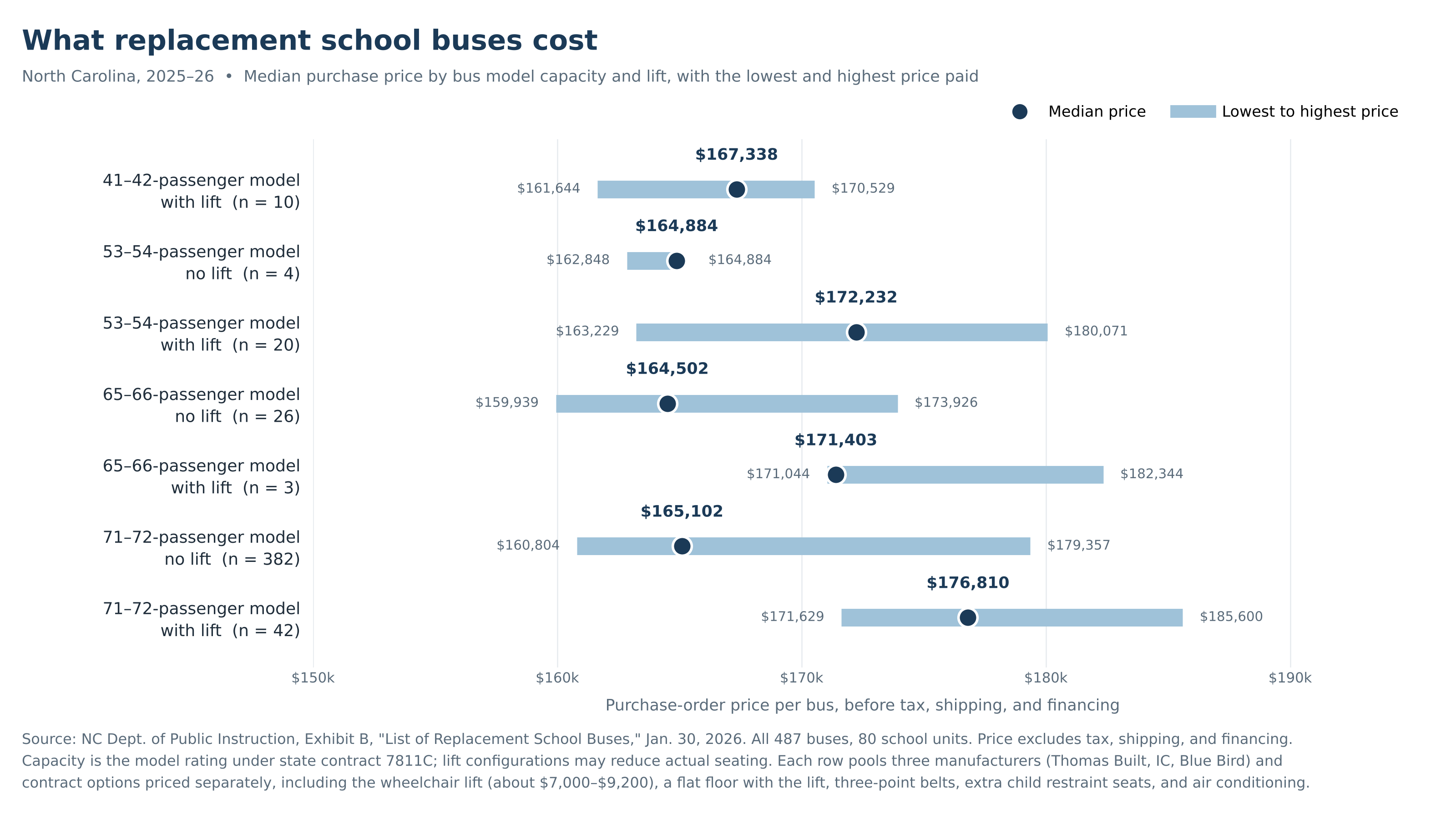
The economics favor the largest bus model at $2,456 per seat, versus $3,053 per seat for a 54-rider bus.
Purchase price is the smaller part of the bill. A 42-seat bus with no lift costs about $154,000 and serves for something like 15 years, while its driver earns roughly $26,000 a year for a 32-hour week across a school year. That means that, over the bus’s life, the driver costs about 2.5 times the vehicle. How do AVs compare? America’s driverless car companies don’t sell their vehicles, but outside estimates put Waymo’s new Ojai van at $75,000 to $125,000, which seats only four. Over 15 years, though, two Ojai-class vans, having no driver to pay, cost well under one bus and its driver; and if Waymo attached the Waymo Driver to vehicles with more capacity, the unit economics get even better.
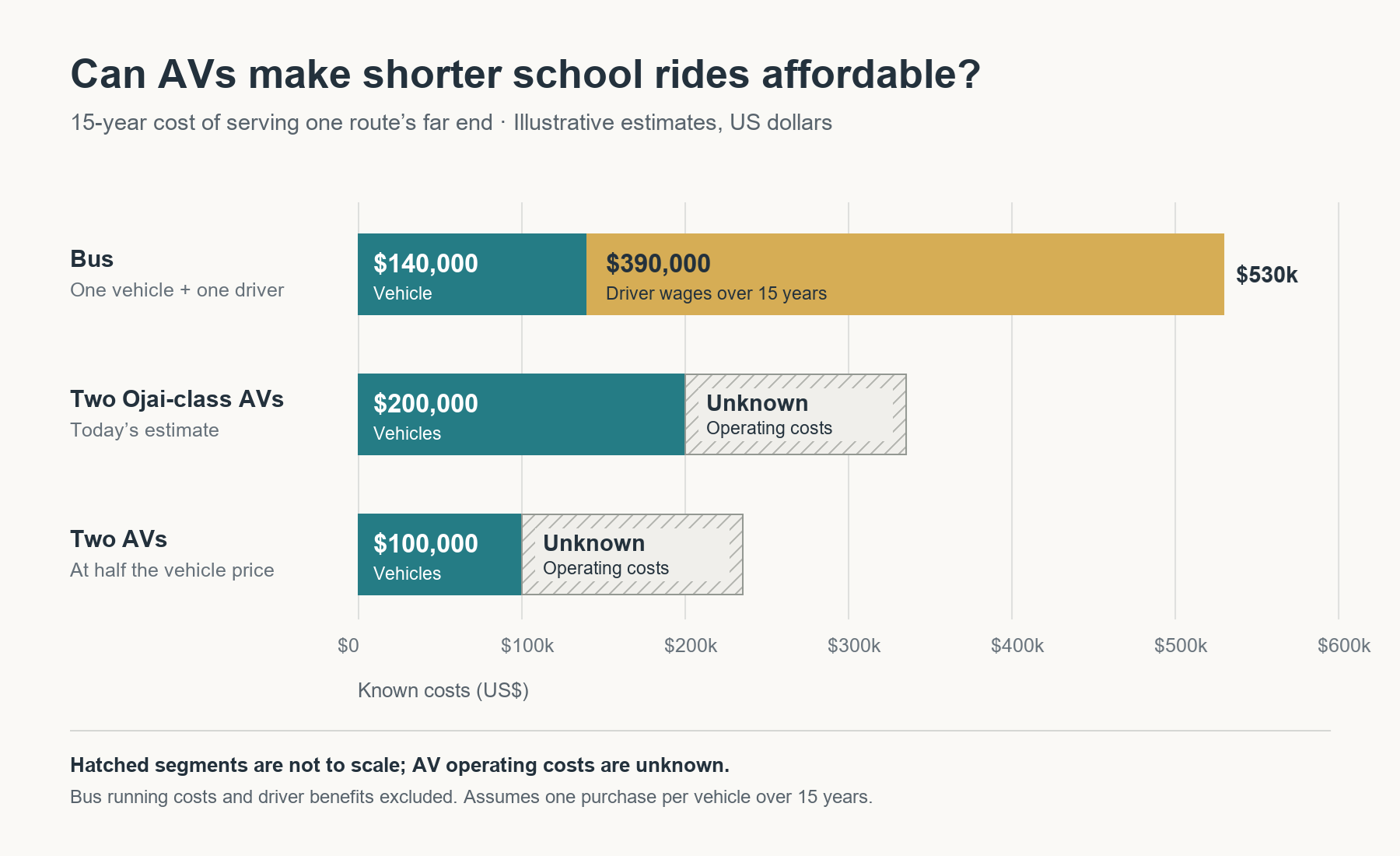
As this chart shows, though, the catch is the operating costs. Remote supervision, insurance, and maintenance; only Waymo knows the price of these. But each time Waymo cuts its vehicle cost, as it has done so far in each generation of vehicle, these other costs bite less.
Someone should do a pilot
Many questions remain. How would liability work? Do rural areas have enough cellular coverage to permit AVs to operate safely and consistently? During a medical emergency, would the AV pull over or take the student to a hospital? How old do students need to be to ride in the AV? Would they travel a set route every day, or could riders on an AV route cancel their pickups, making the route shorter at the expense of consistency? What about parents who hate this idea and refuse to participate?
These are all good questions, and the way to answer them is by doing a pilot project. What we need to know is if AVs can help cut the longest rides on a few routes by half an hour or more, at a cost per student below a second bus (with no more discipline incidents than comparable bus routes). If it can’t do that with a few dozen volunteer families, it won’t work at scale… but if it can, the potential benefits are obvious.
The first step would be to find parents supportive of the idea, since absent that endorsement the experiment is bound to fail. We already know what they think about existing school transportation options, thanks to the 2025 AP-NORC/HopSkipDrive School Transportation Parent Survey. They rate buses as the safest option, with 78 percent of parents saying they are very or somewhat safe. The next most trusted option is “carpool with another parent or family” at 76 percent very/somewhat safe, followed by “School-arranged supplemental transportation services in cars or vans” at 63 percent. What do they think of AVs in general? What do they think of another parent or family carpooling in a car without a driver? What kind of trade-offs speak to them? Has anyone surveyed the families whose kids practically live on the school bus, about anything?
We have talked for years about the shortcomings of the packed school bus. Local news coverage has featured long rides in the rural South, the rural North, the Mountain West, and the Desert Southwest. Until now, there’s been no way to get around the labor bottleneck. In this sector, like in others, that is going to change, and we should think hard about how we can change with it.
AV school transport may be a nonstarter for most parents today, but we don’t need ‘most parents’ for a pilot program, just a few dozen. And, of course, an AV or two. Waymo has been offering some riders free trips in the Ojai (one of your authors rode in one earlier this month and wasn’t among the lucky ones). Would the company extend that offer to a select group of kids who have to get up with the bakers and the trash collectors to get to school on time?
If so, Waymo would find that at least some long-suffering schoolchildren, and their parents, are willing to take them up on the offer.
Mike thanks Kevin Hart, the TIMS Project Leader at the NC State University Institute for Transportation Research and Education, for explaining how buses are routed.
2023–24 is the most recent year for which North Carolina’s Transportation Information Management System has released data.
North Carolina Department of Public Instruction, Transportation Information Management System, 2023–2024 Pupil Transportation Service Indicators Report, PSU pages for Edenton-Chowan Schools (210) and Madison County Schools (570).
Consolidating schools also increases riding time. The very first city ordinance providing government-funded transport to and from school, in Quincy, Massachusetts in 1869, was in response to a local school closure. Closures remain a major factor today, due to an aging population and increasing conflict over property taxes.
One routing expert consulted for this essay recalled a meeting with a state actuary who said if they could only remove the reverse gear from school buses, they’d reduce claims against their insurance policies by 95 percent.
Two of my kids ride a short special ed bus - it has capacity for like 30 students but only 3 ride in the morning, but it requires 2 workers (driver plus an aide). I imagine that AVs would be more economical for this purpose too, rather than using a full special ed bus for every load of special needs kids you could have a regular vehicle servicing these small routes (when no one needed wheelchair lift) and just the aide working.
Here in Los Angeles, lots of kids were showing up at the fancy Westside private schools each morning in Waymos until the California Gig Workers Union filed a complaint with the CPUC to get Waymo to enforce rules blocking minors.