

Have we reached peak book?
We’ve reached lots of peaks before. Take home video:
Production of VHS cassettes peaked in 2001, as DVDs displaced them1
DVDs in turn peaked in 2007, having been displaced by streaming video
Music followed a similar trajectory:
Vinyl records peaked in 1978, having been displaced by audiocassettes2
Audiocassettes peaked in 1989, having been displaced by compact discs (CDs)
CDs peaked in 2000, having been displaced by digital downloads (which were then displaced by streaming)
Books are harder to assess. Unlike films or music, there is no single, continuous, globally-accepted series tracking how many books are produced each year. So the question “when did book production peak?” turns out to be surprisingly difficult to answer.
So let’s instead answer a different question, and look for the closest defensible proxy. For books as physical objects, that proxy is copies printed; these track print-unit sales over time relatively closely, since publishers print roughly and only what they expect to sell. In the best-documented large market, the United States, sales of print books peaked in 2021, when roughly 840 million print copies were sold.3 Every year since has been lower.
That fact alone doesn’t mean much. We hit peak DVD, but watch more video than ever before; same with CDs and music. The format may have changed, but the activity remains, and in fact is doing better than ever. So perhaps the real question is not whether books as objects have peaked, but whether books as a medium have.
Have they? To answer that, we need to be precise about what “peak book” could mean.
Production Up, Attention Down
If ‘peak book’ includes e-books, then we are nowhere near it.
In the United States (again, the market where publishing statistics are particularly detailed), we can see that e-book sales rose rapidly from the mid-2000s through the early 2010s, as dedicated e-readers and smartphones made long-form digital reading convenient.
We had no idea what was coming. Back then, when e-books were introduced, the annual number of new titles was in the low hundreds of thousands; in 2005, for instance, roughly 280,000 new titles were released. By the early 2020s, once self-published books are included, the figure was closer to three million.
That’s right: production of books, whether physical or electronic, has increased by more than an order of magnitude in less than two decades.
That may seem impressive, but hold on: industry revenue has barely moved. Both unit sales and revenues from e-books peaked around 2013 and since then have declined modestly. In nominal terms, it is roughly where it was twenty-five years ago; in real terms, it has fallen sharply.
Why are e-books exploding despite not finding any readers? It’s because electronic publishing removes the key bottleneck, which is production. Once, getting a book into the world required a publisher with access to a press and to distribution networks. The limits on access to those meant one also needed to gain institutional approval. Those constraints limited supply. But they also meant that works that did make it into the world had been professionally edited—an important contribution to quality—as well as at least some chance of being encountered.
None of this is true any longer: today the bottleneck is discovery. When millions of books, most poorly written and unedited, compete for a fixed pool of reader attention, most are never found.4 The result is a statistic that any would-be author should sit down and reflect upon: the average book now sells only a few hundred copies.
What this means is that, on one side, physical books are in decline… but on the other, despite their vast numbers, e-books aren’t taking their place in the culture. So, yes, if ‘peak book’ means production of e-books, it hasn’t happened… but if it means production of physical books, it was 2021.
Rome Didn’t Fall in a Day
Leaving physical objects aside, “when was peak book” can be answered in at least three ways, each harder to pin down than the last, but all arguably more consequential.
The first is the most straightforward: when did sales of books, physical and electronic, peak relative to population?5 There are several ways to approach this, none fully satisfactory, since national publishing statistics vary, international comparisons are messy, and population growth complicates aggregation, etc. Still, plausible reconstructions across different countries find a cluster around the early 2000s, roughly 2000 to 2005. If that estimate is wrong by a few years in either direction, it would not change much.
So peak book-sales was roughly twenty to twenty-five years ago.
The second way in is this: when did books cease to be a widespread form of popular entertainment? This is harder to measure, but it matters far more. In my lifetime, reading was close to universal, not just among the educated but across the middle of society. Cheap paperbacks were everywhere, from Penguin Classics to the ones Gordon Lightfoot described in 1970 as “the kind that drugstores sell”. These were mass-market products because reading was a default way to spend idle time.
If you’ll permit me the indulgence, I’ll say that my own lived experience suggests that this world was already fading by the late twentieth century. Growing up in the 1980s, to me the world felt saturated with books: I still have vivid memories of visiting the small bookshops of Canada—Coles, W.H. Smith—as well as of buying cheap books at newsstands and pharmacies. But by the mid-1990s, that saturation was thinning. By the 2000s, reading—especially long-form reading—was no longer a universal habit. That shift has since accelerated; long-term surveys now show that teenagers who read daily for pleasure have become a minority.
Here, the answer seems to be the same as for the last question, around the end of the 1990s and beginning of the 2000s. In this case, the Harry Potter books, so celebrated at the time as a gateway for young people to the joys of reading for pleasure, turn out to have been the end of the old world, the last time the bell rang so loudly.
The third way to ask the question, and of particular interest to me as a non-fiction writer, is when did writing a book stop being the default way to change the world? Not the only way, not merely one way among many, but the obvious way, the default strategy: the thing one did if one wanted to intervene seriously in public life.
For much of the twentieth century, it was a strong strategy indeed.6 Just off the top of my head: Ken Kesey changed the way his and subsequent generations thought about mental-health provision in One Flew Over the Cuckoo’s Nest (in retrospect, not obviously for the better). Betty Friedan’s The Feminine Mystique catalyzed second-wave feminism. Ralph Nader’s Unsafe at Any Speed and Rachel Carson’s Silent Spring created constituencies who argued successfully for regulation of business and the environment.
Books could, sometimes, be engines of cultural change, and people who had arguments that mattered wrote books to get them across. But that strategy, on the whole, no longer works.
It’s hard to say when that happened, because people are still writing non-fiction books about public policy that have strong impact on the world: just last year, for instance, we had Klein and Thompson’s Abundance, and Yudkowsky and Soares’ If Anyone Builds It, Everyone Dies. Other notable candidates from this century might be Piketty’s Capital in the Twenty-First Century or Kendi’s How to Be an Anti-Racist. These examples are striking precisely because they are rare; non-fiction public policy books that have a big impact seem limited to one, or perhaps two, a year. If I told you the name of the fifth-best-selling book of public policy of last year, would you recognize it? Suave and intelligent readers of Changing Lanes probably would, but I bet most people have never heard of it.7
Al Gore, c’est moi
Everything Ends
So, if we look at all our answers, when was peak book?
The data points cluster. In absolute terms, print sales peaked in 2021, but that was a pandemic-driven anomaly in a longer decline. E-book revenue peaked in 2013. Books sold as a percentage of the population peaked back in the first decade of this century. Reading rates have been falling for decades, with the sharpest drops among the young. It’s still the case that books can shape elite discourse, but fewer and fewer have an opportunity: perhaps one or two a year.
By any of these measures, peak book is behind us, falling somewhere in the early twenty-first century, with the exact year depending on which metric you privilege.
And what that means is this:
Books are a dying art form.
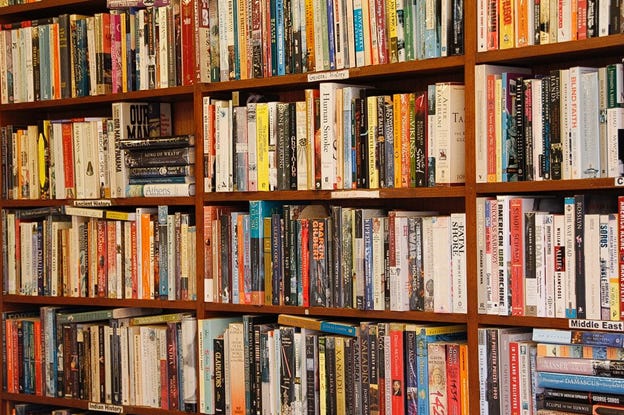
“Books bookshelf read” from Pixabay (2016), public domain under CC0 1.0 Universal
That’s a pungent statement, so let me hasten to explain what it means, and the best way to do that is to think about a different dead art form: opera.
Opera is still performed. The Metropolitan Opera still stages productions; regional companies still exist; new operas are still commissioned, with roughly thirty premieres per year in North America alone. OPERA America counts more than 200 professional companies in the United States and Canada.
But none of that means opera is alive. Attendance has collapsed: in 2017, only 2.2 percent of American adults had attended, even once, a live opera performance. And of those who do consume opera, they aren’t interested in new works. As per Sam Hughes at Works in Progress:
This interesting website has a database of all operas performed globally today. Of the top fifty operas by number of performances, only one was written after 1914 (Turandot, 1924)… The vast number of modernist operas written over the last century have virtually no place in the performance canon.
So some few people still enjoy opera, and those few people are, I imagine, much wealthier and more educated than the median person. But that doesn’t matter to our evaluation of whether opera is dead. Opera is certainly dead… because opera no longer participates meaningfully in the broader cultural conversation. No one expects a new opera to define a generation’s concerns, or to be the place where important cultural work happens. In fact new opera, though it exists, is barely attended to, even by the art form’s few fans.
Books are not there yet, but they are closer than many readers of books would like to admit.
To be clear, in the intervening years people have never stopped encountering text: articles, newsletters, social-media posts, and on and on. But the book is a particular kind of text: a long-form collection of words, typically no fewer than 80,000 words, expected to be consumed over long, uninterrupted stretches of linear time. And I think uninterrupted is key here. Reading a book requires not only a commitment of time, but of attention as well. Books are cognitively demanding; one cannot read a serious book while doing something else. Conversely, one can, and many routinely do, watch television, listen to podcasts, or scroll video feeds while cooking, commuting, exercising, or half-working. These other kinds of media tolerate distraction but books don’t.
That makes them unsuited to our time, and even less so for the world that is coming.
The death of the book has been a long, uneven process, still going on. Books lost cultural power first, then leisure dominance, and only later did this show up clearly in sales figures. Books were outcompeted, slowly and unevenly, by media better suited to the modern attention economy, which no longer rewards sustained, exclusive focus. They will continue to exist, and to matter to some. But the era in which they served as the central organizing unit of intellectual and cultural life is firmly behind us.
Which is a roundabout way of saying that while I’m proud of what my co-authors and I accomplished with our book, The End of Driving (buy it here!), I think writing a second book would be a bad use of my time.
The book is dead; long live the Substack.
Surprisingly, of all the format discussed here, VHS is the hardest case to establish cleanly, because VHS includes both blank tapes and prerecorded cassettes, with reporting split among studios, rental chains, and trade groups that no longer exist. As a result, 1998 is a plausible candidate, but so too are 1999 or 2000.
The ‘killer app’ for audiocassette dominance was Sony’s introduction of a portable cassette player, the Walkman.
Presumably a downstream effect of the Covid-19 pandemic.
This pattern is not unique to books. Film production has surged even as theatrical releases have declined. Music production has exploded even as listening concentrates around a small fraction of artists. Across creative industries, the same structure appears: the cost of making things collapsed, while the cost of getting noticed did not, meaning most entertainment sectors now have a winner-take-most structure.
I’m using English-language sources here. If anyone wants to look into how it shook out in other countries, I’d be interested, but surprised if the result was much different.
Harriet Beecher Stowe’s Uncle Tom’s Cabin showed it was a decent strategy in the preceding century too.
Answering this question is quite difficult because data is jealously guarded, but a defensible guess would be Jill Lepore’s We the People: A History of the U.S. Constitution, which sold perhaps 40,000 copies nationwide. Full confession: I had never heard of it… and Lepore is a former colleague of mine from graduate school.
I agree with you about books here (and opera) I remember David Weinberger who wrote Too Big to Know:
“Books do not express the nature of knowledge. They express the nature of knowledge committed to paper cut into pages without regard for the edges of ideas, bound together, printed in mass quantities, and distributed, all within boundaries set by an economic system.
To think that knowledge itself is shaped like books is to marvel that a rock fits so well in its hole in the ground.”
I wrote about the end of books recently https://lloydalter.substack.com/p/i-will-miss-the-cheap-paperback-book?utm_source=publication-search