


Before we begin, let me note that it’s been a busy week for me, with several pieces of my writing and commentary being newly published elsewhere:
In Vital City, I argue that New York’s openness to sensors collecting public data allow it to take the next step, namely to use AI to measure how people actually behave on the street, and that this is the path the City can take to achieve Vision Zero (i.e., zero fatalities or injuries from road traffic)
On the CBC, I discussed California’s decision to pull Waymo’s driverless vehicles off its freeways, and the firm’s subsequent suspension of freeway operation anywhere in the USA, after repeated instances of robotaxis behaving badly around emergency operations
But most relevant to today’s issue is my essay for the Foundation for American Innovation’s Futurecraft volume.
The thesis of Futurecraft is to imagine the ‘day after AGI’ and answer the question ‘What might non-physical AGI do for us in the physical world?’ My answer is, it could help us move goods more efficiently. Today, goods move quickly on ships, trains and trucks, but move very slowly at the handovers between them; containers routinely sit at ports and railheads for days. The hold-up that AGI can solve is what I call “the exception”: the moment an automated crane or cart stops working because it has detected something anomalous, and waits for an accountable human to say it’s safe to proceed.
AGI can fix that problem, I hope. But we don’t need to wait for it to fix today’s problems, which are the subject of today’s piece. Let’s follow a container out of the port storage facility to its next handover, the short haul from port to warehouse, and see what happens when we take the driver out of that trip.
With the recent passing of Patrick Stewart, Star Trek: The Next Generation has been on my mind lately. The show had plenty of classic routines it went back to a lot; my favourite of these belonged to the ship’s engineer, Geordi LaForge. Given a puzzling engineering problem, he would report to the holodeck and, with the help of the ship’s computer or a holographic simulacrum, have a back-and-forth conversation where he sketched out the problem, explored the possibility space, and found a solution. (Amazingly, as Lars Doucet has pointed out, this bit anticipated by three decades how people work today with AI assistants like Claude.)
In that spirit, let’s work through our own design problem. Imagine a shipping container sitting at the Port of Long Beach. It must travel to a warehouse that happens to be three kilometres away by road. We have to build a machine to get it there.
What is the cheapest thing we could make?
Let’s begin (as Geordi often did) by considering the received wisdom. The standard answer would be a tractor trailer; this is how most containers today make that trip. So what we would build would have many parts. It would need the tractor, a diesel-powered engine inside a vehicle structure. And it would need a chassis, a wheeled steel frame pulled by the tractor, onto which the container would sit.
Of course it also needs a driver; it can’t run without one. And that driver needs to be paid; over the life of the vehicle, the driver’s wages would be one of the largest single operating costs. So Geordi starts here. Do we need the driver? No, we don’t; driving automation has advanced to the point where vehicles can drive themselves. So let’s add self-driving sensors and computing equipment, and now we can subtract the driver.
But wait… if we don’t have a driver, then we don’t need a cab, which only exists to hold the driver. Let’s subtract it too. So now we have a tractor but without a cab. Can we subtract anything else?
Yes, we can subtract the tractor itself. Remember that we don’t need to take this container more than a few kilometres. The tractor engine and its diesel fuel tank are both there to accommodate long hauls, but that’s out of scope for this assignment. So let’s replace the engine and fuel tank with a motor and battery: much cheaper. We can put those in the chassis itself to save space.
So when Geordi has done his work, the computer and the holodeck have created his prototype: a flat platform, with wheels, motor, and batteries.
That intellectual process, more or less, is what Humble Robotics has done. Just replace Geordi LaForge with Eyal Cohen.

Humble founder Eyal Cohen. Photo courtesy of Humble Robotics.
Cohen’s question is “How do we move freight at the lowest possible cost, and what would that vehicle look like?” His company, Humble Robotics, has built its candidate for the answer. I visited Cohen at Humble’s test track at Richmond Field Station, across the bay from San Francisco, on 7 October 2026. I came away impressed with Humble’s vision, and hope the firm succeeds. So, evidently, do its investors: earlier this month Humble announced a $51 million USD Series A, bringing its total raised to $75 million less than a year after its founding.
Whether Humble succeeds has interesting implications for all of us, not just the firm’s investors. That’s because the most automatable leg of freight is also the one that determines not only how fast ports clear, but also where warehouses sit.
The Skateboard for Freight
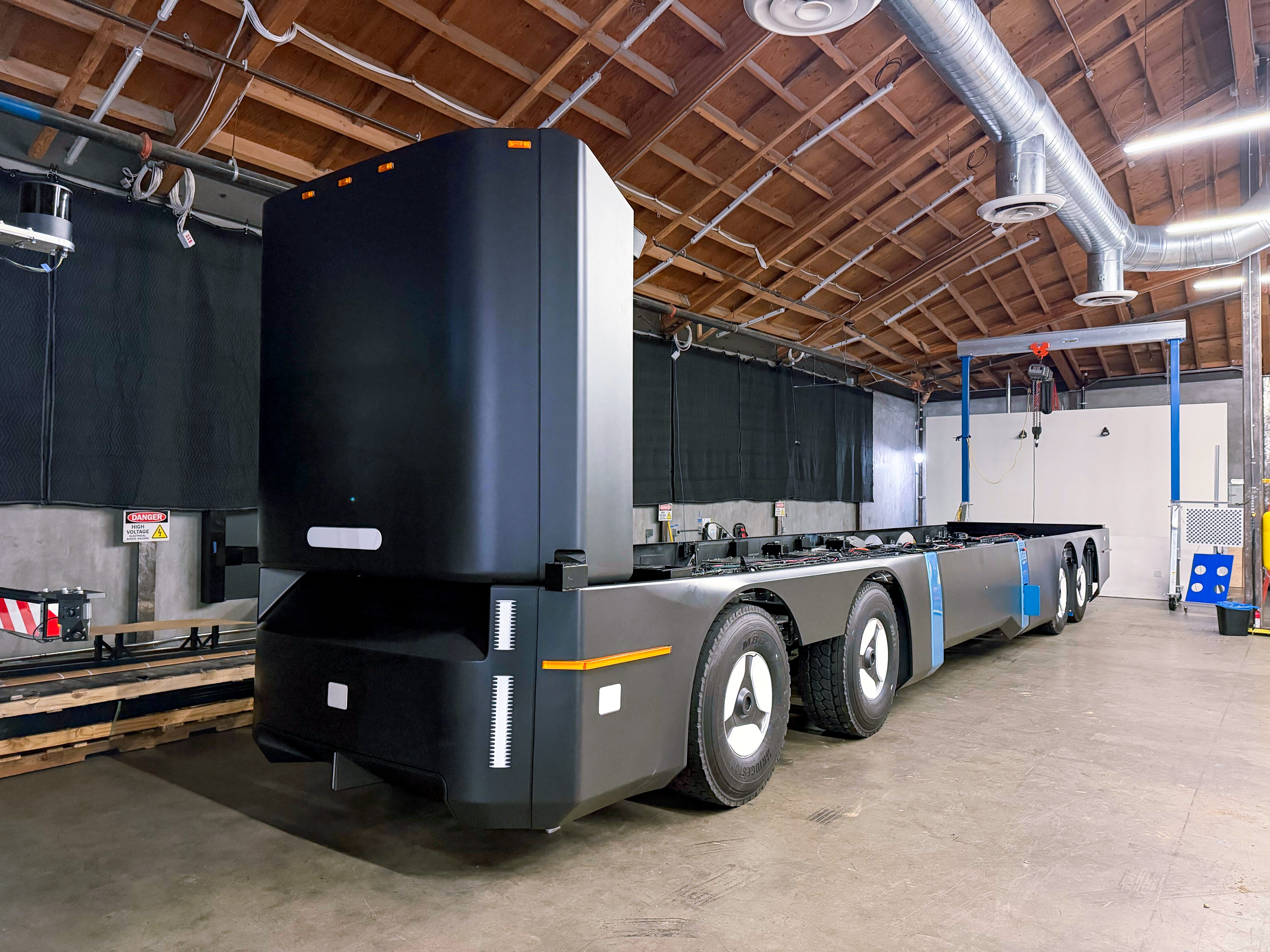
Humble’s solution to Geordi’s problem is the Humble Hauler.
The Humble Hauler. Photo courtesy of Humble Robotics.
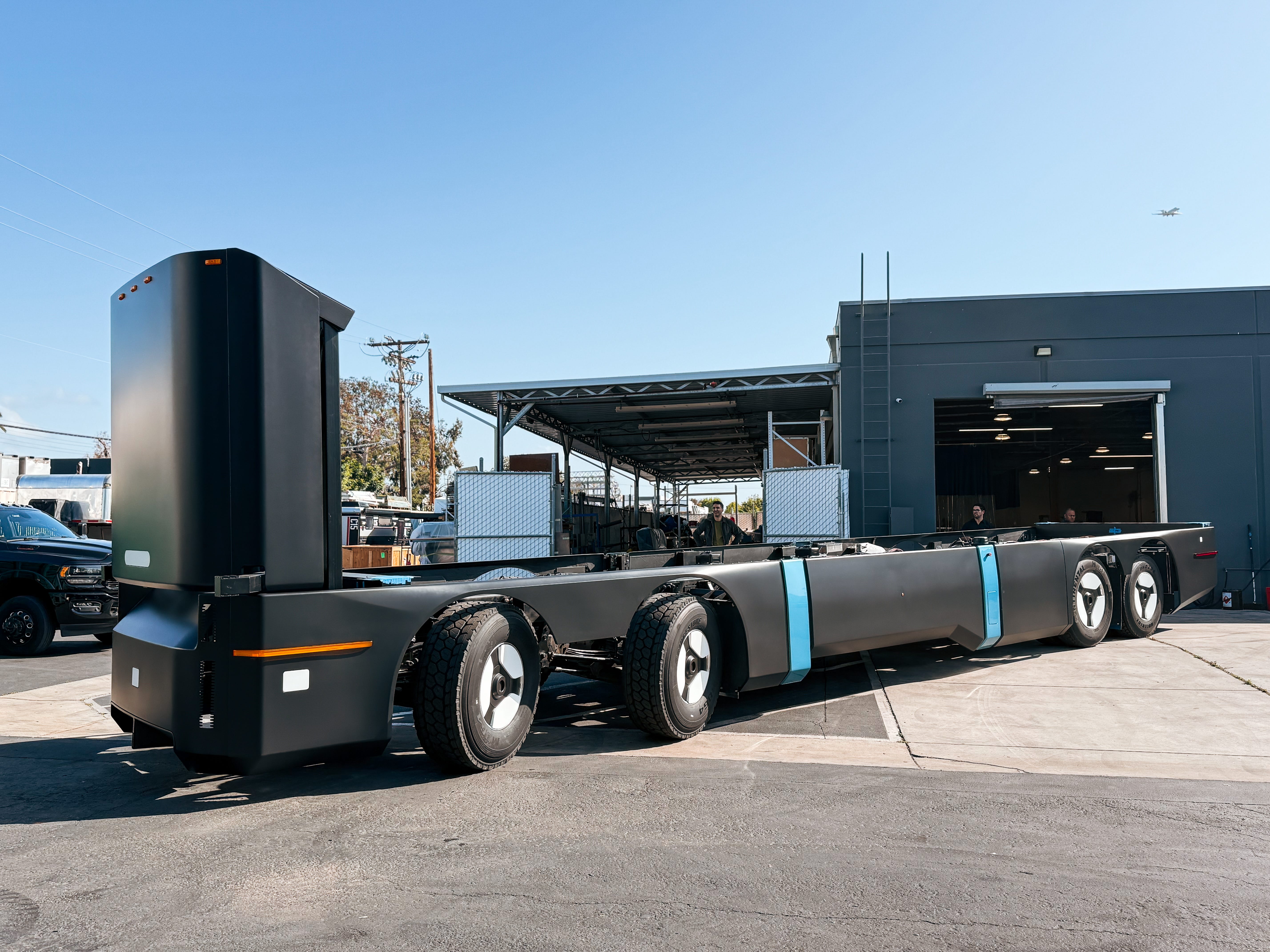
It is a flat, battery-electric, self-propelled container chassis with no cab. A container is lowered onto it, the container is locked into place, and the Hauler drives it from loading point to its destination, at a range of up to 320 km (200 miles) and a top speed of 105 km/h (about 65 mph).
That range may seem extraordinarily limited. After all, Aurora, the leader in automated trucking, has validated driverless operation on a 1,600 km (about 1,000 miles) route from Fort Worth to Phoenix. But Humble is solving a different problem from Aurora and its rival Kodiak, which are attempting to automate long-haul trucking, whereas Humble is trying to automate short-haul trips between ports and warehouses, what industry folks call drayage.
Short hauls are most of what American trucks carry. The US DOE Freight Analysis Framework shows that in 2021, 44% of American truck tonnage moved less than 160 km (i.e., 100 miles), making up part of the 87% of American truck tonnage that moved less than 400 km (250 miles).
Drayage is notoriously among the worst jobs in trucking. That may seem strange: surely doing short runs is preferable to days-long treks across the country, eating bad food and sleeping in the cab? By no means. Short runs are endlessly repeated, which is its own kind of tedium, but the principal difficulty is that drayage drivers are typically paid by their load, not the hour. And paperwork and bottlenecks mean that, to get a container out of a port, drivers must spend hours and hours waiting, none of which they get paid for. Few stay. “Some of the carriers I’ve met have over 100% turnover per year”, Cohen told me. “When you go down to Long Beach, the volume of trucks just sitting there waiting is enormous… So many trucks just hanging out, waiting for their load”. All that waiting is an immense waste of time, and of physical capital… not to mention human capital, as I wrote about recently in the Washington Post.
Inside the terminals, automation is already old hat. At Long Beach Container Terminal, battery-electric automated guided vehicles shuttle boxes between the quay cranes and the stacks. These are less ‘automated vehicles’ than they are ‘industrial robots’; like all such robots, they excel, but only in controlled spaces where the only humans who interact with them are trained to do so. The Hauler has taken the terminals’ insight—that moving containers by robot is the most efficient approach—and scaled it up by making a vehicle that can operate on public roads.
To do so, it needs excellent AI. As with Waymo or Tesla, Humble can acquire the sensors the Hauler needs without much difficulty; teaching the vehicle how to use that data is the hard part. Cohen describes Humble as “very big on end-to-end models”: one large model trained on as much video as possible, in the hope that general understanding emerges from scale. (As I have written in Asterisk, end-to-end systems like these are bottlenecked by their training data, and specifically the rare cases in them; I hope Humble’s dataset is broad and rich.) In any case, the Hauler’s AI is supplemented by a human in the loop; like Waymo, that human does not remotely drive the vehicle, but drops breadcrumbs such that when the Hauler is confused, it takes single steps until it reaches a state where it understands how to proceed. “If you’re one-to-one”, Cohen told me, meaning the ratio of human assistants to vehicles, “you haven’t really solved much of a problem; you’ve just moved it in a very strange way.” In the fullness of time, “we can imagine ten to one”, and perhaps even better.
Excellent AI is necessary but not sufficient; there are also regulatory problems to solve. California’s new rules for heavy driverless trucks require testing to begin with a safety driver aboard, and the Hauler has no place to put one. Faced with a similar problem, Tesla’s solution was essentially to shrug and say YOLO; Humble is being more cautious, and making the Hauler’s cab modular. “Just as you drop a container onto our skateboard and it locks in, you can [also] drop a cab”, Cohen explained. “I always tell people that the way you do AVs is crawl, walk, run.” To satisfy the state’s well-founded requirements for proof of safety, Humble is still crawling, on its closed track. Even that path depends on politics: Governor Newsom twice vetoed bills that would have required a human operator aboard every heavy driverless truck… and he leaves office in January.
The Hauler’s natural first market sits just outside the Port of Long Beach, at the transload yards. These yards are a testament to the power of standards to shape commerce: they exist mostly to unpack international 40-foot containers and repack the goods into 53-foot domestic ones. “Forty-foot is the international standard, and 53-foot, much like imperial versus metric, is something you find almost entirely in North America”, he said. The result is a constant shuttle of boxes between terminal and transload yard, often only a few kilometres. “You can really automate these repetitive back-and-forths to the transloading facility. It’s a great use case.”
The other market Humble is eyeing for early entry is night operations. “Nobody really wants to do the 2-to-8 a.m. shift”, Cohen said. “That’s a perfect place to drop a container on a skateboard and move things back and forth.” That gives him a pitch to carriers that carry on the human-operated drayage business and want to keep it: “think of this [the Hauler] as a piece of equipment that augments your fleet”, by adding a night shift.
The Humble Hauler. Photo courtesy of Humble Robotics.
That extension of the working day is the most obvious route Humble has to making money. The advantage of an electric vehicle over an internal-combustion-engine one is not its upfront cost—batteries are expensive—but its operating cost, which is cheap; electricity is cheap per kilometre and diesel is not (plus electric drivetrains have fewer moving parts, so there is less to break and less to maintain). That means that an electric vehicle wins to the extent that it runs many hours. By foregoing the need for scarce human drivers, the Hauler makes the night shift feasible, giving it the edge it needs… provided it uses those extra hours moving freight, not waiting to move it.
To my mind, this is the sting in the tail. One reason the contemporary drayage business looks as it does is that the expensive part of the operation is the tractor; the chassis is not. So a driver that has delivered a load unhooks the chassis and departs quickly to their next job. But since the Hauler is the chassis, it must wait at both ends of its journey for its load to be attached or removed, keeping it off the road. When I put this to Cohen, he was sanguine about it: “If you make the equipment inexpensive enough, it’s okay to leave it idle.” He added that even as Humble works to automate drayage, ports and warehouses are automating loading and unloading, cutting dwell times from hours to as little as 20 minutes. I wished I shared his optimism about the enthusiasm of ports and warehouses for automating their operations.
Automating Drayage Could Clear the Ports and Move the Warehouses
The most interesting thing about the Hauler, to my mind, is the set of consequences it may pose to the urban geography of our ports and railheads.
North America’s ports are, by definition, waterfront property, which means that, in our modern age, they sit on valuable land. Many of them sit in dense cities where there are many competing land uses: certainly the ports of Los Angeles, New York and New Jersey, Vancouver, and Montreal do. This means that land around a port is expensive and comes in small parcels, which means in turn that port operators hate containers sitting idle, taking up the port’s very limited space. “They don’t want to warehouse at all”, Cohen said. “Ideally it comes right off the ship, never dwells, and is immediately out.” Today it dwells: at Los Angeles and Long Beach this July, truck-bound imports sat at the port just over three days, and rail-bound ones more than six. (For more on this, see my piece “The Exception” in FAI’s Futurecraft.)
So the containers must go to a distribution centre, which also is ill-suited for an urban waterfront: such places want large parcels of flat, cheap land next to a freeway… but they also want to be close to the port so they can transship quickly.
Hence the trade-off. Warehouses may rest on land near the port, which means a shorter haul but costs much more to buy; or land far out, which is cheap but adds a permanent surcharge for transport on every box it hosts. Finding a solution to that trade-off produced the endless warehouses of the Inland Empire, roughly 80 to 100 km east of southern California’s docks; or the similar logistics zones of Delta and Surrey around Vancouver (hemmed in by British Columbia’s Agricultural Land Reserve, which protects much of the flat land a warehouse would want).
Cheaper drayage could change that geography. It has happened before; as per Marc Levinson in The Box, the advent of the container emptied the piers of Manhattan and Brooklyn and moved the port of New York, and its warehouses, to the New Jersey marshes. Once the trip needs no driver, distance factors less and land price factors more in deciding where a warehouse goes. The shift in emphasis makes it more feasible to put some distribution centres further away from the port, specifically the import distribution centres whose outbound freight is leaving the region by truck or train, deeper into the continent.
Cheaper drayage could also help to improve the ports themselves. Back in 2021, during the Covid-inspired backlog at Los Angeles and Long Beach, three constraints bit hard. Firstly, a yard that should have had about 1,000 chassis on hand had about 35 because they were tied up holding stranded containers. Secondly, speaking of those stranded containers, the yard was full of them, running at 120% of capacity. Finally, though the port opened a third shift, and opened the gates 24/7, but with warehouses outside the port closed, the overnight hours went largely unused for lack of any place to send the freight.
The Hauler bears on two of those constraints directly. It brings its own chassis (or rather it is its own chassis), so a box lifted onto it never waits for one; and it can work the night shifts that people won’t. It may even help with the third: a Hauler cheap enough to sit idle can carry a box out at 3 a.m. and wait, loaded, in the warehouse yard until the dock opens, so the port can release a box without waiting for the morning for someone to receive it. To the extent that our ports and railheads are the bottleneck on goods movement, the Hauler could open the neck of the bottle, letting more boxes through the same terminals.
There is another way to empty a port, which is to put the boxes on trains rather than trucks. BNSF’s Barstow International Gateway, approved in June 2026, will send containers from the San Pedro Bay ports straight from ship to train and sort them on a 4,500-acre site far out in the desert. Canada’s Port of Prince Rupert, which calls itself “the continent’s first purpose-built ship-to-rail container terminal”, already works this way. Projects like these design away the drayage leg at the port… but that only moves the short haul further inland, since every rail hub needs short hauls of its own, from the ramp to the warehouses around it. To see this in action, look at greater Toronto, which has no container port of any size. Instead, its imports arrive overland from the coastal ports, much of them by train; CN moves containers from the Port of Montreal’s docks to Toronto in a day. So despite its lack of a port, it has ample warehouse belts, all inland around the railways’ terminals: CN’s in Brampton, which it calls Canada’s largest rail intermodal terminal, and CPKC’s in Vaughan. The Hauler’s advantages apply in places like these as well, meaning that driverless drayage is more likely to complement rail than to compete with it.
Boring on Purpose
I asked Cohen about his company’s name. Humble, he said, was a declaration of purpose to an industry that has heard this-time-is-different far too often. “We also have a long history in this industry of, let’s call it, overpromise, underdeliver.” He was at Otto in 2016 when it sent an autonomous truck 190 km (about 120 miles) on Interstate 25 with a load of Budweiser and a driver watching from the sleeper berth. “At the time we thought, ‘It’s 2016; this is two years away’”, he recalled. “Now it’s 2026 and I’m still working on autonomous trucking.”
That decade taught him to aim low and close, at the most tempting target. In his words, Humble’s thesis is to “find the most boring, repetitive route that nobody wants to do, and go do that”. It’s a good approach, namely to solve the most immediate problem in the goods-movement sector that automation can solve. On one side, drayage is short, repetitive, and controlled at both ends, making it perfect for automation; on the other, it is a job no human could enjoy, meaning that automating it will delight employers without threatening workers. If Humble succeeds, the effects could be far-reaching. Automated drayage offers us the opportunity to improve our ports by running robust night shifts, and to build warehouses and distribution centres built further out.
The short haul is the least glamourous part of freight, which is why it may be where driverless trucking changes the sector first. That alone will not build us a utopian future like Geordi would have recognized, but it’s a great step in that direction.