


The story goes like this.
In the early twentieth century, American streets were shared spaces. Pedestrians walked where they wanted, when they wanted to. Vendors plied their wares from the roadbed, next to children playing in the street. Scenes like this, still common in many parts of the world today, were the natural default, extensions of what streets had always been: mixed-use public space.
Then automobiles arrived, and the industry and its allies spent the better part of a decade working to redefine who owned them. At the time, jay was slang for a rube too dim to understand how to behave in a city, so the industry coined the term jaywalker for anyone who walked in the street without benefit of a signal. They went so far as to lobby newspapers to print the word without scare quotes, to show the term’s implicit claims made up the consensus view.
In 1925, responding to this effort, Los Angeles passed an ordinance that declared pedestrians had to cross at intersections, and only at intersections, and only if the light was green. The rapid adoption of similar laws across the country is evidence that the automakers’ campaign had triumphed: whereas only a few years before the question had been whether cars belonged in the streets, it was now whether pedestrians did.
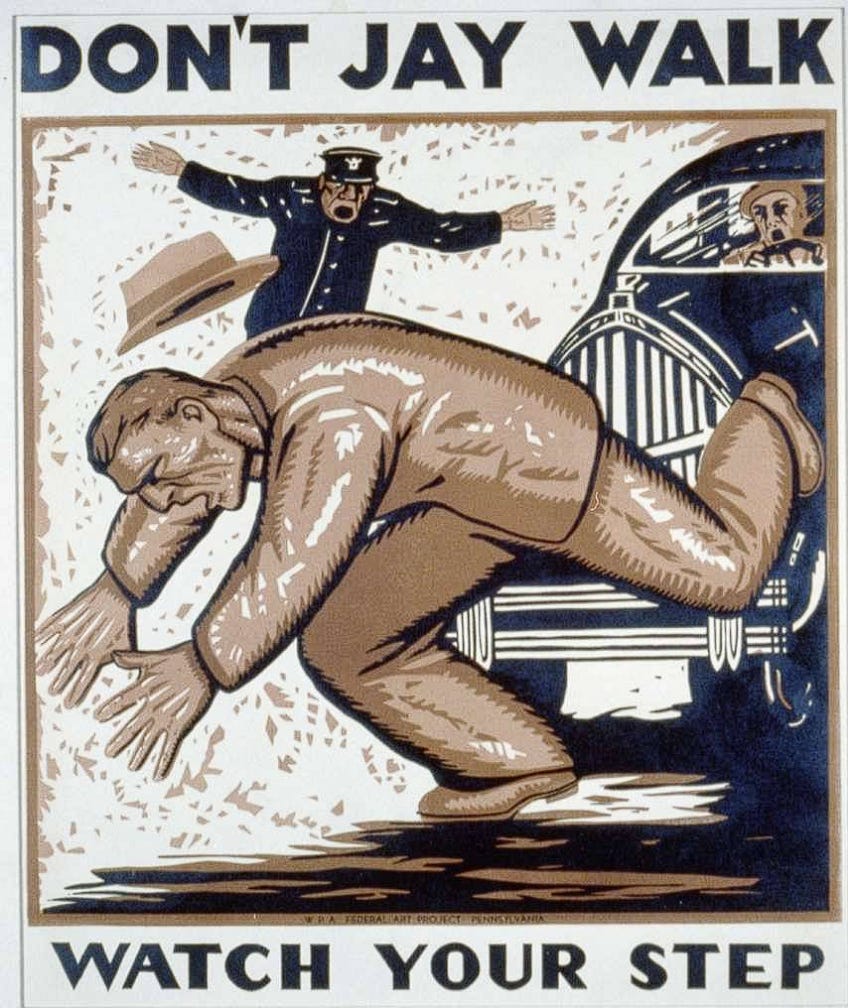
"Don't Jay Walk — Watch Your Step" (1936 or 1937), Isadore Posoff. Library of Congress. Public domain.
This is the story of how ‘motordom’ became dominant in urban transport planning. Among urbanists, it is widely known, thanks to Peter Norton’s documentation of it in Fighting Traffic (2008), where he coined that term. Norton’s work has received wide currency because it fits naturally within what has become the dominant lens in progressive transportation discourse. In this framework, the first question one asks regarding a change is always whom it privileges, and whom it constrains. Who is assumed to own the street? Who must adapt? Who must yield?1
Let me be clear: motordom has done real damage to the city, and the pedestrian-priority framework is right to push back. Car-centric planning has caused genuine, lasting harm, in ways I won’t bother rehearsing here: clearance of urban neighbourhoods for expressways, Robert Moses, oversupply of street parking, subordination of pedestrians and cyclists to vehicle throughput, and so on. Motordom has made our cities uglier, more dangerous, and less equitable, and the people who bear the worst of it are consistently those with the least political power. Every urbanist knows this sorry tale.
But this itself has become a problem: every urbanist knows this sorry tale.
As I will show below, they know it so well that it has calcified from a historical explanation into a reflex. As a result, whenever a new claim about vehicles, about pedestrians, about who is endangering whom appears, it is not examined on its own terms, but is instead pattern-matched to the motordom template. New things are classified as instances of the old Bad Thing and dismissed rather than engaged; the conclusion precedes the analysis.
Call this the Jaywalking Analogy. It is familiar and legible, which makes it persuasive. It assigns good guys and bad guys, which makes it seductive. And it is applied indiscriminately, which makes it an obstacle to thinking clearly about automated vehicles.
Analogies Aren’t Arguments
In August 2025, here in Changing Lanes, I argued that Robotaxis Have a Bullying Problem. The problem in question was that pedestrians in San Francisco had discovered that Waymo robotaxis would reliably stop if a person stepped in front of them, and were exploiting this behaviour by crossing in front of them when they had the right-of-way, knowing the Waymo would stop. I argued this was a genuine problem: that the behaviour would spread as it became known, that it created real inefficiencies in urban transport networks as a whole, and that, left unaddressed, it would make city-dwellers as a whole worse off, especially the most vulnerable.
Lots of people liked the piece. Lots of others didn’t.
Pushback came from many directions, mostly on social media and mostly in the form of short, dismissive, even abusive remarks. I won’t reward that sort of behaviour with attention, so I will focus here on Lloyd Alter’s response at Carbon Upfront! It pains me to do so, because Alter, a sharp thinker and writer, actually put in the work by writing a full essay in response rather than merely making a snarky comment. I regret singling him out, since he took the highest and best approach toward writers with whom we disagree: not performative dunking for the crowds, but fully written-out rejoinders. But since he did the work, I want to highlight it here, because his response demonstrates the mechanism I’m describing clearly.
Alter’s essay is titled “Will self-driving cars and robotaxis bring us Jaywalking 2.0?” Why did he call it that? Because in his view, I was merely running the jaywalking playbook of a century ago, this time on behalf of automated vehicles. And in my view, he reached this conclusion not by examining the argument’s evidence, but by pattern-matching, as follows:
Here is a piece raising concerns about pedestrian behaviour near vehicles, and
It maps onto the motordom campaign of the 1920s, which means
It is a version of that campaign.
Alter goes on to predict that any policy response to robotaxi exploitation would inevitably turn authoritarian—pedestrians will be fenced off, criminalized, or surveilled—because “laws everywhere are designed to favour drivers and penalize people who walk or cycle”.2 He quotes Rebecca Solnit approvingly: “We don’t need new ways to use cars; we need new ways not to use them.”
Notice what the Jaywalking Analogy did here. Confronted with a specific, novel situation, namely pedestrians discovering they can exploit an automated vehicle’s safety programming, the essay classifies it as an instance of a known bad pattern before asking whether it actually fits that pattern. Consequently, none of the evidence in the newsletter needed to be engaged with, because the conclusion had already been reached.
The specific weaknesses in Alter’s analysis are worth pointing out, because they show how much gets skipped when the pattern fires early.
