


As a reminder: Changing Lanes puts aside serious reporting on mobility innovation for the holidays. Today, we offer an alternative: serious film criticism. If that’s not what you’re interested in, I invite you to come back next week, when we’ll be back on our beat. But if is what you’re interested in, please enjoy my Christmas gift to you…
When we think about Christopher Nolan’s Batman films, we think about The Dark Knight.
Batman Begins was a competent genre picture, the work of a skilled and intelligent director of small-scale crime stories graduating into blockbuster genre filmmaking. It’s a pulpy adventure featuring mysterious indeterminately-Asian ninjas and cartoonishly-broad gangsters, while leavening those elements with realism. Some of that realism has to do with plot; we finally learn the answer to the question asked about Batman decades before, namely where he gets those wonderful toys. More importantly, some of the realism has to do with theme. The film asks: should Bruce Wayne become a vigilante? Is it possible to pursue justice outside of the law, and if so, what are the limits of that pursuit?
Batman Begins doesn’t have much to say about these questions, but it has something to say, and certainly more than any filmic treatment of the character before it. I remember watching Batman Begins and enjoying it, and looking forward to what would come next.
I was not prepared for what we would get. The Dark Knight, I would argue, is a masterpiece, not only of superhero filmmaking, but of cinema; the most important and impressive film of its decade. It transcended genre expectations, dramatizing genuine ethical dilemmas—security versus freedom, order versus justice—in ways blockbuster cinema rarely attempts. Almost every single character faces a personal test, and most fail. Few ‘serious’ films have this much to say, on any topic, but The Dark Knight does it all, while also providing stupendous action set-pieces.
Unfortunately, in my view, The Dark Knight Rises failed to reach the heights of its predecessor. And it seems the broader culture agrees with me. Fifteen years on, the cultural consensus is clear: while The Dark Knight endures as touchstone of superhero cinema, The Dark Knight Rises is largely forgotten.
I’ve read lots of critique of The Dark Knight Rises but most of it is at the level of nit-picking. The ‘clean slate’ program that Catwoman is attempting to obtain is a plot device, not anything that could really exist; same with the heist that bankrupts Bruce Wayne, and the details of Bane’s preposterous scheme to turn, and keep, Gotham City into a medieval fiefdom with himself as its warlord. If you don’t know what I’m talking about, never mind, because the details are unimportant. It’s not the pulpiness that makes the film a failure.
What makes the film a failure is that The Dark Knight made concrete promises about what would come next: promises that, because of that film’s greatness, carried unusual weight. And the failure to deliver on them not only means the third film in the trilogy fails to land as it should, but also that it retroactively undermines the greatness of the second.
The Dark Knight incurred debts, and The Dark Knight Rises refused to pay them.
Bruce Wayne Is Bigger Than Batman
In The Dark Knight, the viewers learn that Bruce Wayne sees Batman not merely as a symbol, but also as a means to an end. Wayne is using the symbol to achieve the goal of making Gotham safe from crime. In the first third of the film, we further learn that Wayne thinks that achieving that goal may be in sight: between the efforts of Batman on one side, and Gotham’s institutions— led by the hard-driving district attorney Harvey Dent—on the other, organized crime is on its heels. In the near future, the mob’s hold on Gotham might be broken, and traditional law enforcement would be able to maintain order in the city. And if that happened, Wayne could stop being Batman.
One of the impressive achievements of The Dark Knight is that it shows us something we’ve never seen on film before: a Bruce Wayne who is bigger than Batman, a Bruce Wayne whose fight against crime is not a never-ending battle, not a debt to his parents he can never repay, but a project he can complete and then set aside, secure in the knowledge that he has made a difference. And at the same time, it also shows us a Bruce Wayne who is aware—because his confidant Alfred reminds him—that his health and strength are finite, and that while Batman the symbol may not suffer any weaknesses, Bruce Wayne the man has limits. His body will not sustain an indefinite struggle.
In other words, The Dark Knight is the first film to give us a Bruce Wayne who, despite his larger-than-life adventures and habits and possessions, feels like a real person.
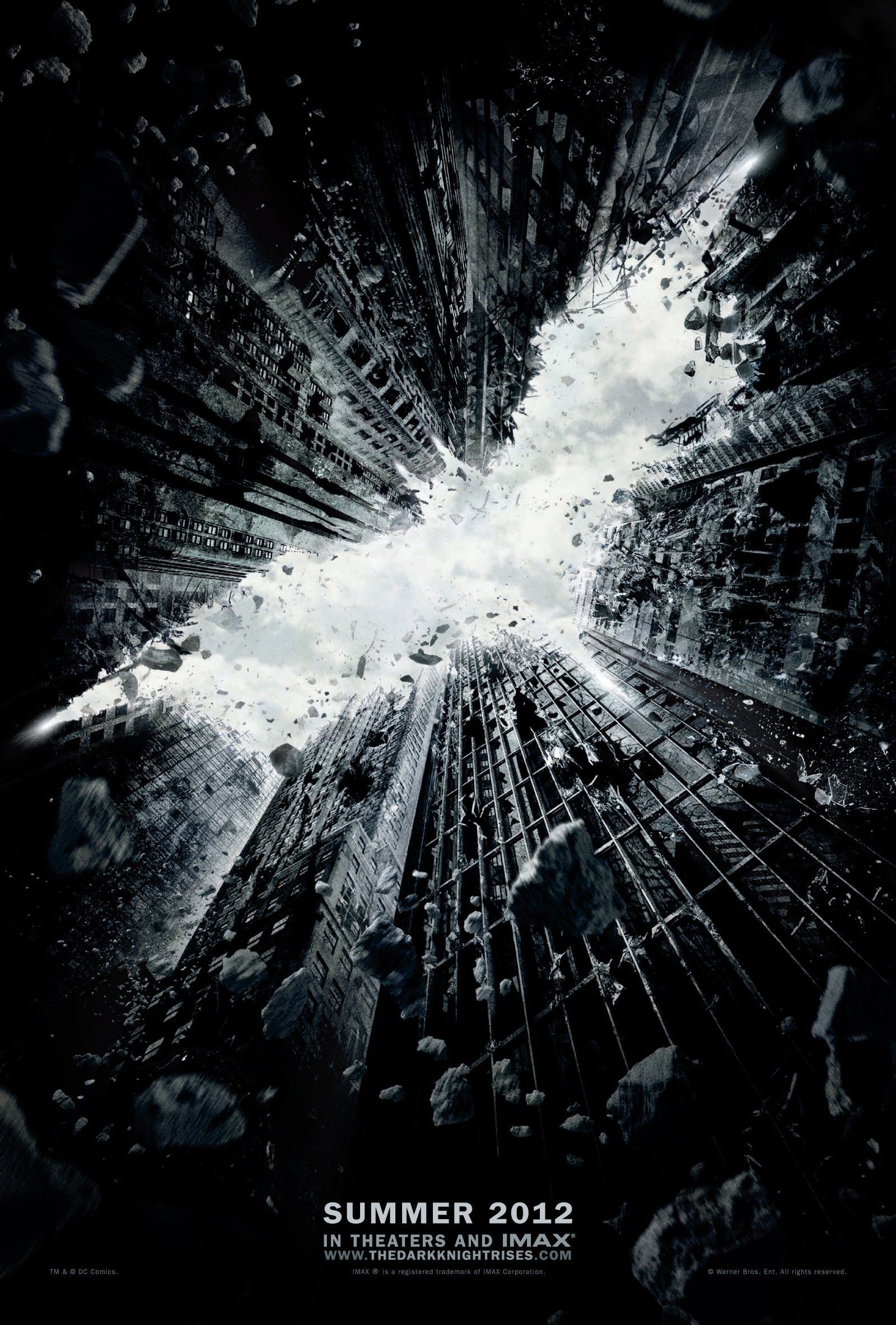
Teaser poster for The Dark Knight Rises, copyright Warner Brothers
The film is so rich with incident I cannot recapitulate them all here. Suffice to say that by film’s end, Wayne’s hopes are dashed. He has managed to snap organized crime’s hold over Gotham, while also capturing the anarchic ‘urban terrorist’, the Joker. Batman’s victory is complete… but the film’s ending (one of the things that makes it great) also foregrounds that this victory is unstable. Gotham’s freedom from crime and lawlessless rests on several fault lines, which the film itself underscores for the viewer.
Leave the specifics of those fault lines aside for the moment. The point is that it’s clear, when the film ends, that the story isn’t really over. We don’t, for instance, think we know everything we need to know about Bruce Wayne at the end of The Dark Knight. His story clearly isn’t over. And it is a story, not an episode; it has the progression, consequences, and accumulating weight of the dramatic hero, not the eternal recurrence of the iconic hero. Further, we don’t think we know everything we need to know about Gotham, or Batman, because both rest upon a series of lies, and the exposure of those lies will shatter their peace. The film doesn’t just leave questions open, it foregrounds them specifically to ask: how long can this hold?
The consequences of this means that The Dark Knight makes promises most films do not, and ones of unusual weight. As filmgoers, we know what this means. Classic trilogy structure promises the third film, the third act, must deliver on those promises.
And the tragedy of The Dark Knight Rises is that it does not.
The Four Broken Promises
What are those promises? There are least four.
1. The Ongoing Sacrifice
The Dark Knight ends with a haunting speech from Jim Gordon overlaid over images of the wounded Batman escaping the police, who incorrectly take him to be a multiple murderer. Batman is innocent of these crimes—the real perpetrator was Harvey Dent—but Batman has actively encouraged the mistake. Gordon’s son asks why Batman is running. “Because,” Gordon replies, “we have to chase him… we’ll hunt him, because he can take it.” The film’s argument is explicit: Gotham’s institutions will clean themselves up and rise to the task of governing the city well because Dent’s heroic example will inspire them. But that inspiration requires Batman to be a villain, and more than that, to be seen as one, as an ongoing threat and challenge. The lie requires both sides to function. Batman’s continued darkness as Gotham’s vigilante and ongoing ‘threat’ is what will give the martyred Dent’s light its power to redeem the city’s institutions.
What does this suggest? Batman has to sacrifice his reputation as a hero devoted to justice. And it’s not a one-time sacrifice, but an ongoing one: isolation, perpetual pursuit, hatred and illegitimacy… and Batman deliberately courting it all. The Dark Knight suggests that Batman will endure years of being hunted, operating in the shadows, unable to claim credit or find vindication, but will bear this burden in order to give Gotham a chance to redeem itself.
But he does not. We learn at the opening of the film that after escaping the police at the conclusion of The Dark Knight, Bruce Wayne withdraws into Wayne Manor and remains there for eight years, never leaving, becoming a Howard-Hughes-style recluse.
Batman does not keep fighting crime from the shadows, he does not endure the cost of being Dent’s dark counterpoint, he just disappears. By simply withdrawing without consequence, we learn that Gordon’s speech closing the last film was wrong. Batman does not let them hunt him because they need to chase him. He is neither a silent guardian nor a watchful protector.
Batman is not a dark knight.
2. Gotham Can Redeem Itself
It’s easy to forget, as the last act of The Dark Knight is concerned with Batman’s struggle with the Joker, but at film’s end organized crime in Gotham is crushed. One of Dent’s last acts as district attorney was to lock up 549 mobsters. Unexpectedly, the Joker himself destroys those who remain, along with their cash reserves. Despite all this, with Dent dead and the Joker imprisoned, it’s reasonable to expect that the mob would reassert itself.
This was the other reason why Batman must continue his crusade against crime, even while the police furiously attempt to capture him; his job is as much to keep Gotham’s gangsters from bouncing back as it is to be the target whose crimes give Dent’s martyrdom its power. He needs to do both to keep Gotham’s peace alive.
So if Bruce Wayne just hid in stately Wayne Manor for eight years, why did the peace hold? According to The Dark Knight Rises, the answer is ‘the Dent Act’. To honour its fallen district attorney, Gotham suspended civil liberties, denied parole, imposed harsher penalties, and used other tactics unbefitting a liberal polity. This is what eliminated organized crime: not ongoing effort by liberal institutions, but legal harshness and abuse of process.
This outcome is not only profoundly dissatisfying on its own terms, but is also a repudiation of The Dark Knight‘s own thesis. Late in the second film, in the ferry scene, the Joker puts a randomly-selected group of Gotham citizens into a position where they can save their own lives by murdering others. To the Joker’s surprise, the citizens, without any prompting from outside, refuse to do so, demonstrating that regular people can reject nihilism. Gotham’s citizens prove their moral capacity, despite the pressure the Joker brings to bear.
Through the Dent Act, The Dark Knight Rises says that, actually, what Gotham needed was not moral capacity, nor citizenship, nor respect for the law, but rather more willingness to dirty its hands. It turns out the solution to institutional rot is not reform, but the suspension of civil rights. The point of preserving Dent’s legacy as a martyr was because of his zeal for cleaning up Gotham through the law, but apparently undue regard for the law was the problem in the first place. So Dent’s actual work (prosecuting crime appropriately) was pointless, and the ferry scene’s demonstration of human moral capacity under pressure was irrelevant.
The Dark Knight Rises voids The Dark Knight of its moral argument.
3. The Truth Must Be Reckoned With
Gotham’s reform rests on the falsehood that Harvey Dent died a hero, killed by the murderer Batman. But actually, Dent was the murderer, and his last act was an attempt to kill a child. Batman conspires with Gordon to conceal these facts, and to take the blame for Dent’s crimes himself: a noble lie that will sustain Gotham’s efforts to reform itself.
It is not the only deception at work. Wayne’s ultimate hope was to set Batman aside so that he could be a partner to the woman he loved, Rachel Dawes, now dead at the Joker’s hands. But Wayne believes that Rachel would have joined him when he was finally willing to end Batman’s war, and his belief that she reciprocated his love is what sustains Wayne’s lonely crusade. This belief is unsound; before she died, Dawes wrote him a letter saying her love for him had come to an end. Alfred, Wayne’s confidant, was to have given him this letter. Instead, in the film’s closing montage, he burns it. In a neat inversion of Wayne’s own behaviour, Alfred also thinks that the truth would be so painful that it would make Wayne give up, and therefore that a noble lie, that Rachel died with her love intact, is preferable, because it will lead to better consequences.
These are not stable equilibria, neither mimetically—in the end, lies are always exposed—nor dramatically. At the end of The Dark Knight, viewers understand that, at some point, both Gotham and Wayne must learn the truth, so we viewers can learn if they are strong enough to bear it.
The Dark Knight Rises does show the truth emerging. At the film’s opening, Gordon, conflicted, is preparing to give a speech exposing the actual circumstances of Dent’s death. But he decides against it, and the moment passes. Later, the film’s antagonist, the supervillain Bane, finds the text of the speech and exposes its contents… but does so after Bane’s men have captured the city, imprisoned its police, and set themselves up as an occupying force. The institutions that should have reckoned with the Dent Act have already collapsed, and never face accountability for what they have done. Even if they had, the fact that it is Bane who reveals the truth the city robs the indictment of any force, because there’s no reason Gotham should believe anything he says.
In parallel fashion, earlier in the film, Alfred tells Wayne that Dawes wrote a letter withdrawing her love, but that he burned it. In response, Wayne… continues as he has, altering neither his work nor his attitude toward it. This revelation should have changed him, but it doesn’t. The only result is that Alfred, for unrelated reasons, escapes the situation by retiring to Italy.
Neither Wayne nor Gotham confronts the consequences of being deceived. We learn nothing about whether the city or the man can bear the truth. How could we, when the truth coming out doesn’t make any difference?
4. A Symbol or a Man?
The most interesting thing in Batman Begins is the exploration of why Wayne chooses to become a masked vigilante. In past treatments of the character, the decision is rooted in the simple fact that bats are scary. Following Frank Miller, Nolan establishes that bats are particularly frightening to Wayne personally; Wayne is becoming the thing he most fears. But the roots of idea stretch back almost to the character’s inception. As per the first telling of Batman’s origin in 1939’s Detective Comics #33, criminals are a “superstitious, cowardly lot”, and by adopting a frightful guise, Batman will exploit that weakness.
But in Batman Begins, Batman is more than this. Wayne explains to Alfred that the purpose of Batman is not merely to strike fear into the hearts of his enemies, but to inspire hope in the hearts of everyone else. “As a man I can be ignored, destroyed,” he says. “As a symbol I can be incorruptible, everlasting.” It is language like this that makes Wayne’s contemplation of giving up the role in The Dark Knight so interesting: it suggests that, notwithstanding the guise’s mythic qualities, Batman is not “everlasting” but merely a tool to be set aside when the work of Batman is complete.
So: is Batman a symbol, as per Batman Begins, or a tool, as per The Dark Knight?
The Dark Knight Rises is aware of the problem and chooses not to solve it. At the film’s end, Wayne has indeed given up the role. Both Batman and Bruce Wayne are presumed dead, casualties of the film’s events, and Wayne has secretly begun a new life. But that is not quite the end of the film. The final shot is of Wayne’s protégé, Blake (who we finally learn has the given name ‘Robin’) stumbling into the Batcave.1 The implication is that while Bruce has settled his debt to his parents and moved on, Batman, the symbol and role, will continue.
That is to say, the film wants both outcomes—Bruce free and Batman eternal—without reconciling them. If Batman’s work was complete, Bruce’s retirement is earned, but Blake taking up the mantle is unnecessary. But if Batman’s work is incomplete, Bruce’s retirement is abandonment, and Blake’s succession is necessary because Gotham still requires mythic intervention. And if that is the case, it means Gotham’s institutions are still failures, and Wayne hasn’t achieved anything.
The film never chooses. At the film’s end, we viewers don’t understand what we’ve seen: completion or continuation, freedom or abdication, success or failure. We are left unable to judge what any of it means.
What Was Lost
The Dark Knight achieved something rare. It’s a mass-market blockbuster that functioned as serious cinema. Few films in the ‘superhero’ genre approach its depth; a handful before it, and—despite the immense output of Marvel Studios—none since.2 This is a film that I constantly return to for its ideas, its moral complexity, its willingness to engage adult themes, and to dramatize genuine dilemmas about security versus freedom, truth versus stability, and order versus justice. Despite being almost twenty years old at time of writing, it still feels contemporary.
The film’s greatness established high stakes for the final film in the trilogy, as well as clear expectations for what that film had to do. Batman Begins suggested Bruce was building something eternal. The Dark Knight challenged that suggestion, arguing instead that such an ambition was neither possible nor appropriate. This was a live debate between the two films that the third one had to settle. Further, the last film had to test the fault lines its predecessor foregrounded: not only in Batman’s victory but in the role of Batman itself.
But The Dark Knight Rises retreated from these questions and tests. Our protagonist simply retreats so as to build himself up (in weak imitation of the first film); the consequences of lies and abuses of trust are never confronted; and no one’s sacrifices have any cost.
I don’t blame Nolan for this. I’m sure that studio meddling interfered with him. Whatever else Batman is, he is a valuable piece of intellectual property, and directors will always be made to understand they are only ever custodians of that property, not its arbiters. I’m also sure that the untimely death of Heath Ledger interfered as well. There is no doubt in my mind that had Ledger lived, Nolan would have told a different story, and the absence of Ledger the actor, and the character of the Joker, foreclosed choices Nolan would have made.
But if the failure of The Dark Knight Rises isn’t blameworthy, it’s still bitterly disappointing, because Nolan was exploring this territory for the first time, and that can only happen once. Future filmmakers will be working post-Nolan, meaning that they will, of necessity, be responding to his attempt rather than making something fresh. The next filmmaker who wants to explore whether Batman can finish his work will be doing it in dialogue with The Dark Knight Rises’ retreat from the subject. The question remains open, but the chance to answer it for the first time, with the cultural weight The Dark Knight carried, has passed.
The Dark Knight remains a masterpiece. But it’s now a standalone masterpiece with a very good prequel and an uneven sequel, one that will always prompt its admirers to ask what might have been.
I said there were at least four problems deliberately. Here’s a fifth: the Batcave. The treatment of Batman’s iconic home is small stakes compared to other matters, but it also illustrates how The Dark Knight Rises breaks promises the earlier films made.
The final scene of Batman Begins is Alfred and Wayne discussing how, as part of the renovation of Wayne Manor, they will transform the caverns beneath the foundation into a suitable headquarters for Batman’s work; the film ends by promising that the Batcave, not yet seen, will indeed be part of Batman’s iconography. The Batcave is absent from The Dark Knight, but viewers are told Wayne is working out of the sub-basement of Wayne Tower while the cave is completed; the end of that film shows Lucius Fox destroying part of the sub-basement facility, strongly hinting that the next film will feature the Batcave as Batman’s base of operations.
But The Dark Knight Rises gives us a Batcave that has been built but never used. Wayne never needed it during his eight-year hiatus, and upon Batman’s return, Bane almost immediately invades and loots it, to power his invasion of Gotham. There are no scenes of operational work in the Batcave: no planning, no equipment testing, no forensic science. We see Blake enter it in the trilogy’s final shot, but we never see the Batcave function; a two-film setup that is never paid off.
Captain America: Civil War comes closest.