


Before today’s article, I’d like to pass along another piece of good news, to complement last Thursday’s note about my upcoming public appearances, and forthcoming book. And that is:
I’m pleased to announce that I am joining the Institute for Progress as a Non-Resident Senior Fellow.
IFP is a non-partisan think tank in Washington, DC, that works to speed up scientific, technological, and industrial progress in the United States. Some of you will already know it through my work: I wrote a chapter on automating American transit agencies for IFP’s Transit Abundance Playbook. Since then I’ve been contributing to its work behind the scenes, and formal affiliation seemed to both to be the natural next step.
As a fellow, I’ll be working with IFP on how to advance better transport and mobility in the USA, particularly as applied to public transit, driving automation, and allied matters. These are problems that need close attention, and I’m glad to join the company of people who believe working on them is important. (I’m also looking forward to being the subject of one of their sweet cartoon portraits but that may take some time do produce.)
Having said that, I want to stress that for now, nothing will changes here. Changing Lanes remains independent, and the views in it remain mine, not IFP’s nor anyone else’s.
In February I published The Iron Law of Air Travel, which argued that consumers always choose the cheapest airfare available to them. In May, the cheapest airline in America went out of business.
You may be surprised to learn that I regard this as confirmation of my theory.
The Iron Law says the bulk of travellers will always choose the cheapest fare. Consequently, any airline that tries to compete on quality rather than price loses customers, and bleeds revenue until it reverts. To be more precise: consumers choose the lowest displayed price, i.e., the number on Expedia or Google Flights, whose default sort puts these first. I argued in February that a series of crises afflicting commercial air travel each forced prices down, and that the Iron Law then works as a ratchet: prices cannot rise again, so service quality cannot either. This explains why air travel is so unpleasant.
On that account Spirit, which brought the unbundled fare to the USA and spent two decades leading the lowest-fare sorting, should never have gone bankrupt. Either the Law is wrong, or my account of it was incomplete. In some fashion, my reasoning had to be off.
So I made an experiment out of it. In May 2026, a week after Spirit flew its last flight, I wrote down some predictions about what would happen next. Four months later, they have either held, or are still uncertain but trending towards hold. I regard my high hit rate here as vindication of the Iron Law… at least, when phrased carefully. The Iron Law holds that the cheapest displayed fare wins, and that is true.
But it would be reasonable to take as a corollary that the cheapest airline wins also. Had I been asked in February whether Spirit would outlast its rivals, I would probably have said yes, and I would have been wrong.
The body was willing but the Spirit was weak
Before we get to the predictions and the theory of the case they support, let’s rehearse the facts of Spirit’s downfall.
On 2 May 2026 Spirit stopped flying. More than 2,000 pilots and 15,000 other employees lost their jobs, and the airline’s principal assets went to auction. These included 48 Airbus A320-family jets (about two-fifths its fleet, the rest having been leased from private owners); 22 slots at LaGuardia; and, scattered among the other airports of the USA, the boarding gates of what had once been the country’s seventh-largest airline.
For its roughly 34 years as a commercial passenger service, Spirit didn’t attempt to compete on schedule depth, network breadth, or brand value. Instead it aimed to offer the cheapest fare. Innovations we now take for granted came to the USA through Spirit, notably ‘unbundling’. Unbundling is the now-ubiquitous practice of selling a fare as low as possible, but charging separately for every amenity that was formerly bundled into the price: bags, seats, boarding order, and more. The ‘you see $289, you pay $500’ phenomenon first appeared at Spirit around 2006–07. As I argued in my original piece, this strategy was a creative response to a subsidy disappearing: business travellers, who had paid several times the economy fare for the same seats, did not come back after 9/11. Somebody had to make the cheap seats pay for themselves.
Spirit’s pioneer spirit kept the airline cheaper than its competitors for a decade, which is how long it took the legacy carriers to catch up. Delta introduced the basic economy fare class in 2012, and United and American followed in 2017. By 2017 the legacies could match Spirit’s number on any route they cared about, though it took until 2024–25 for the matching to become routine across the network. With the gap closed, the contest went to tiebreakers, where the legacies had the advantage: brand, network, and frequency. Spirit understood the Iron Law first, and that insight let it hold its own, for a time. It won so long as it had the cheapest flights. Once it drove its competitors’ fares down to its level, it had no other cards to play.
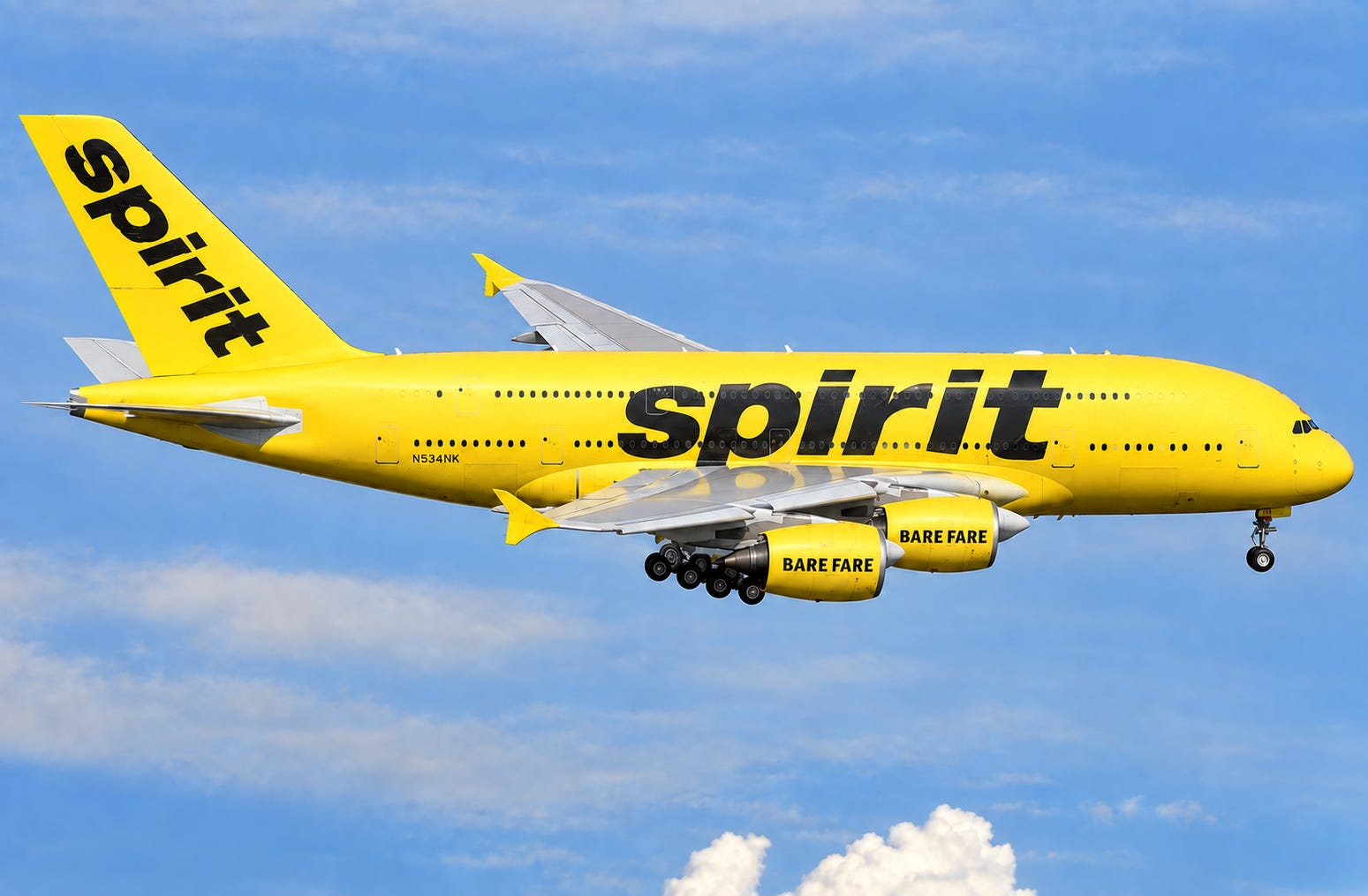
Savegary. (2023, April 5). Spirit Airlines A380-800 [Photograph]. Wikimedia Commons. https://commons.wikimedia.org/wiki/File:Spirit_Airlines_A380-800.jpg License: CC BY-SA 4.0. Remixed by ChatGPT.

You may wonder why Spirit was able to remain a going concern for almost a decade after the price gap closed in 2017. The answer is two bad things that were perversely good for Spirit.
The first was the pandemic, or more precisely, the federal payroll support that Spirit and other US carriers received through 2020–21. In the pandemic’s wake, demand outpaced the carriers’ ability to serve it, which kept even cheap fares high enough to keep Spirit in the black.
The second was an engine recall. Spirit, and other discount airlines, relied on the Airbus A320neo family of aircraft, which feature geared turbofan engines made by Pratt & Whitney. In 2023, the firm disclosed a manufacturing defect in those engines. In consequence, hundreds of aircraft were grounded for safety inspection. This meant capacity was short across the discount sector and fares stayed high; Pratt’s compensation payments to Spirit for the flights it couldn’t offer helped as well.
Spirit could only squeeze juice out of these lemons for so long. Post-pandemic inflation hit it hard on pilot contracts, maintenance, and everything else. Facing real competition on discount fares at last, it could not stay solvent. The USA’s misadventures in the Middle East caused a fuel spike which finished Spirit off, echoing the demise of Silverjet and its peers in 2008. But the fuel spike was only the inciting incident; the cause of death was loss of its pricing advantage.1
Matthew Yglesias argued in May that the real lesson of Spirit’s bankruptcy was “the airline industry is highly competitive and works pretty well, and in a competitive industry companies sometimes fail”. Aviation assets are fungible, and with Spirit’s dissolution, those planes, slots and gates are now available to be used by other carriers. He didn’t write, but could have, that the pilots and other human capital Spirit held could be picked up by other carriers as well.
The summer proved Yglesias’ point: twenty of Spirit’s owned jets were sold to CSDS Asset Management in a court-approved sale, and JetBlue won Spirit’s LaGuardia slots at auction on 20 July. And Frontier and JetBlue expanded service into the vacuum Spirit left behind. As per David Casey at Aviation Week, competitors had replicated only 48% of Spirit’s capacity at the summer peak, rising to about 60% by September; the remaining 40%, the “thinner leisure and VFR markets”, were not replaced, and “remain underserved or have lost service entirely”.2
Why the hybrid carrier wins
The Iron Law says that customers always choose the lowest price, meaning that airlines can’t compete on quality. Spirit’s experience shows that, over time, the market converges on the lowest price, after which customers will look at other amenities as tiebreakers. So, over time, what wins is a hybrid carrier that unbundles everything. In that game, legacy carriers can match any discounter’s fare in its basic tier, and then seek to upsell.
Against this, as the market sorting after Spirit’s exit shows, legacy carriers still have overhead to pay, and while they can compete with discount players on a route, it’s only worth it to them if there is sufficient opportunity to upsell in it. Where there is no such opportunity, a legacy airline will instead use an available aircraft in a more lucrative corridor. That means that a discount model can still work, but only where there’s insufficient upselling to be had, meaning linking cities that are leisure-only, like Las Vegas or Orlando; or regional centres, like Provo or Latrobe; or regional-to-leisure. The USA has plenty of price-sensitive travellers, but relatively small demand for travel on routes like these, and that is what held Spirit back. (Conversely, densely-packed Europe has large demand for travel on routes like this, which is why RyanAir and others ultra-low-cost carriers, or ULCCs, thrive there.)
Having built this model in my head, I made some predictions. They are expressed in a few ways, but the common idea was this: basic economy will persist even absent Spirit to enforce market discipline on the legacies. My theory was that the stripped-down unbundled tier had become the shape of the market. If it was only ever a gambit to keep up with Spirit, then with Spirit gone the legacies would declare victory and re-bundle, and the Iron Law was wrong. I predicted they would stay unbundled, and that the hybrid model was the future.
(One caveat: I wrote these down on 10 May in a note to myself but never published them. Please take my word that this is the whole list, not just the flattering parts.)
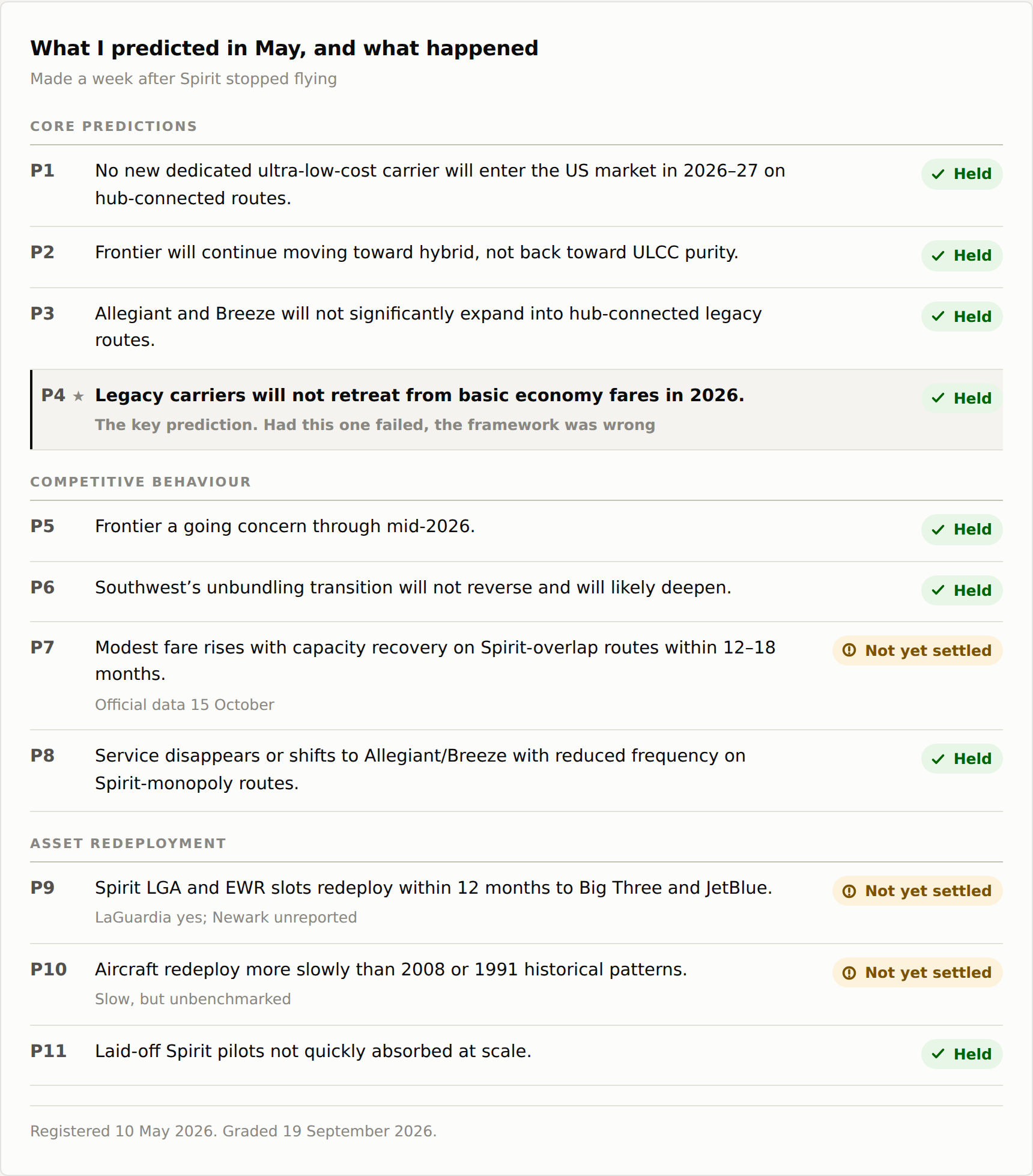
Stripped of detail, the bet was this. Nobody would start a new discount airline. The surviving discounter would keep turning itself into a hybrid. Where Spirit had been the only carrier, service would vanish or come back thinner. And the legacies, with nobody left to undercut them, would keep the stripped-down fare anyway.
The legacies kept the unbundled fare
I can report that my predictions largely came true.
The most important one was that, as I anticipated, the legacies continue to lean hard into the hybrid model rather than returning to higher and bundled fares. On 8 July Delta went ‘full unbundled’, launching Basic First Class and Basic Business Class as fare options. Two days later, it reported quarterly results in which premium ticket revenue again exceeded main cabin. United already sold basic, standard and flexible fares in its premium cabins, and its chief commercial officer, Andrew Nocella, put it beyond doubt on the 16 July call: “That does not mean that we’re going to step away from basic economy.” American reported premium revenue at nearly half its ticket revenue, collected on roughly 30 per cent of its seats.
In other words, the big carriers spent the summer exporting the basic architecture into first and business class, if they hadn’t done so already. None of them even mentioned Spirit in a pricing context on their earnings calls. That’s what one would expect if their commitment to the fare category was not about competing with Spirit, but was instead about responding to a structural feature of the marketplace.
Meanwhile, on its 29 July call, Frontier described its strategy as “segmenting our revenue base” through first-class seating and other premium products, while genuflecting toward “preserving the cost discipline that defines Frontier’s model”. That is the hybrid model in a nutshell. Allegiant, which now styles itself the “leading leisure-focused U.S. airline”, has not expanded beyond its Las Vegas, Florida and Arizona markets. Finally, while Breeze has expanded modestly in secondary leisure markets, neither it nor Allegiant has announced any intention to compete with the legacies on main routes. And no new discount airline has emerged to do so.
How are things in the markets that only Spirit served? As per Casey above, service in those places disappeared, or came back thinner. Atlantic City, where 94% of seats were Spirit’s, now enjoys Breeze and Allegiant flights, albeit most of them only two or three times a week (Spirit was daily). Business Insider analysis found fares up about 14% on routes Spirit had already exited in 2024–25, against 6% where it kept flying.
What we’ve learned
I have to take my lumps. I had expected, though I didn’t frame it as a prediction, that Spirit’s routes into hubs would be absorbed by the legacy carriers’ basic economy service. But this did not happen; the airline that did the most to fill the vacuum was the other ULCC, Frontier. That carrier added about 1.3 million seats into Spirit’s markets, in contrast to JetBlue at half a million, and Delta at essentially none. I suppose what I had missed was that JetBlue and Delta didn’t need to add seats, because they could absorb demand with existing capacity. Delta, for its part, told investors it was not growing its main cabin, and would rather chase revenue than market share.
So here is the Iron Law, slightly rephrased to reflect what I’ve learned. Consumers always choose the lowest price, yes. But one obvious corollary is wrong: the Law doesn’t mean that the carrier with the lowest price wins. Instead, the one that can offer that price, and supplement with premium upselling, will win. The ‘pure players’ that have only ultra-low costs to offer, or conversely only luxury service, are outcompeted in each case by hybrids, which can take the top row of the search results when they think it worth it, and then upsell behind that number. The North American market, over time, converges into one of full-spectrum carriers competing tier against tier at the top of a search-results page, more entrenched, and more artfully unbundled, every quarter.
This may seem gloomy: the future of commercial air travel seems to be a consumer, being nickel-and-dimed on every aspect of their trip, forever. The American government seems content with this outcome; courts struck down a Biden-era fee-disclosure rule in February, and it was formally rescinded in July. A further DOT proposal would let airlines unbundle the displayed fare even from mandatory taxes and fees, noting that “Under the current regulation, the total price must be displayed more prominently and in a larger font than any individual component of that price”, and that this rule “is unnecessarily prescriptive”.
But there is one ray of hope, shining on Europe. Courtesy of EU regulation, from late 2027 fares advertised in Europe must include a cabin bag, and must be displayed by default before booking begins. This is the remedy I have proposed before: require the advertised fare to include a bag and a seat, so the search results have a floor higher than ‘you get to sit down’.
Now this is very small beer; one reason air travel is unpleasant is that, to avoid checked-bag fees, everyone packs carry-on only if they can, which delays boarding and deplaning, and leads to Hobbesian battles for space in the overhead bins. But at least it sets a principle that advertised prices should take a more-comfortable baseline. It’s still the case that airlines may sell a no-bag fare underneath the mandated one, but that’s fine by me. My beef with air travel is not price competition, but that fare display puts everyone in a sub-optimal equilibrium. Once the default advertised fare includes a carry-on bag, we are at least taking a more comfortable flight as our baseline.
My expectation is for good news here: that European discounters will compete harder on the bundled number, rather than pushing hard on ‘down-selling’. If that comes to pass, then perhaps regulators will find the courage to go further, and extend the baseline to a checked bag. That last one seems so remote as to be not worth thinking about… but any trip, no matter how long, has to start somewhere.
Some will argue that the real cause of death was the Biden Administration blocking JetBlue’s proposed acquisition of Spirit in 2024. I don’t have a dog in that fight; whether through Chapter 11 or acquisition, Spirit had run out of runway, and the question I’m interested in is why.
On the Laguardia slots: though the sale was approved by the bankruptcy court, the FAA has so far only tentatively approved it.
On VFR: this stands for Visiting Friends and Relatives, i.e., passengers travelling for personal reasons rather than business or vacation, and as such more price-sensitive.