


Before we get to today’s post, a brief editorial announcement.
I’m pleased to report that last week, the Washington Post published my argument that no one likes back-to-back meetings, but that there is a simple solution to the problem: a calendar setting everyone has access to, meaning you can solve this problem with two clicks.
If that op-ed is how you found Changing Lanes, welcome! Changing Lanes is a weekly newsletter on mobility innovation, covering everything from vehicle automation and transit policy to the platform economics of Uber. Recent pieces have covered California Forever’s mobility vision; why ghost kitchens failed; the structural reasons why air travel is unpleasant; and how to think about robotaxi liability.
As for me, I’m a transportation professional active full-time in the field, and a freelance writer who, in the past six months, has published in outlets as diverse as the Wall Street Journal, the Globe and Mail, American Affairs, the New York Post, and Asterisk.
You may wonder why Changing Lanes exists, given the other opportunities I have to publish my work, and the demands on my time. The reason is that I like writing independently, outside any single publication’s editorial line. And I’ve been successful at it: over the past year, the number of subscribers to this newsletter has more than doubled, from 700 readers then to 1,800 today (helped along by my appearance earlier this spring on Ross Douthat’s New York Times podcast “Interesting Times”). Changing Lanes is growing!
But it needs to be sustainable too, given the opportunity cost of writing it. That’s why, in four weeks—specifically, Tuesday, 16 June—the price of a subscription will go up. The current rate of US$10/month or US$100/year ends; from that date, new subscriptions will be US$13/month or US$130/year. Existing annual subscribers keep their current rate until renewal, while monthly subscribers move to the new rate on the first billing cycle after 16 June. What that means is, if you’ve been thinking about subscribing, now’s the time, especially as annual subscriptions taken at today’s rate will be locked in for a full year.
In concrete terms, paid subscribers get two things that free subscribers don’t: a paywalled issue each month, and direct engagement from me in the comments. But equally importantly, they receive my gratitude for keeping Changing Lanes alive: reader support is what keeps it going.
Andy Masley recently catalogued seven beliefs that cluster among low-trust, populist voters. It’s so good that I want to quote it at length.
There are no positive-sum trades. In every exchange, someone is winning and the other person is losing. Profit is usually a sign that someone’s been harmed.
Every trade-off is a trick. Anything harmful cannot be made up for by other unrelated positive effects. If someone tells you we need to make a trade-off, they’re hiding a much better solution where everyone’s better off and nothing bad happens.
Big, global institutions are always way less trustworthy than small, local institutions. The real political axis is the virtuous, authentic, everyday, rooted people vs. the unrooted powerful cabals who run society.
It’s very important that all resources be spent on your specific value system and vision of the good life. Pluralism is a trick. Other people pursuing very different values are basically always a threat, because there are no positive-sum trades.
The world is getting irrevocably worse. Technological progress is always just a march toward something worse.
Individual humans are magic. Any implication that things humans do can be truly replicated by machines is an attack on human dignity.
Some form of a folk labor theory of value is true. The value of a good is determined by how much thoughtful human labor has gone into making it.
Reading this list, my immediate thought was that the same cluster shows up in opposition to driving automation.1
Masley introduces this framework to discuss popular objection to data centres, which is real and increasing everywhere, including Canada. It’s a useful exercise in helping to separate object-level from subject-level thinking, and recognizing how a great deal of opposition to data centres stems from blanket pattern-matching.
In my view, the same separation is worth doing for automated vehicles (AVs).
Where the framework travels
No positive-sum trades. This is a standard move. On this view, every Waymo ride steals work: from a cab driver, or a ride-hail driver, or the local transit system. (This image, and all subsequent ones, link out to the original.)

On this view, benefits accrue entirely to one party, harms entirely to another, with no overlap. The possibility that a cheaper, safer transport service might leave working people better off as riders, even as it displaces some of them as drivers, is ruled out by the framing.
Every trade-off is a trick. This is clearest on safety.

Waymo’s per-mile injury rates in the cities where it operates are meaningfully below human-driven baselines. The beginner-level move is to not engage with this data, arguing that safety is unproven without addressing the existence of evidence to the contrary. The impressive master-level move is to argue that robotaxis are a complex and foolish kludge, and that the obvious better move is to simply retrofit all cities such that cars are unnecessary.
Big global institutions are less trustworthy than small local ones. This one travels strongly.

The idea here is that piloting transportation technology on public streets, where it will be used, is illegitimate, because it’s big companies based far away that are doing it. It’s easy to pair with the implication that any city councillor who lets AVs operate has been captured. As with data centres, when a national or global firm like Waymo or Tesla wants to operate locally, their bigness makes them suspect, and the actual question of whether the operation is net good for the community is skipped. (I have seen this dynamic in operation up close and personally).
Pluralism is a trick. On this view, if anyone doesn’t want a robotaxi on their street, then no robotaxis should be permitted anywhere in the city at all.

It’s reasonable for a city to consider where and on what terms AVs should operate, but on this view the only question is whether they should be present, full stop. The idea that the city should accommodate the desire of consenting adults to use the service while addressing externalities that arise does not appear.
The world is getting irrevocably worse. Hello, Black Mirror:

On this view, robotaxis are a step toward a colder world: algorithms piloting machines, workers displaced, and public streets converted into a private revenue stream for tech firms that do not answer to anyone local.
On another view, the actual dystopia is the status quo of roughly 40,000 annual U.S. road deaths because of poor human driving, and hundreds of thousands more worldwide. Driving automation is the most promising solution on offer to solving that problem; but because that problem already exists, it is generally taken as a neutral baseline rather than as a catastrophe to be urgently addressed.
Individual humans are magic. I think robotaxis surface this claim even more strongly than data centres do.

This move, from ‘some rides involve genuine human contact’ to ‘human connection is the essence of what a taxi is’ is precisely what Masley is pointing at.
Folk labour theory of value. Put one way, this is just the previous objection in different words: a ride is only really worth something when a human has provided it.
Put another way, it’s an economic claim: AV firms are extracting value they haven’t earned. None of the deployed capital, the research and development, the data infrastructure, the years of testing counts as the kind of investment that legitimates a return. Real value, on this view, comes from human effort applied directly to a task, and anything else is rent. From this, the conclusion follows that AV profits should be heavily taxed and redistributed to displaced drivers, and that the appropriate posture toward an AV firm is suspicion of rent extraction rather than recognition of value creation.

This objection, and the previous one, measure the worth of a transport service by its inputs, specifically human input to operation, rather than the outputs, i.e., what the rider gets out of it. A trip provided by a person is categorically different from a trip provided by software, irrespective of the rider’s experience or cost.
While this summary has teased out the individual objections, it’s usually the case that they travel in packs. San Francisco Supervisor Jackie Fielder manages here to hit all of them at once:

What lies beneath
This framework’s value is in identifying the style of opposition, which is real and prevalent. That’s a useful contribution, but let’s respect its limits; it would be a misuse of the framework to conclude that all the objections here are without merit, merely because of the way they are articulated. Robotaxis do pose several policy difficulties that deserve serious consideration, irrespective of who points them out or how they are phrased.
Robotaxis operate in shared public space, and as such can offer physical risk to non-users. ‘Let consenting adults transact’ is not an answer here the way it is for a data centre. It’s reasonable to ask for safe operation to be demonstrated before permitting widespread rollout… but of course there is no regulator nor robotaxi firm that asserts otherwise.
It’s true that the populist view that there are no positive-sum trades is wrong on its face. If a robust robotaxi system makes travel cheaper, more trips will be taken; because travel is expensive, there are some trips people would like to take but don’t because of cost, and robotaxis would allow those trips to happen. This is induced demand at work: just as new highway lanes encourage more trips to be made, so too will cheap robotaxi networks. More trips means more people are better off.
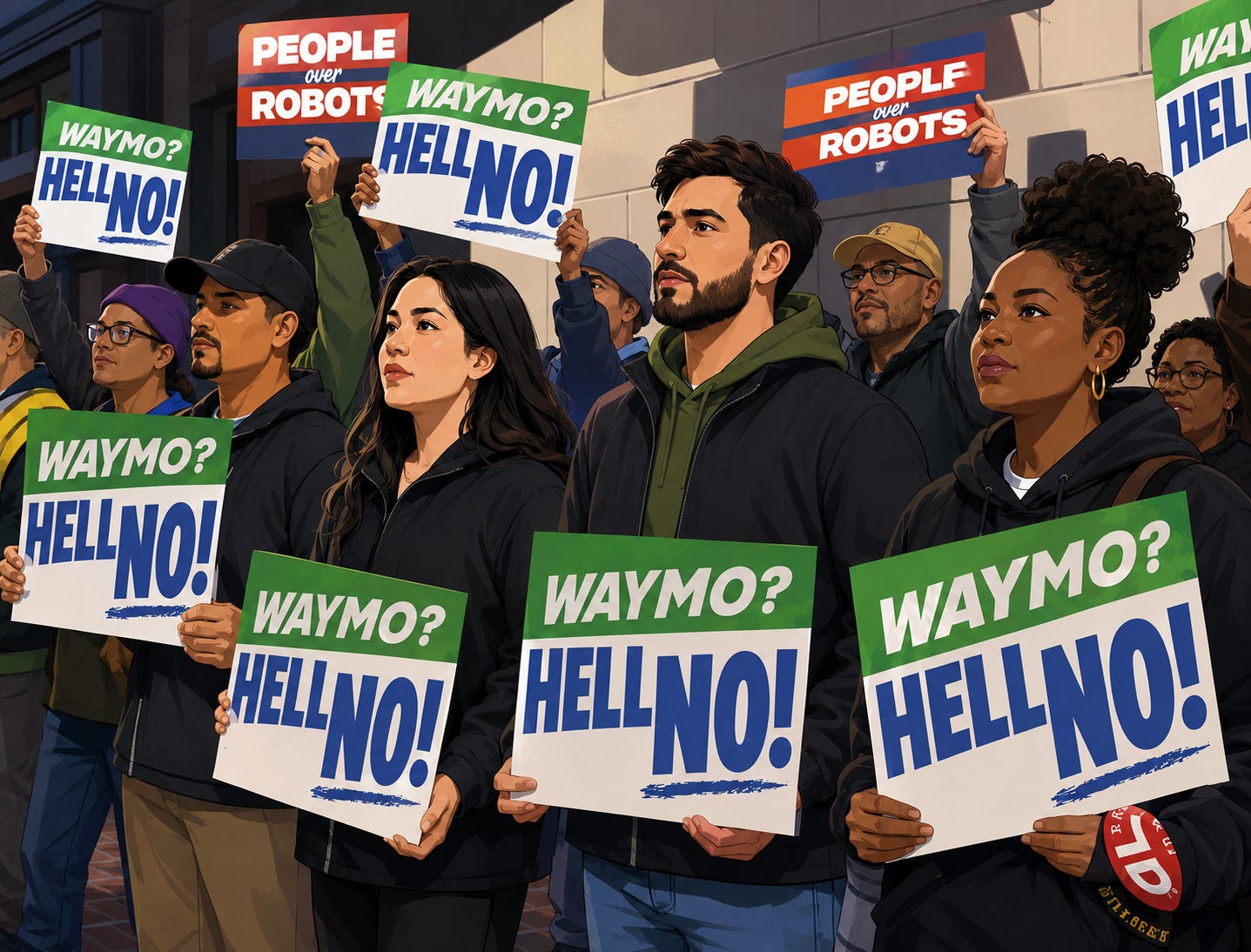
But it won’t all be positive-sum. Human-driver ridehail companies will face direct competition from a service with a structurally-lower cost base, and transit agencies will bleed users to a cheap alternative that offers private and direct trips. There is a genuine trade-off here; some parties are going to be worse off. Waving away concern about this as folk Marxism is no way to win hearts and minds.
Similarly, induced demand bites as hard with robotaxis as it does with new highway lanes; we may expect both to generate congestion. Ironically, the solution here, road pricing, is politically difficult to deploy in most North American cities because of the very same populist hostility.
The ‘humans are magic’ claim in its strong form is silly, but a weaker version has merit. The populist version is wrong: there is no metaphysical link between a taxi driver and a patron, and only rarely a moment of profound human connection. Most customers, in practice, spend their taxi or ridehail trips scrolling their phones in silence, and it’s the bored driver who wants to make small talk (Uber has its ‘request a quiet driver’ feature for a reason).
But human operators of taxis, rideshares, and buses really do perform functions beyond piloting: answering patron questions, handling medical emergencies, and deterring antisocial behaviour. Robotaxis (and, one day, automated transit buses) will have to handle these too, through fleet response, dispatched staff, in-vehicle communications, and a redesigned operating model. The duties don’t disappear with the driver, but will instead be relocated, and a thoughtful AV policy framework will have to ensure they have been relocated competently.
Given these real policy issues, we can’t just point out a populist move and then dismiss the speaker, tempting as it may be.
On one side, there are genuine concerns about shared public space, congestion, and the fortunes of the vulnerable (not only ridehail drivers, but everyone who depends on a flourishing public transit system) that tend to be expressed in this register. On the other, everyone gets to vote, which means that widely-articulated views must be met with argument, not sneering. Robotaxi advocates must shoulder the burden of demonstrating safe operation in shared streets; pricing the externalities that automation will amplify; and using some of the profits of the winners to reduce the pain of the losers.
We had best take this seriously, or we will spend the next decade winning the argument but losing the politics.
Masley’s original list has eight. His fifth entry, which I have omitted here, is “Information is not valuable and not worth spending resources to acquire. What matters is physical goods. Thus, digital goods cannot make life better. It is at least somewhat sinful to spend physical resources to produce digital goods.” Given that driving automation, on the surface, features neither information nor digital life, I’m excluding it from this analysis.
Overcoming cognitive distortions driven by emotions will be the biggest challenge to the growth of autonomous vehicles. And yet, when I think about the visions of “the future” from the entertainment of our younger years…so much of it contains automated transportation, either neutrally or positively depicted. I also want to be able to set coordinates and say “engage!” Providers of this technology need to start tapping into the uses that generate positive emotions among the public.
"it would be a misuse of the framework to conclude that all the objections here are without merit, merely because of the way they are articulated"
This is the crux of what you're arguing here. For example, when you point out that it's not all a zero-sum game, we should also note that many tech companies rarely offer the same standard of service for very long. Waymo might be much cheaper to start off; but once there is no competition, what will stop prices from rising back to current rideshare and taxi levels?
Governments will likely see an opportunity for licensing revenues. The influence of revenues from private companies in a less competitive market could also make governments dependent on those companies and less willing to enforce stricter requirements on the technology to protect public safety. When licensing requirements are tied to individual drivers, there probably isn't as much conflict between revenue and regulation. If someone isn't willing to pay licensing fees because of an objection to a condition of a licence, there is more than likely someone else who will. If a collective ownership structure like a corporation does not want to pay fees, and its failure to continue to operate will reduce capacity by a significant percentage, local government is stuck with a shortfall in transportation options or capitulation to the company's desired outcomes.
Basically, populist objections of the moment should not be dismissed because dynamics will almost certainly change after a policy decision in favour of robotaxis.