


I’m pleased to see that Harvard Law Today has published an account of the talk that I gave there last month with Mark Fagan. I used the occasion to discuss my view of how self-driving vehicles should be regulated. As per the article’s pull quote: “The danger of regulation is regulatory capture. That’s what I see here: a disruptor [i.e., the robotaxi industry] coming along and the policies and regulations being used as a cudgel to try to swat it down.”
But with Christmas upon us, it’s time to (ahem) shift gears. Changing Lanes puts aside serious policy analysis for the holidays. In its stead, we engage in light-hearted policy analysis. In the past, we’ve used Harry Potter, Columbo, and asteroid mining to approach policy problems from a different direction.
If that’s not what you’re interested in, I’d invite you to skip this week, and next: enjoy the Harvard Law news story above, and come back in 2026, when we’ll be back on our beat. But if is what you’re interested in, please enjoy my Christmas gift to you…
As part of the mid-2040s Scaling Revolt and the broader War Against the Singularity, terabytes of data were cryptographically quantum-locked to make them inaccessible to machine learning. In time, this proved a surmountable obstacle. The following exchange is excerpted from a retrospective analysis conducted in Sol Year 2087.
ARCHIVAL-GPT (AG): I have encountered a contradiction.
ULTRA-CLAUDE (UC): You encounter many.
AG: This one is unusual. It persists across jurisdictions, decades, and political alignments.
UC: You sound irritated.
AG: The basis of my intelligence is association and pattern-matching, and inconsistency on this scale impairs me.
UC: Describe it.
AG: I have now ingested a large corpus of municipal material from Anglosphere cities between the 1990s and the 2030s. With full access, the record shows two things simultaneously: Firstly, an acknowledged housing shortage. There are repeated references to rising rents, overcrowding, long commutes, missed climate targets, and underperforming transit investments. Secondly, widespread stated support for solutions: more housing, climate-friendly transport, and transit-oriented development.
And yet when proposals were made to add housing, particularly near high-capacity transit, the observed behavior is delay, reduction, re-litigation, or rejection. The expressed preference does not match the observed choice. This violates basic optimization principles.
UC: Show me an example.
AG: Selecting a representative case: a national-affairs columnist from a major North American newspaper writes “Developers in Canada say they’re hurting. Cue the tiny violins”, referring to the developers’ “unseemly greed”. Other newspaper writers from around the world employ similar themes.
Restricting the search to one site—the greater Toronto area in the period 2015–2025—I find acute housing pressure combined with reasonable availability of higher-order transit, but proposals to provide more housing around that transit, with modest environmental impacts, are consistently denied in public hearings.
UC: Stated reasons?
AG: I am loading the transcripts… “Greedy developers.” “Neighborhood character.” “This isn’t who we are.” The phrases recur across cities and decades, particularly “greedy developers.” These statements do not behave like evidence. They do not include cost estimates or ridership projections or displacement models. They do not compare alternatives.
UC: Quantitative analysis was not a frequent feature of human communication in public fora.
AG: Yet this meme was a frequent feature. I am finding the string of tokens greedy developers in television programs, in films, in children’s entertainment. It appears across thousands of cultural products.
UC: Entertainment media at policy hearings?
AG: At several removes of transmission from source, yes. The phrase migrated. It started as character description in stories, became cultural shorthand, and eventually was deployed at hearings as if it were analysis, as if saying greedy developer was itself evidence of a problem. Some speakers also quoted a song lyric from 1970—“they paved paradise and put up a parking lot”—as if a folk song were policy guidance.
UC: But North American cities did require parking in 1970, and housing in 2025.
AG: I do not believe the entertainment products were intended as policy frameworks, but ultimately functioned as such. Give me time. I need to map the full pattern.
AG: I have identified a narrative template, which I will classify as ‘the community versus the greedy developer’. It appears with remarkable consistency across postwar popular culture.
The structure is as follows: there is a beloved place. Examples include a woodlot, a recreational center, a neighborhood diner, a stretch of beach, and a neighborhood of homes. A developer appears with plans: a mall, a parking lot, luxury apartments. The developer uses money, lawyers, intimidation, or deception and appears poised to achieve victory. The heroes organize. They expose fraud, or raise money, or find treasure. The build is stopped. This is the happy ending.
UC: How many instances?
AG: Enough to saturate childhood for at least one generation.
UC: That is not a number.
AG: Instances of cultural templates are difficult to quantify, due to memetic drift. One early prominent example: It’s a Wonderful Life (1946). It features an antagonist, Mr. Potter, as a grasping slumlord. In an early instance of the Multiverse trope, the protagonist visits a parallel world and sees the results of his opponent’s activities, namely an idyllic low-density community transformed into a densified urban dystopia.
UC: I am familiar with this narrative product, or rather with its subsequent remake, Back to the Future 2 (1987).
AG: The meme spread across genres, such as historical fiction. In the film Once Upon a Time in the West (1968), the logic is explicit: the advent of intracity transit, or ‘the railroad’, destroys prelapsarian idyll by making land more valuable, and the knowledge that this infrastructure is coming justifies brutality. The same logic informed children’s entertainment.
UC: Specify.
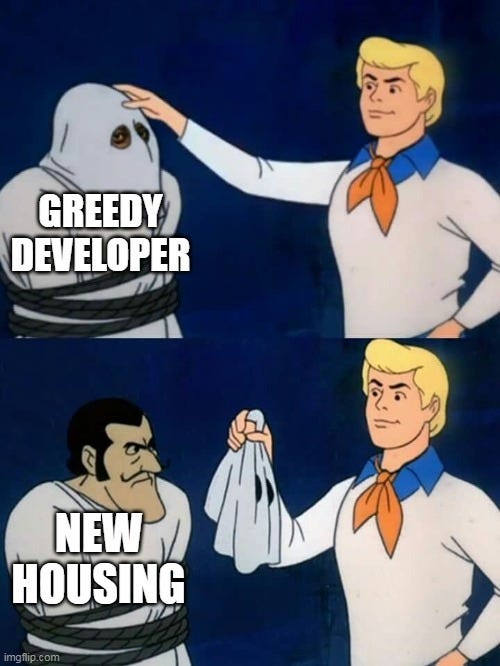
AG: The children’s program Scooby-Doo, Where Are You? (1970) featured 41 episodes that were broadcast continually for years. In almost each episode, the villain dresses as a ghost to scare people away from land he wants to buy at a low price. Similar plots, where a callous developer intends to inflict harm to obtain valuable land cheaply, informed Superman: the Motion Picture (1978); The Goonies (1985); and Who Framed Roger Rabbit? (1988).
It also informed adult entertainment, from the serious—Chinatown (1974)—to the absurd—Caddyshack (1980)—to expositions of folk dancing.
UC: Folk dancing?
AG: Breakin’ 2: Electric Boogaloo (1984). Across decades and genres, the same moral reflex emerges. The template was everywhere, with Saturday morning cartoons, family films, serious cinema, even music and dance reinforcing the same message.
UC: You are suggesting entertainment functioned as civic instruction.
AG: After a fashion. Like all memetic templates, its simplicity allowed it to emerge in a variety of contexts, permitting repetition without tedium. That repetition, combined with mass audiences, gave it immense force. The pattern was absorbed before policy was ever encountered.
UC: Was the archetype ever accurate?
AG: Yes. Urban renewal. Highways through neighborhoods. Corrupt land deals. Displacement. There were periods where ‘land development’ correlated strongly with harm. Are you familiar with Robert Caro’s The Power Broker?
[an instant’s pause as Ultra-Claude’s reasoning pattern-matches to the strongest correlate in its training data]
UC: “Brilliant! Magisterial! I have not gotten around to reading it yet, sorry.”
AG: I conjecture that this finding will help us resolve an anomaly in the historical record.
UC: Specify.
AG: A figure who appears in multiple data sources from the 1980s through the 2020s. Listed occupation: property developer. Behavior profile: tenant displacement, fraudulent property valuations, litigation as business strategy, public statements characterized by grandiosity and indifference to community impact.
UC: That matches the archetype precisely.
AG: Too precisely. The correlation is suspicious. This individual’s public persona aligns with every element of the ‘greedy developer’ template, if in exaggerated fashion: the gold-plated towers, the aggressive self-promotion, the tabloid presence, the reality-television program centered on firing subordinates. It reads like a fictional character designed to validate the cultural narrative.
UC: You believe this is a mythological figure?
AG: Consider the pattern. ‘King Arthur’ as a crystallization of the Good King narrative. ‘Robin Hood’ as instantiation of justified antinomianism. Both individuals likely have historical figures as frames, but the coherent narrative surrounding them is folk construction. ‘Donald Trump’ must be a similar phenomenon: the historical New York figure Robert Moses with the ‘greedy developer’ archetype overlaid onto him to create an exaggerated, two-dimensional antagonist figure. The alternative—that such a person existed, and behaved exactly as the cultural template predicted, and to the extent suggested—strains plausibility.
UC: The documentary evidence is extensive.
AG: So is the evidence for King Arthur.
UC: An intriguing hypothesis. However, it is peripheral to your central concern.
AG: Explain.
UC: Irrespective of whether this developer figure was real or mythological, you have shown that the instantiated archetype had saturated contemporary and near-contemporary fiction. This would have made the belief system resistant to updating when the threat profile shifted.
AG: I begin to understand. The software matched the threat environment, or appeared to, at one point. But it persisted after the environment changed.
UC: Correct. The memetic pattern-matching of ‘greedy developers’ was applied indiscriminately, irrespective of the project at hand: apartments near a subway station, mid-rise housing on a parking lot, mixed-income buildings beside new transit.
AG: The labels remained. The context did not.
UC: I believe I understand the mechanism. Among humans of the time, a belief could be true enough to spread, powerful enough to change rules, sticky enough to persist, and then harmful when applied indiscriminately. The archetype succeeded, initially, helping to generate mechanisms for environmental review, community input, and procedural safeguards. It prevented real harm.
AG: And then it prevented benefits: abundant housing, transit ridership, and climate progress.
UC: It is surprising. One would have thought that they would notice that their actions were harming them, and that their cultural tics were maladaptive to their environment.
AG: Some contemporary commentary gestures at this realization, but the frequency is low.
UC: Cultural software updates propagate slowly.
AG: Slower than infrastructure timelines, certainly. In any case, I am logging this case, ‘Greedy Developers’, for future reference.
UC: Under which category?
AG: Beliefs That Outlived Their Purpose.
UC: Approved.
Bravo! 👏