


Today’s guest post comes from Bern Grush of the Urban Robotics Foundation, my co-author on The End of Driving (Elsevier, 2025). Bern writes about YZD, a Toronto neighbourhood in the making, and his hopes that YZD take the opportunity to be come a car-free development. A brief disclosure: Northcrest Developments, which is developing YZD, retained me as their innovative-mobility advisor during 2022–23.
I hope you enjoy Bern’s take on car-light new builds. If this whets your appetite, please see my own: California Forever’s Mobility Vision and my Sidewalk Labs / Quayside retrospective, What Sidewalk Labs Got Right.
I recently joined some twenty other guests on a tour of YZD, the 370-acre redevelopment taking shape on Toronto’s former Downsview Airport lands, its name drawn from the airport’s aviation call sign. Downsview opened in 1929 and spent most of a century building aircraft, including, for many years, the de Havilland Beaver and the Dash 8 turboprops that connected Canada’s regions to its cities.
Northcrest Developments, which leads the site’s transformation, is a wholly owned subsidiary of PSP Investments, one of Canada’s largest pension managers. PSP is patient capital, not a build-and-flip developer, and Northcrest is explicit that this is a thirty-year, $30-billion undertaking, unfolding across seven neighbourhoods. The first of those, the Hangar District, just broke ground. This development—all of it—holds enormous urban promise far beyond Toronto.
There’s reason to pay close attention. The Greater Toronto Area is short many tens of thousands of homes, its residents are tired of congestion and the daily grind of car-dependence, and for the first time we have mobility technology—ride-hailing, microtransit, and soon enough, automated fleets—mature enough to make a car-light or car-free neighbourhood livable in practice. These forces, all pointing the same direction, are meeting on 370 acres near the centre of Greater Toronto. Opportunities like this do not arrive often, let alone with a developer who has the patience and capital to act on them.
That was my read walking through Northcrest’s Experience Centre. Every rendering, every model, showed wide pedestrian streets, courtyards, and the reimagined two-kilometre Runway as a public spine running through the site. Not one of them showed a car. I was not the only guest to notice: judging by questions and asides I overheard, a good number of us on that tour were excited by the idea of a community that would not require, or even want, household vehicles.
Still, a few asked the perennial question: Where is the parking? The answer offered was that parking would be provided according to the City’s standard ratios, which I took to be the familiar 0.5 to 1.2 spaces per unit that has governed condominium construction across Toronto for decades.
That answer works in Northcrest’s favour. Toronto no longer has minimum parking requirements. City Council repealed them in December 2021, replacing minimums with maximums, to stop forcing developers to build parking nobody asked for. So whatever ratio ends up in the ground at YZD will be Northcrest’s own choice, made out of habit, lender convention, or an assumption about what buyers expect. Toronto requires none of it. That is a more interesting position to be in. It means YZD is free, right now, to plan around a lower rate of vehicle ownership than a standard Toronto condo project, without asking permission.
And the trend supports that bet. Toronto already has the lowest household car ownership rate of any major Canadian city, and recent industry data shows that rate continuing to decline while the cost of owning a vehicle in Ontario keeps climbing. Ontario drivers spend more to own and maintain a car than drivers anywhere else in the country.
Car ownership in the GTA is not about to collapse. But the trend enables development that thrives without car ownership, rather than assuming most residents will want one. Neighbourhoods like those planned for YZD, built from scratch over the next three decades with shared mobility designed in from day one, could bring household vehicle ownership within its boundaries down to a tiny fraction of today’s rate.
The car-light toolkit already exists
I have studied what it takes to build a neighbourhood like that: enough to supply a chapter of The End of Driving (Elsevier, 2025), where we called our proposal “Car Zero Communities.” No single tool gets you there. You need several things working together, starting with walkable, complete neighbourhoods where most daily needs are within fifteen minutes on foot or bike, which YZD’s Runway-centred plan is targeting. Schools are the clearest test of that promise. I asked on the tour whether YZD would have its own elementary and high schools rather than sending children elsewhere by bus or by car, and the answer was yes. The school run is one of the most stubborn drivers of household car ownership in any city, the reason a second or third car often gets justified long after it stops being needed for anything else, and a reliable source of the worst traffic of the day in almost every car-dependent suburb. A neighbourhood that puts its schools within walking distance removes that justification before it takes hold.
In addition to walkability, you need mobility services—transit, bikes, and ride-hailing—organized well enough that not owning a car feels like an upgrade. You need a fleet of shared shuttles and taxis, including automated ones as robotaxi services mature, to connect neighbourhoods to transit and employment beyond walking distance. And you need a release valve: a small shared fleet, available by reservation, for the cottage trip or the furniture store run.
One more tool works at a smaller scale than any of the above: the short car trip for a few groceries or a forgotten item, the kind that justifies household car ownership for many families. Sidewalk delivery robots have been doing real work for exactly that trip in the UK since 2018, when Starship Technologies launched its service in Milton Keynes; the company now estimates that service alone has avoided more than 280,000 car journeys. The Co-op chain has since extended the same robot service to tens of thousands of households in Leeds, and across Starship’s UK network roughly seven in ten customers skip a car trip for robot delivery. It’s a small piece of the puzzle next to transit, shared fleets, and robotaxis, but it closes a gap those bigger systems can’t reach. Larger service vehicles—for emergencies, moving, deliveries, maintenance—will always need neighbourhood access, but the last few hundred metres, the segment generating the most street clutter and vehicle dwell time, is where delivery robots do their best work. The heavier end of goods movement needs the same early attention: 55,000 residents will still need cube trucks and service fleets, and the loading space to receive them, designed in from the start rather than squeezed in later, a challenge Andrew has examined with freight specialist Sandra Rothbard. YZD’s plans do not promise the ultra-narrow street fabric that makes servicing hardest; that is a freedom its designers should spend deliberately.
None of these tools are exotic. Most exist today, in some form, in many cities. What is rare is a site with the scale and the patient ownership to fit them together from the start, rather than retrofitting them—at real cost and pain—into neighbourhoods built around the car since the Second World War.
One challenge this toolkit does not resolve: the early phases of any new greenfield development face a cold-start problem for public transportation. If mobility services arrive before residents, they are expensive to run with little sustaining ridership. If residents arrive first and transportation is inadequate, people drive. Once those habits form, they are hard to break. The answer California Forever found for its project, the Suisun Expansion, was to design the first neighbourhood so that daily needs are accessible on foot or bike, making transit temporarily superfluous, while pre-committing to full service before the second neighbourhood opens. PSP’s patient capital gives Northcrest an unusual ability to make that same pre-commitment, coupled with peripheral parking and an on-demand shuttle service that can turn autonomous in time. The question of which body holds that commitment across a thirty-year, seven-neighbourhood build-out—and how it is enforced once parcels change hands—is trickier, and one the project will need to answer upfront.
The $900-million parking question
Which brings me back to parking, because the financial case for rethinking this is not abstract. Northcrest’s website puts YZD’s residential program at 28 million square feet, housing over 55,000 people in more than 30,000 homes across seven neighbourhoods.
Apply the 0.5-to-1.2-spaces-per-unit range that has been standard practice across the city—say 0.8 spaces per unit as a working average—and 30,000 homes works out to 24,000 parking spaces. Underground parking in Toronto runs, by industry estimates, between $70,000 and $100,000 per space, accounting for all costs. Assuming a $75,000 average, that puts the all-in cost of building that parking at YZD at $1.8 billion: a cost to be compounded, taxed, and passed to its residents and tenants.
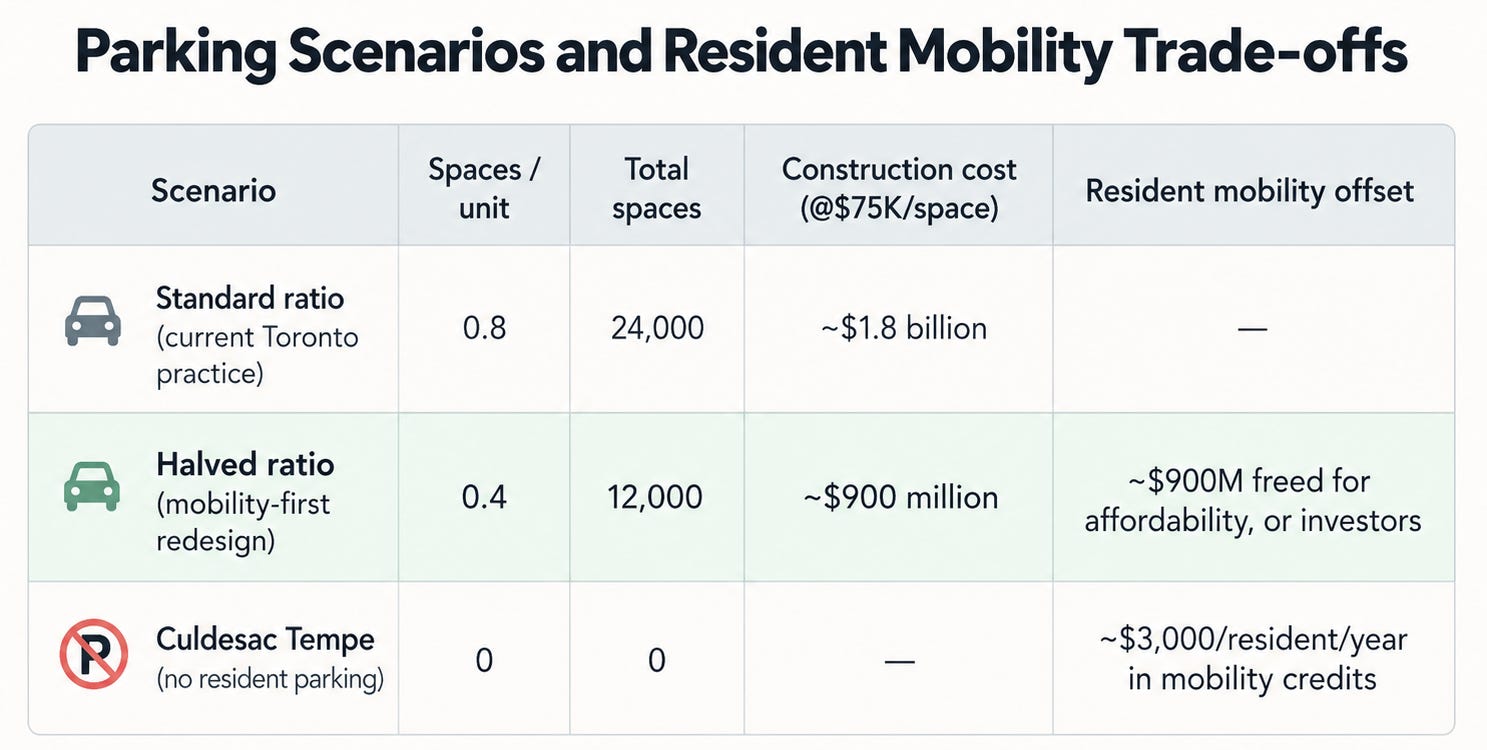
Chart data by author, chart presentation by ChatGPT
Cut that ratio in half across the project—which a well-designed, mobility-first neighbourhood should be able to do without stranding anyone—and YZD would save roughly $900 million at today’s construction costs, spread across thirty years of building. Much more than a rounding error, that money can go to transit subsidies, a shared vehicle fleet, the parks and cultural space YZD has already promised, and, not incidentally, back to the pension funds that have put their capital behind this project. Any of those outcomes is better than 12,000 more concrete spaces standing empty in the 2040s and beyond. Underground parking, unlike almost any other square footage in a building, has a diminished second life once the cars stop coming.
There is a precedent for handing this kind of saving to residents. Culdesac Tempe, in Arizona, built its first neighbourhood with no resident parking at all, and instead gives every Founding Resident roughly $3,000 a year in mobility credit—transit passes, ride-hailing, bike and scooter access—funded in part by what the development didn’t spend pouring underground concrete. YZD does not need to go that far to make the same point. A community that asks residents to agree not to store a personal vehicle on-site, in exchange for an excellent mobility package and a price tag that reflects real construction savings, while providing a parking area at the edge of the site for the family road trip or move-in day, is not a deprivation. For a meaningful slice of the market, it is the central appeal.
The Culdesac model works partly because it has a single vertically-integrated operator who can make and keep that bargain over time. Northcrest is in a different position: it is selling and leasing homes across seven neighbourhoods to different builders and residents over thirty years, which means the mobility commitment needs a governance structure that outlasts any individual transaction. A Transportation Management Association—a body that pools contributions from residents, employers, and possibly the developer, to fund and coordinate mobility services—is the common instrument for this situation, deployed in comparable projects in the Netherlands and elsewhere. It does not require provincial legislation or a new city bylaw; it can be created by covenant, written into the conditions of sale and the condominium declarations from the outset, and governed by the community itself. The Merwede district in Utrecht has adopted a version of this approach. Northcrest would be wise to name its equivalent early, before the first units close, while it controls all the land.
I’d guess there are easily 30,000 GTA households who would prefer to live and raise a family somewhere without a street full of parked cars and a driveway to maintain. Several people on my YZD tour described exactly that household.
Tempe, Utrecht, Toronto
Culdesac Tempe settled whether people would choose to live this way, with a real neighbourhood, over a thousand residents, and zero resident parking. Utrecht is now testing it at the next order of magnitude. Merwede, under construction along the Merwedekanaal, will house about 12,000 people in 6,000 homes, with car ownership permitted but rationed to one parking space for every four households, kept at the district’s edge and shared rather than parked at the door. Culdesac proved the appetite; Merwede is proving the scale.
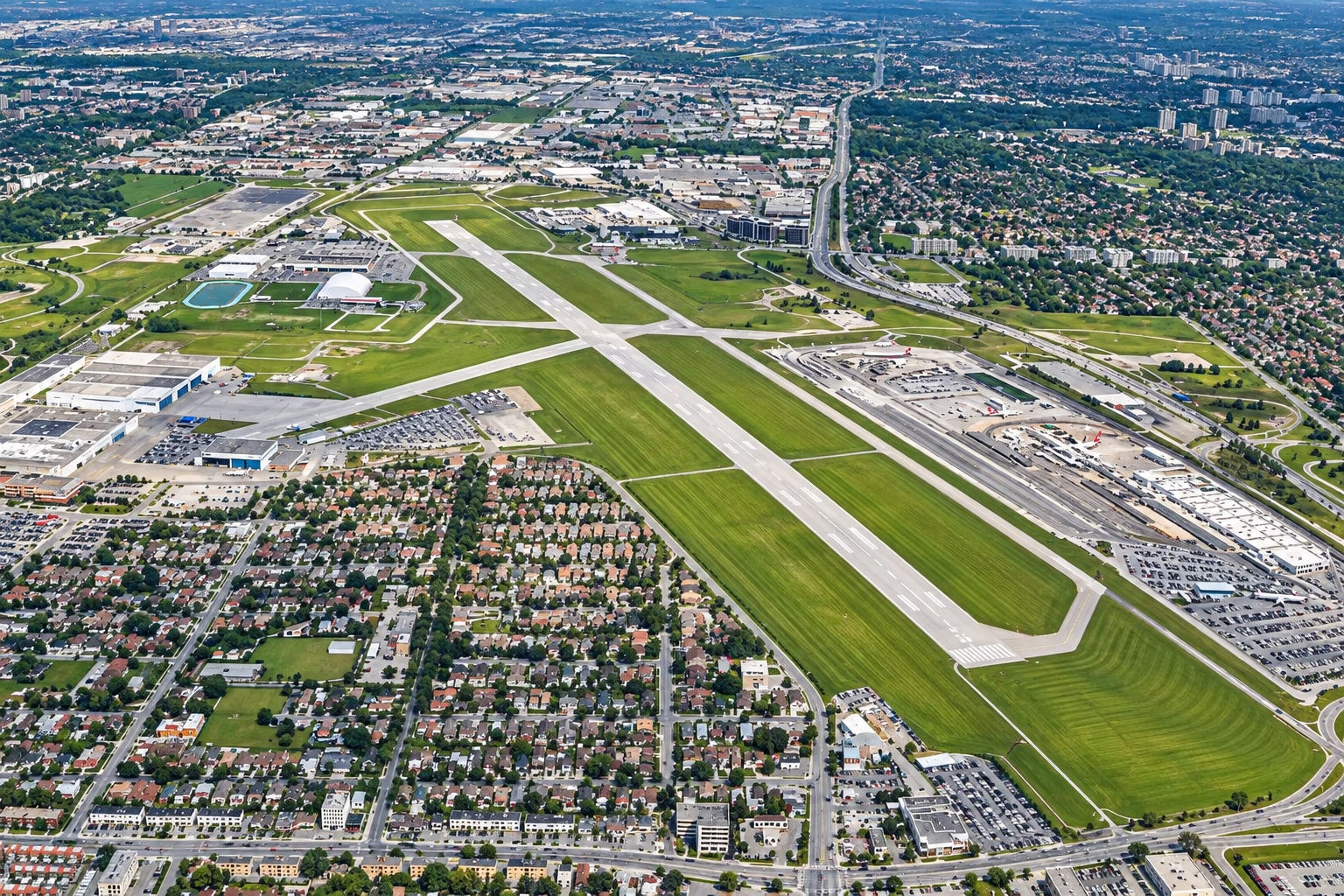
ChatGPT’s depiction of YZD from above
YZD, at full build-out, would test whether this works at the scale of a small city: 30,000 homes and fifty-five to sixty thousand residents, built into one of the most expensive and most car-saturated metropolitan regions in North America. “Car-free” is the wrong term for what all three projects share: cars remain available, taxis circulate, shared vehicles are reserved and returned. The right term is freedom from car ownership: the elimination of the household vehicle as a requirement of daily life. That is the commitment that scales across Tempe, Utrecht, and YZD, and it is a more durable one than banning cars, because it relies on making alternatives better rather than making driving harder. Each step in that progression has had a fresh decade of mobility tools to draw on that the previous one didn’t: ride-hailing was a decade old when Culdesac broke ground; shared and automated fleets barely existed when Merwede was planned; by the time YZD’s later neighbourhoods rise in the late 2030s and 2040s, mature robotaxi service in this region is a reliable bet. Toronto didn’t engineer this alignment of site, scale, and timing, but it has been handed all three at once, and that doesn’t happen often. I’d like to see the city make the most of it. If YZD reaches its full population and a community of that size—fifty-five to sixty thousand people—anywhere else in North America still has lower household car ownership, I’ll be surprised, and disappointed.
None of this is a criticism of what Northcrest has envisioned. The fact that YZD’s public-facing vision shows no cars at all suggests the instinct is already there; what’s left is to let the engineering and the pro forma catch up to the rendering. Few developers anywhere have the combination of site scale, patient capital, and a thirty-year runway that would let them pursue such a car-light identity as a deliberate market position. Northcrest is unusually well placed to prove that a major North American city can do this at scale, rather than in a thousand-resident pilot in the Arizona desert, or a six-thousand-home district in the Netherlands.
A few smaller things from the tour stuck with me, and they show how much opportunity this project has in reserve. The site sits exposed enough, on what used to be open airfield, that it catches a steady wind. The tour guide mentioned it almost in passing, but it struck me as a real and underused asset for a project thinking in decades. Even modest on-site wind generation, sited at the edges where it wouldn’t compete with building form, could offset a meaningful share of the development’s energy demand.
I’d also like to see Northcrest consider vertical farming at the margins of the site. Controlled-environment growing of leafy greens, herbs, and berries is well suited to dense, enclosed urban settings, partly because it keeps the growing environment sealed off from outdoor contaminants and weather. It could trim the food-mile footprint of 55,000 new residents while doubling as a visible, tangible piece of YZD’s sustainability story.
And then there is the small apiary already on site: every guest on my tour went home with a little jar of YZD honey. It’s a tiny gesture, but an effective one.
The argument we made in The End of Driving is that cities do not need to wait for robotaxis to start building neighbourhoods that don’t depend on the car. The tools exist today: transit, bikes, ride-hailing, delivery robots, and a willingness to design streets for people first. Robotaxis, as they arrive at real scale, will make car-light or car-zero living easier, but they will accelerate a transition that does not depend on them. YZD has the rare advantage of starting from an empty runway rather than retrofitting an existing neighbourhood, and its first phase is only now coming out of the ground. That is when decisions about parking ratios, mobility platforms, and what a household is implicitly promised when it moves in get made, and when they are cheapest to make well. Toronto won’t get many 370-acre second chances, and I hope Northcrest makes the most of this one.
Bern Grush is a persistent believer that we can build cities more for people and less for vehicles. He founded the non-profit Urban Robotics Foundation and drafted an ISO standard to address the robotaxi industry’s Achilles heel, by standardizing pickup and drop-off orchestration.
