


Before we begin: due to circumstances beyond my control, the next Changing Lanes Live with Aurora’s Chief Safety Officer, Nat Beuse, is being postponed till September. I’ll provide more details closer to the event.
Are data centres bad? Should Ontarians prevent them from being built here?
The question is pressing. In Mississauga, Prologis has filed the city’s first application for a hyperscale data centre; if you click through that link, you’ll find the headline of the newspaper report opens with “Shut It Down”. On 29 July, the week following original publication of this issue of Changing Lanes, City Council will vote on whether to impose a one-year pause on new data-centre applications, with at least half of councillors reportedly onside. In Hamilton, a proposal for the former Stelco lands moved City Council there to consider a moratorium on new data centres. That would have been a first for a Canadian city, had it passed. It did not, with Council voting it down on 15 July, 10 to 6. That same week, just to Ontario’s south, New York became the first American state to freeze new hyperscale permits altogether. Everyone is deciding at once, but there’s no emerging consensus.
At least some of my friends and family have already made up their minds. They’ve decided that data centres are bad neighbours. They take in too much water, using up some and polluting the rest. They jack up electricity bills (what Ontarians call hydro), while employing almost nobody. Some people I like and some I love sincerely hold this view, as do many people I don’t know. When Abacus Data, the polling firm, asked Canadians whether they would welcome a data centre in their own community, only 16 per cent said yes.1
I’ve read my Andy Masley (constant readers of Changing Lanes will remember his framework from “Robotaxis Are the New Data Centres”), so I had my priors that data centres were a mitigated good. Still, this is happening where I live, and people I respect have opposite intuitions. So I have set out to answer the question: who is right? What should a reasonable person in Ontario, watching the AI build-out arrive on the Lake Ontario shoreline, want to happen?
Normally in my Changing Lanes pieces I give the verdict up front, but this time I’m going to resist. I want to take the objections seriously and follow the evidence where I think it leads. I hope that by following along, you’ll see the conclusion is reached honestly, and therefore take it seriously.
Begin with a definition of what we’re talking about. A data centre is a warehouse of computers; indeed, it’s reasonable to think of it as a giant computer, just like a desktop machine, but at the scale of a building rather than a tower case. It has rack upon rack of servers. These store data and run computations, providing support to everything that happens ‘in the cloud’. Historically that has meant providing the engine that runs Internet powerhouses like Gmail or Microsoft Office 365, but also any humble firm offering a mobile app that uses remote data. By some counts there are as many as 108 data centres operating along Lake Ontario. Things are changing, though: the AI boom needs vast amounts of the ‘compute’ that data centres provide, meaning that they are a bigger business than ever. Accordingly, Microsoft is expanding its footprint in Vaughan and across the GTA, and more centres from more firms will follow.
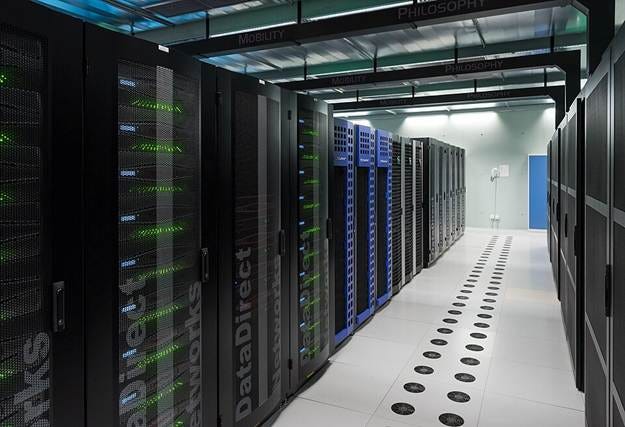
High Performance Computing Center Stuttgart HLRS 2015 07 Cray XC40 Hazel Hen IO.jpg by Julian Herzog is licensed under CC BY 4.0.

Once built, a data centre needs two things. It needs abundant electricity, ideally sustainably generated, because the servers are always on. And it needs cooling, because nearly every watt of electricity that enters a chip leaves it as heat, and if that heat is not removed promptly, the chips fail. Cooling can be accomplished with electricity—think the fans installed inside your desktop machine—but at the data-centre scale, it’s also done with water. Ontario is unusually fortunate in these regards, with Great Lakes water, cold winters, and one of the cleanest power grids on the continent. That’s why data-centre operators are keen to build them here.
Let’s see if we should let them.
Water Fears Are Overblown…
Let’s start with water. There are two claims here: that data centres will poison the water, and that they will use it up.
Poisoning the water, or (to put it more precisely and less emotionally) contaminating it, essentially does not happen during normal operation. Some data centres cool themselves with closed-loop systems, meaning cold water is run through pipes in the building, absorbing heat, which is later released outside. The circulating water sits in a sealed loop and is reused continuously, topped up only to make good small losses. It only touches pipework, and never the servers nor the outside air. This delicate use of water is in sharp contrast to other Ontario industrial sectors, like paper or metal. Unlike a pulp mill, there is no process effluent to speak of. Unlike a mine or ore refinery, there is no tailings pond.2
Using up the water, or (to put it more precisely and less emotionally) consuming it, is a stronger charge. Many data centres, rather than using closed-loop systems, cool evaporatively. In these cases, the servers heat the air around them, and this heated air is channelled over water. That water evaporates, taking the heat with it.
Whether this is a problem depends on where that water came from. If it’s drawn from an aquifer, on any human timeframe that water is lost forever. If it’s drawn from a river, it might permanently exit the watershed; if the water is taken from the river far enough upstream, that water will never reach the downstream system. If that is practiced at scale in suboptimal places, the water loss is real, and enormous. In Mesa, Arizona, for example, a single campus holds standing permission to ramp from one million to four million gallons a day, half of it drawn from the Colorado River. That is a genuine loss, because the Colorado is a closed, badly over-allocated basin. Water evaporated off a cooling tower there leaves as vapour that rains out far downwind, never returning to the watershed in any usable quantity.
But southern Ontario lies almost entirely within the Great Lakes–St. Lawrence basin. Here, evaporative draw offers a negligible chance of watershed loss; water taken from the watershed evaporates into the air and returns, via the water cycle, to that watershed. So nothing is consumed.
Well, almost nothing. The international compact governing the lakes will formally count evaporative cooling as a loss, since some negligible vapour rains out beyond the basin. But the quantities at stake are minute against the scale of the lakes, which hold roughly a fifth of the world’s surface fresh water. No array of evaporative-cooling data centres we can realistically contemplate would amount to more than a rounding error.
That is stipulating that such an array would be constructed. That’s unlikely. Evaporative cooling is a design choice, and architects choose it for data centres to be built where the air is hot and dry. Ontario has many virtues, but a hot and dry climate is not one of them. Across autumn, winter, and spring, southern Ontario’s daily mean temperature sits well below the mark (roughly 18°C) at which outside air alone can cool a data centre. In particular, Toronto’s seasonal means run from about −2°C in winter to 8°C in spring. This means that the province can cool without water through something like three-quarters of the year. In warmer months, the lakes remain cold, and data centres take advantage. Equinix, the world’s largest data-centre operator, cools its downtown Toronto facility from Enwave’s deep-lake loop, which pulls near-freezing water off the bottom of Lake Ontario. Meanwhile, Microsoft says its Ontario sites draw municipal water for cooling only when temperatures exceed about 29°C. That happens for less than five per cent of the year.
There are many horror stories about data-centre water consumption, but they all happen in arid regions. Even there, the stories lack any sense of proportion. Maricopa County, Arizona, one of the biggest data-centre markets on the continent, expected its data centres to use about a billion gallons of water in 2025. That seems bad… until one learns that the county’s golf courses were expected to use twenty-nine billion. By the same token, if Ontario is concerned about wasting water, rather than get concerned about what data centres may do, we should look instead to the ways we use water now. Concern on that front is conspicuous by its absence.
Is there anything critical to say about water and data centres in an Ontario context? Only that our systems need good data to make good decisions. There was a mild flap when it was found that one Quebec facility had no water meter at all. We can’t audit what we don’t measure, so even though Ontario’s climate makes heavy water use unnecessary, let’s meter every facility, including those buying city water, which today’s permit rules don’t reach. Let’s publish the readings, tracking against a cap on use, which we should write into the servicing agreement. Developers have historically fought disclosure, but I would expect that they won’t fight hard in an Ontario context, because they know just how little water they will use.
…Electrical Fears Are Not
In contrast to concerns about water, concerns about hydro (which, confusingly, is how Ontarians refer to commercial electricity) are real. Data centre electrical loads can be staggering. A single centre, if large enough, can draw as much power as a mid-sized city. The hyperscale campuses now being contemplated are designed for anywhere from 300 megawatts to a full gigawatt of continuous load. For context, a gigawatt is roughly the output of one of Darlington's nuclear reactors, or enough to power some 800,000 homes.
Demand on this scale is not hypothetical. As of this month, data-centre projects totalling some 7,000 megawatts have active requests to connect to Ontario’s grid. Ontario’s electric operator, the IESO, now expects data centres to make up 8.6 per cent of Ontario demand in 2050, more than half again what it forecast a year ago.
Adding this much demand to a neighbourhood can create two problems for everyone else: it can raise the price of electricity, and it can require the addition of expensive new infrastructure. In the abstract, this might be a problem; but in Ontario, there are rules in place that mean the power costs of a data centre aren’t socialized.
Let’s start with prices. The data centre pays for what it uses, just like any other large industrial customer. Believe it or not, that can be good. A quirk of Ontario’s system, thanks to its nuclear plants delivering high baseload power, has meant that during some nights Ontario has surplus power it has had to sell at a loss. Always-on data centres can soak up that capacity, meaning the system’s fixed costs get spread across more electricity sales. But of course, during some peak periods, Ontario does not have enough power. In those hours the marginal generator is a natural-gas plant, meaning that a data centre running flat out through a July heat wave is (at one remove) burning natural gas. More gas hours mean more emissions and higher market prices, and both land on everyone.
The fix is giving us the right to interrupt the flow to big data centres if we need to. Texas and Alberta already do this, connecting them faster in exchange for curtailment during the tightest hours of the year. A data centre that we can throttle back for the fifty worst hours costs the system little; if they don’t want to be throttled, they should simply be required to pay for the peaker they make us run.
Ontario seems to be on its way to this requirement already. Bill 40, passed in December, lets the province decide which very large loads serve its economic interests and may connect to the grid, and the IESO published draft technical requirements for large computational loads in May. The pieces of a sensible large-load regime are on the table; the one that is missing is the public’s ability to throttle data centres’ electrical use if necessary.
Of course, the centres may very well choose to throttle themselves. Ontario’s power system has a bizarre feature where it computes everyone’s share of the system’s fixed costs (the ‘global adjustment’) by tracking their usage during the five heaviest hours of the year. There is a whole system of consultants that advise clients on how to anticipate those hours, throttle back use during them, and thus shift their costs onto someone else. (How do I know this? Don’t ask.) Data centres, with batteries and flexible workloads, would be excellent players of that game. That, more than anything, is why Ontario should refine the global-adjustment system, and more than that, designate a new rate class for very large consumers, to discourage this kind of game-playing.
On the question of infrastructure, there is good news: in Ontario, a data centre that requires extension of the local grid cannot just hand that bill to the public. The utility estimates what the new wires, transformers and substations will cost, compares that with the revenue it expects to collect from the customer, and can require the developer to pay the shortfall. It can also demand a deposit, retaining it if the promised demand never appears.
So if a new substation exists only to connect the data centre, the centre will largely pay for it. The weaker point is farther upstream. If the project requires reinforcement of the shared transmission network, that work may be rolled into the regulated cost of the provincial grid. Sometimes that is reasonable: a larger line may benefit an entire growing region. But if a billion-dollar upgrade is needed principally for one enormous customer, spreading the cost across everyone’s hydro bills would amount to a public subsidy.
So what we see is that there are reasonable concerns to be had about data centres and electricity. A new data centre will not automatically raise its neighbours’ bills, and Ontario protects ratepayers from much of the cost of connecting it. The danger is that enough centres might spike the cost of dirty peaking power in the near term, and in the longer term might require big investments in new generation and transmission infrastructure.
In my view, those are investments that Ontario should be making anyway. We should be building clean generation, at scale, now; and we should be doing that irrespective of how many data centres are knocking at the door.
As Jonathan English has pointed out, Ontario is one of the few jurisdictions in the world right now that knows how to build nuclear on time and on budget. We should be building more of it while our expertise is current (a case that Eric Lombardi made in these pages last month). At the same time, we should be supplementing with wind and solar, which are cheap and fast to add (thanks, China!). Building more capacity now is sensible; even if no data centre ever came to Ontario, electric vehicles have already arrived, and more are coming. The province’s ambitions in battery manufacturing, rare-earth processing, and other 21st-century industry will all rest on cheap, green power. Let’s build for that, and let data centres come along for the ride.
Other Concerns Are Modest
Beyond water and electricity, the remaining objections to data centres are mild and resolvable.
Large data centres hum. They emit a continuous, low-frequency drone from thousands of cooling fans, joined intermittently by the roar of backup generators on their test runs. The hum is a by-product of active cooling, so a small or fully liquid-cooled facility can be nearly silent; the sites that draw complaints are the big, air-cooled ones. These emissions can be measured; monitors at homes near American facilities have recorded outputs of 40 to 59 decibels. In the abstract, that range runs from ‘quiet library’ to ‘a window air conditioner’. Residents near facilities in Virginia have described it as ‘a jet engine that never turns off,’ with some sealing their windows or sleeping in earplugs. Those accounts warrant some amount of skepticism, since neighbours fighting a project have every reason to dramatize, but we shouldn’t dismiss them.
Here Ontario holds a lever most American jurisdictions lack. NPC-300, the province’s environmental noise guideline, does two useful things: it sets numeric limits at the property line (40 decibels at night in rural areas), and it requires a noise study before approval. In much of the United States, neighbours discover the hum first and go looking for a remedy second, but in Ontario, the remedy can be written into the permit before construction.
It’s true that NPC-300’s limits are tuned more-or-less to the midrange frequencies that human hearing notices most (the technical term is A-weighted). That standard can undercount low-frequency tonal drone, which is harder to notice consciously but can be subconsciously unsettling. Fortunately, Ontario’s noise rules already penalize tonal sound, adding five decibels to the measured level of a steady hum. The real gap is procedural: smaller facilities can self-register without a full study. For a hyperscale site, the province should insist on the full noise assessment for each one.
Another complaint we often hear is that for all their costs, data centres contribute nothing to the communities that host them. That’s true, I suppose, if we count contributions as jobs. A large campus needs few people, on the order of 20 to 30 permanent staff per 100 megawatts of capacity. While it takes thousands of jobs to construct them, maintaining them doesn’t require very many people.
But if we count contributions as property tax, it’s a different story. Exhibit A here is Loudoun County, Virginia, the densest data-centre cluster on earth, where the industry supplies 38 per cent of the county’s general fund from four per cent of its commercial land. Sadly that example is not applicable to Ontario. Loudoun taxes the servers themselves, reassessed as the equipment refreshes. Loudoun levies a business tangible personal property tax on the computer equipment itself, and a hyperscale building refreshes tens of thousands of servers on a rolling cycle, each round taxable. Ontario municipalities don’t do this. Instead they tax the land and the building, and the building is, for assessment purposes, a warehouse. Still, while no fountain of cash like in Virginia, data centres do employ people and pay taxes, meaning a city is better off having them than not.
So a data centre is a quiet, low-traffic, low-employment industrial site. That’s faint praise, but it has an upside, which is that the small scope of gain means that Ontario communities have standing to bargain hard on what they get out of permitting them.
What a Reasonable Ontarian Should Want
But if the gains are so modest, why permit them at all?
Part of it is that refusing permission doesn’t mean they’re not built, it just means they’re built elsewhere. Projects turned away in the United States have flowed toward Texas and Arizona: thirstier places, on dirtier grids. So the blocking places remain free of them, at a net cost to the environment. Similar dynamics are playing out in Canada: Quebec, rich in water and clean power, has capped new data-centre power as a matter of policy, and British Columbia has done much the same. Alberta, with the dirtiest grid of the three and constant stress on its water supply, is where the overwhelming majority of Canada’s proposed capacity has piled up, some of it as off-grid gas megaprojects. Refusal in a clean-grid province is, in practice, an invitation to a dirty-grid one.
Another part, strange to report, is the company that refusal keeps. The New York Times reported this month that state-linked accounts from China, Russia, and Iran have been flooding social media with AI-generated slop warning that data centres will drain the water and wreck the grid. American officials read the campaign as an effort to fan public opposition and slow the West’s AI build-out. That does not make my worried friends and neighbours into foreign dupes, since the West’s enemies are inflaming sincere grievances rather than inventing them, and it is those sincere grievances I’m trying to address here. But when our adversaries spend covert effort discouraging us from building something, they are telling us that they think it’s valuable.3
In my view, Ontario should host as many data centres as its clean supply can carry, because the objections are weak. Water is immaterial, noise can be regulated easily, and power capacity is something we should be building anyway.
What should a reasonable Ontarian seek in return for permitting data centres to be built here? Three things:
Meter the water, publish the readings, and cap the draw in the permit.
Require a full, tonal-aware noise study and provincial approval, including penalties for exceeding noise limits, in advance.
Make developers pay for their own connections, including a fair share of upstream transmission, give very large loads their own rate class, and connect the biggest loads on interruptible terms.
Meanwhile, Ontario should be building clean power generation: renewables immediately, the nuclear Ontario has shown it can deliver, and the transmission lines to carry it where we need it. Those are unambiguous goods even if no data centre ever connects to them.
The citizen’s answer to a data centre shouldn’t be no. It should be yes, with conditions.
That is, 16 per cent of Canadians would welcome a data centre in their own community. Regarding data centres in general, judgment is nearly even: about 38 per cent think they are good for Canada, against 37 per cent bad. Data centres for thee, but not for me.
There is one contamination episode that I know of, from earlier this year in Cheyenne, Wyoming. A rare bacterium appeared in the reclaimed-water system there, which was traced to a Meta data centre; but the pathogen entered during the one-time ‘fill-and-flush’ that cleans a new cooling system before start-up, not during operation, and it never reached drinking water.
It’s good to remember that our enemies propagandizing us to do something is a strong but not overriding data point. If it was overriding, any adversary who knew we reasoned this way could manipulate us by campaigning covertly against whatever it hoped we would do. This signal deserves weight when, as here, it points the same way as the object-level evidence.
I wish everyone in Ontario would read this. I fear we are becoming (even more) the Land of No.