


A quick personal note: I have some big announcements to make that will be of interest to readers of Changing Lanes. I had hoped they would be ready to serve today, but they need a few more days to cool. Expect a special edition on Thursday, 24 September with some exciting news to share!
Hey, kids! Here is a research experiment you can do!
Open X (get your parents’ permission first), type packed or crowded into the search box, then add weekend, and the name of any large North American transit agency. Set the date filter to this past summer.
If you do, you will find entries like these:
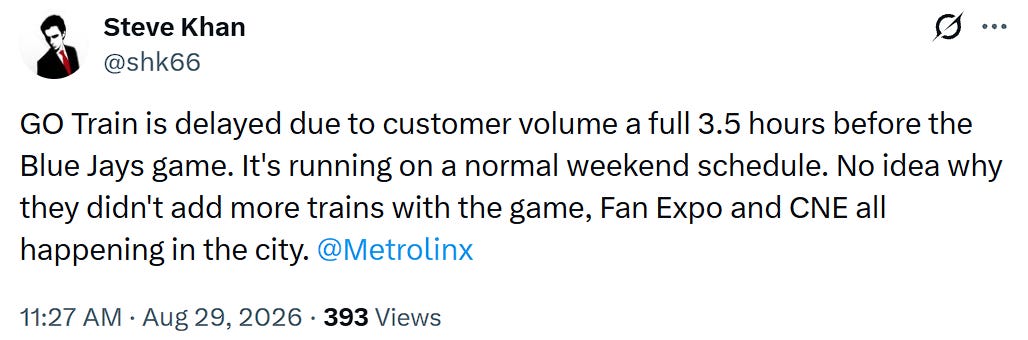
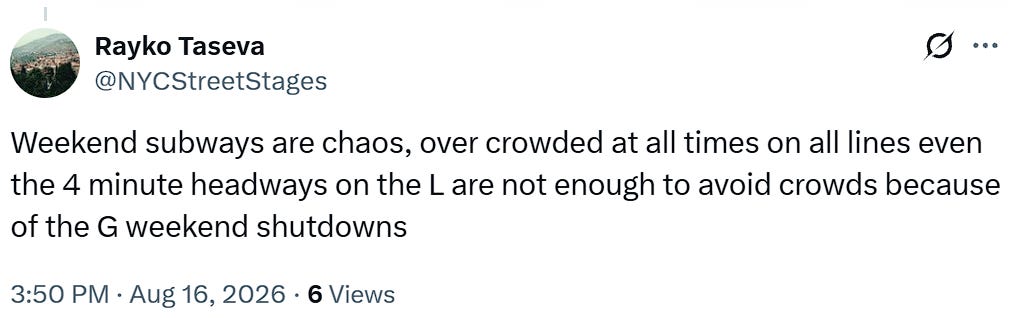
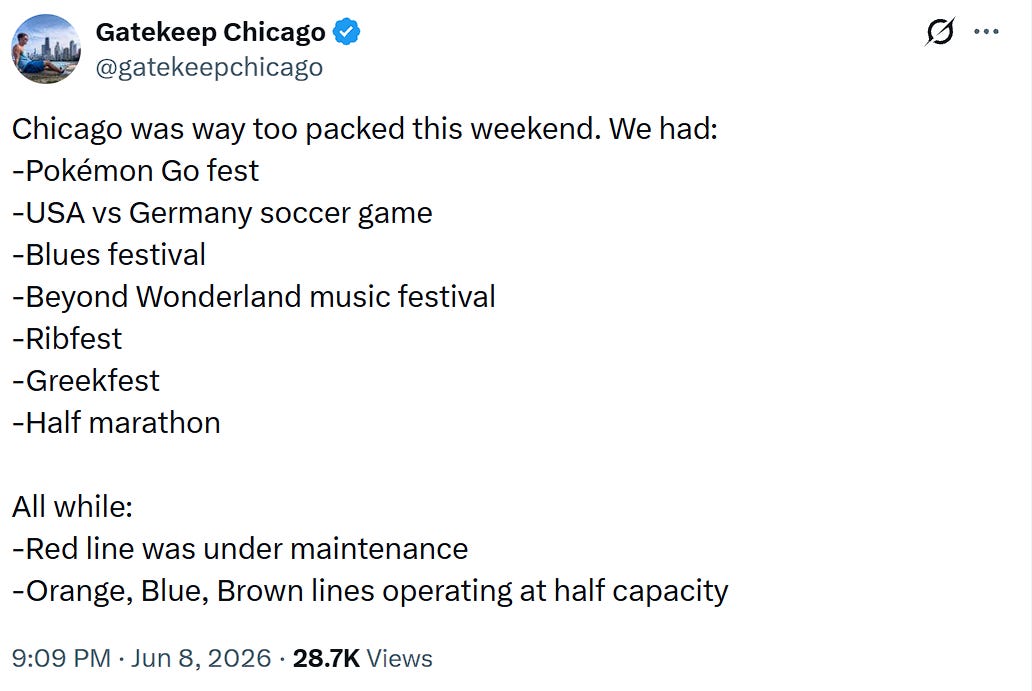
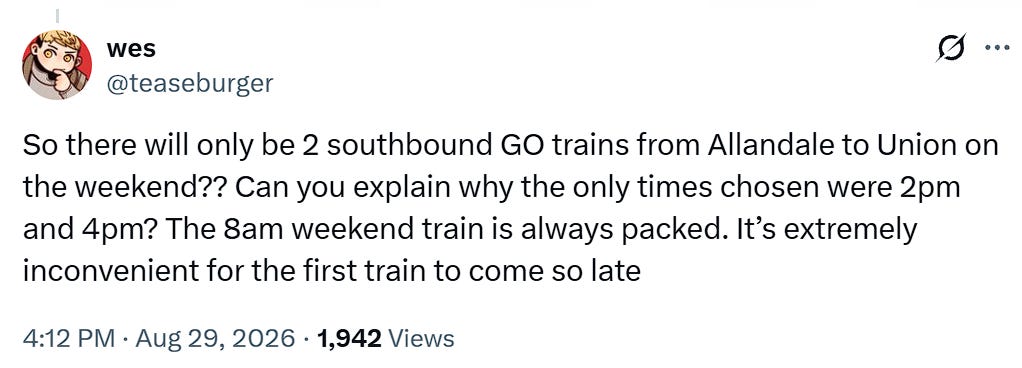
The pattern among these is clear. It’s a Saturday and there’s a special event downtown: a sporting match, music festival, convention, or expo. The poster is complaining about a train that’s too crowded to board and much too crowded to enjoy.
Let’s set aside the fact that X is where malcontents go to complain about things. (In that spirit: you can follow me on X here.) And let’s acknowledge that the plural of anecdote is not data. Having made those stipulations, is there anything to learn here?
I think there is. Notice that nobody is complaining that the train is full. They are instead complaining that the train is full and the agency is running the weekend schedule anyway. The two Toronto grievances are about “a normal weekend schedule”, the first one about doing this before the baseball game. The New Yorker concedes that four-minute headways on the L train, a frequency unheard of in most of North America, are not enough on a Saturday. The Chicagoan is angry that the city is chock-a-block with special events, and the CTA meets that demand with maintenance service and diminished capacity.
What this amounts to is that across North America, transit agencies are running their schedules to protect the weekday commuter peak, at the expense of weekend use.
That’s noteworthy for two reasons. Firstly, it’s strange, because that commuter peak is dying while weekend use is surging. And secondly, it’s paradoxical, because the ebbing of the weekday peak and surging of weekend use is actually a good thing. Indeed, it’s the best thing to happen to transit in this generation, and operators are failing to capitalize on the opportunity.
Weekends up, weekdays down
Because anecdotes aren’t data, let’s begin with evidence.
For nearly every major transit system in North America, the part of its service that has recovered fastest from the pandemic is not the weekday peak, but the off-peak: the weekend, and weekday middays and evenings. In several systems weekend ridership has blown past where it sat in 2019, while the morning and afternoon commuter peaks still lag.
Look at New York, where through 2025, weekend subway ridership reached 89% of its 2019 level while the weekday sat at 74%. New York ridership, the highest in North America, is growing again, thanks in large part to the Manhattan congestion charge… and fastest on weekends.
Look at Toronto, home to GO Transit. GO began the pandemic as a railway built around the office commute, with only 39% of its riders travelling off-peak. In May of this year Metrolinx restored 15-minute weekend service between Union and Oakville. That lasted four months: this September the weekend went back to half-hourly, because the railway could not crew it. It kept its weekday peak periods as they were.
Look at Boston, where the MBTA’s commuter rail is the only legacy network of its kind in the United States to have come close to its pre-pandemic ridership. And how did it achieve that feat? By rebuilding its timetable around hourly, all-day, two-way service and a ten-dollar weekend pass. Roughly half its riders now travel for something other than their jobs.
Finally, look at the Bay Area. Across the fiscal year that ended in June, a year in which World Cup matches and watch parties put more than 38,000 riders onto Caltrain, system ridership rose from 64% to 82% of pre-pandemic levels. That increase was helped along by weekend ridership, which increased to 150% of those levels.
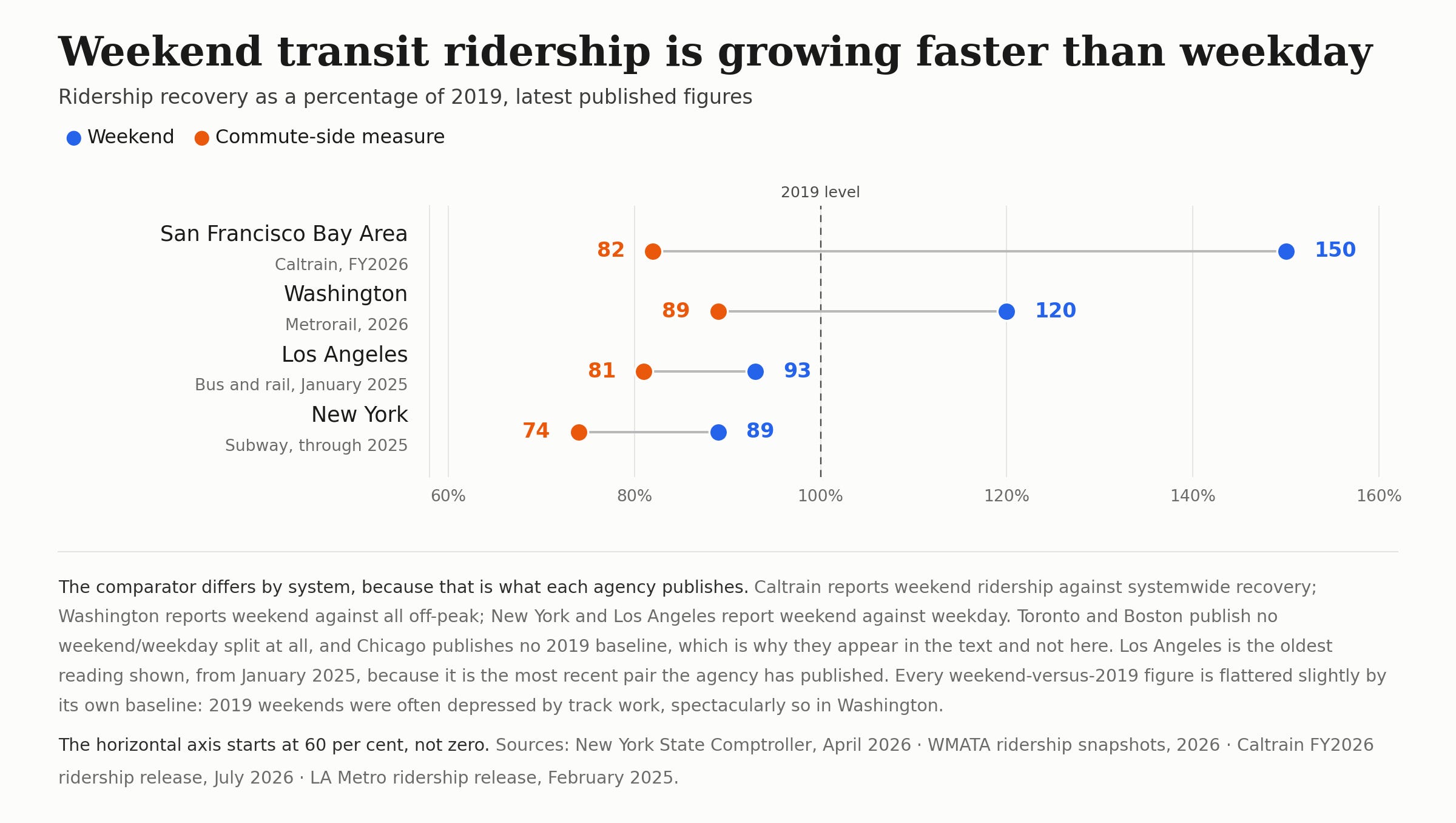
Caltrain reports weekend ridership against systemwide recovery. Washington reports weekend against all off-peak. New York and Los Angeles report weekend against weekday (LA figures from January 2025). Some cities I would like to show are absent; Toronto and Boston publish no weekend/weekday split at all, while Chicago publishes no 2019 baseline. To avoid misleading through charts, I must note that the horizontal axis starts at 60%, not zero. Chart courtesy of Claude.
Given this much evidence, the conclusion is clear. North America’s transit systems are not undergoing a slow post-pandemic recovery that will, eventually, get them back to the ridership numbers and patterns they had in 2019. Instead, they have structurally changed: the passenger these systems are gaining looks more like a weekend user going for entertainment, not a weekday passenger commuting to work.
No, the peak isn’t rebuilding itself
If I were prosecuting this case in court, I’d expect defence counsel to argue that, to the contrary, the pandemic recovery is still happening. That recovery happened on weekends first, and it’s happening in the workday peak periods as well, just more slowly than anyone anticipated. Return to office mandates have been slow to come, but they’re coming, and eventually will be everywhere. And return to office means return to the weekday peaks.
The best evidence for the counterargument is that peak ridership is indeed growing in absolute terms almost everywhere. That means that, given time, ridership will rise to its old levels. Exhibit A here would be Washington, D.C. On his first day in office in January 2025, President Trump ordered federal employees back to their desks full time. As a result, weekday Metrorail ridership jumped about 20% year-over-year in the strongest months.
As the prosecuting attorney, I’d invite you to look at that evidence more carefully. Washington is an exceptional case in that its economy is dominated by one employer, whose staff dominate the morning commute. We must grant that ordering them all back did have a big effect on WMATA’s ridership.
But then consider Ottawa. It’s even more of a company town than Washington: public administration accounted for 21% of its labour force at the 2021 census, against about 13% across the Washington metropolitan area. The Canadian government ordered its staff back four days a week this July, but OC Transpo’s ridership still ran below the previous year’s in each of the first seven months of 2026, at 67% of pre-pandemic levels. Against this, OC Transpo’s weekend bus ridership was already above its 2019 level by 2022.
So with capital cities, the evidence is mixed, which isn’t good for ‘the peak is rebuilding itself’ argument. But let’s set this reference class aside, since places like that are unusual. In other cities, where hundreds or thousands of employers make up the local economy, there is no one lever to pull to bring workers back to the office. And the fact of competition means that employees can vote with their feet against return-to-office mandates. And they have: from early 2024 to mid-2025 the companies increased the time they required employees to spend in the office by 12%... but the time that employees spent in the office increased by only 3%. The Survey of Working Arrangements and Attitudes, which has measured this every month since 2020, put work from home at 26% of all paid days in May of this year, down only slightly from 28% three years earlier, notwithstanding all the intervening mandates.
So return to office won’t bring the 2019 peak back.
The peak was bad and it should feel bad
Let me be clear: that’s a good thing.
Serving the weekday peak is a pain for operators, and working around the problems it causes shapes everything an operator does. That’s because peak demand arrives all at once, and it’s going in only one direction. There is massive demand inbound in the mornings, while almost none outbound, but outbound trains must run out, so they can run inbound again. The same pattern runs in reverse in the late afternoons. To satisfy this pattern, agencies must own enough vehicles, and roster enough operators, despite the fact it needs them all only for those few hours. The equipment and people are idled between the peaks, through the middle of the day, meaning that assets are unused, earning no revenue.
It’s a heavy burden to carry. Alon Levy has run the numbers: a railway gets roughly a thousand hours of peak operation in a year against some 5,800 hours of daytime and evening running. That means that a car bought to serve the peak costs about five times as much per car-kilometre as the same car bought to serve the base. Counting crew and infrastructure alongside the vehicles, Levy puts peak service at around three times the cost of base service.1
Conversely, spreading demand throughout the weekdays, and seeing more of it on the weekends, is cheaper and easier to serve, spreading riders across the hours that the system must pay for in any case. Since transit’s fixed costs are high and its variable costs are low, most of what a trip costs is spent on the first rider, and every rider after that brings in gain. What that means is, a crowded Saturday train is good news for an operator.
That means that all those complaints on X amount to an operator seeing money lying on the platform floor, but deciding not to pick it up because bending over would be uncomfortable.
Takomabibelot, Empty Platform (New York, NY) [resized]. 16 Jan 2011. Flickr.
Part of operator discomfort in this regard is that this new shape of demand doesn’t bring in the revenue the old shape did. Most systems are not back to total ridership exceeding 2019 totals, because five-day-a-week commuters were steady users, while recreational travellers are more occasional. That means that operational arrangements built on the foundation of the old demand pattern may not be sustainable. Caltrain, for instance, projects an average annual deficit of $75 million from fiscal 2028 and can’t sustain operations on the fares that it charges. Agencies that organized their service around serving the peak, letting the peak determine their timetables, fare products, budgets, and labour arrangements, now find themselves in a different world.
My wish is that rather than simply treating this as another problem that must be solved with higher subsidy—another manifestation of the Endless Emergency—that agencies try something different: recognize that the old world isn’t coming back, and reorganize accordingly.
Not too late to build a better world
The first place to reorganize is with track work.
Historically, the reason agencies did the bulk of their track work on the weekends was that doing the work must begin and end with the lengthy process of moving equipment on and off of the right-of-way. WMATA’s own figures show that, once that process is accounted for, a weekend shutdown can offer up to 48.5 hours of actual engagement with the project out of 56, while a weeknight shift only offers two-and-a-half out of five.
That trade-off was fine when there were few riders on the weekend to discommode. But with weekends now being the growth area, the old way of doing it will have to change. More weeknight services will be required. I am confident that there are efficiencies to be found in right-of-way equipment transfers; the weekend as the stopgap has meant in practice a lack of incentive to look for improvements. The search should commence. Flexibility in service can help too: BART projected that opening service an hour later on weekday mornings would speed up its rebuilding projects by 40%.
The next place to reorganize is timetables. Washington now runs every Metrorail line at least every twelve minutes on weekends, and the Red Line every six. Fixes like this require accommodation with labour, but if that’s what serving the customer demands, then so be it. After that comes fare products. Boston sells a ten-dollar weekend pass, and the TTC recently retired its monthly pass in favour of providing free trips after forty-seven rides in a month; both aim to serve demand where it is growing. Innovations like these should spread.
What should certainly stop happening is sacrificing weekend service when farebox shortfalls begin to bite. That is what GO has been doing lately: to protect its many track work projects, not to mention its labour arrangements, it has been acting to protect the weekday peak, because historically that has been its raison d’être. This attitude also lies at the heart of its biggest recent failure, its broken partnership with Deutsche Bahn, hired to help bring European-style, frequent, two-way service to GO: as one insider told The Trillium, many at GO think running frequent trains in both directions is “a kind of a dilution of their mandate, or an unnecessary frill.”
But the peak commuter isn’t coming back. In a work-from-home world, demand is not so jagged, and there’s more of it on the weekend. People want to ride trains then.
We should let them.
Respect to Abby ShalekBriski and Deric Tilson for feedback on earlier drafts.
Jarrett Walker finds something similar with buses. A peak-only run means paying a driver for more hours than they work, running the vehicle back empty against the flow, and sizing the garage to a demand that shows up only twice a day.