


Before we get into today’s piece, I’m pleased to let you know that my latest feature is now live in Asterisk magazine.
“Seeing Like a Sedan” examines the great philosophical divide in driving automation: Waymo’s sensor-fusion approach versus Tesla’s commitment to cameras-only. I trace the technical lineage from the DARPA Grand Challenges through to today’s Austin streetscape, where both companies now operate robotaxis perceiving the world very differently. The piece digs into the safety data, the limitations that keep surfacing in real-world conditions, and the quiet convergence now underway.
What’s at stake? Whether we want robotaxis that are as safe as human drivers or those that are better.
Read it here.
2023 was the worst year in a generation for the bike industry. There hadn’t been a boom and bust like this since the ‘70s.
2024 was worse.
Kevin McLaughlin
The bicycle industry is in crisis, but you probably haven’t heard about it. But ask the insiders, and you’ll hear about bike shops closing or downsizing, retailers absorbing losses they cannot sustain, and a glut of inventory that won’t move. The underlying condition—a COVID-induced boom-and-bust cycle now stretching into its fourth year—remains largely invisible to consumers and policymakers alike.
This matters beyond the fortunes of bike retailers. E-bikes represent one of the most promising tools for urban mobility: a mode of transport that can replace car trips, reduce emissions, and make cycling accessible to people who would never consider a traditional bike. But the industry that sells and services these machines is struggling to survive, and the policy environment that could support their adoption barely exists.
To understand what’s happening, and what it means for the future of cycling in cities, I spoke with Kevin McLaughlin. Kevin is a Canadian pioneer and leader in healthy-city ventures, spanning shared mobility, sustainable transport, and micromobility, for several decades. He is currently the founder and CEO of Zygg, a Canadian e-bike subscription and leasing service, and has previously founded or co-founded Toronto’s AutoShare car-sharing service, the Modo car coop in Vancouver, and Evergreen Canada. He has commuted by bicycle in downtown Toronto for more than 30 years.

Kevin McLaughlin
We spoke on 16 December 2025. This transcript has been edited for length and clarity.
Year Four of the Crisis
Andrew Miller: What is the crisis in the cycling industry?
Kevin McLaughlin: We’re in year three, at least, of the crisis, [which is] overproduction and oversupply created from the COVID boom. Capacity that had been serving Asian markets suddenly got turned on for North America. All of a sudden there were too many bikes.
The bike business has these intrinsic parent-child relationships between manufacturers and retailers. When we started in 2019, you had to place all your orders in October. The manufacturers push the bikes out to the stores. And then during spring and summer retail stores have their chance to sell, with end-of-season sales in the fall.
2022… that boat stuck in the Suez Canal is a good metaphor. At that point, demand was still COVID-high, massive. All these bikes were getting ready, but a lot of them showed up late that year. Instead of arriving in April, bikes were coming in August, September, October… you missed your season. You’d made these orders and were stuck with inventory. That rolled into 2023, oversupplied, and then more kept coming. It just never stopped.
2023 was the ‘worst year in a generation’ for the bike industry. There hadn’t been a boom and bust like this since the ‘70s. 2024 was worse. And 2025… there’s been no great recovery. Supply—from local bike stores, big-box retailers and now Direct-to-Consumer (DTC) online sales—continues to vastly outweigh demand and has for years. And now the sales start in the spring, not the fall.
AM: Is the pain from oversupply hitting manufacturers and retailers equally, or is one group getting hurt more?
KML: It is asymmetrical, and worse for the bike stores. Once trust is broken between manufacturers and retailers, if somebody pushes inventory down on you, you’re not going to accept that again.
One of the oldest and best bike stores in the city, Urbane, has moved from College and Spadina—where they were for maybe 15, 20 years—further west to a much smaller location. One retailer in 2023 put money back into his company for the first time, a healthy equivalent of what he would normally take out. In 2024, he put in way more still. I know retailers that started COVID with three locations and are down to one. That’s not uncommon. But big brands are suffering too, with one of the biggest e-bike companies—Rad Power—going under late last year. And every bike brand, DTC or local retailer that goes under means another batch of stock at bargain prices.
The crisis in bike retail matters because it is hindering the emergence of bike commuting and transport in our cities at scale. It’s a sad twist that the Covid-19 pandemic, which made many people realize that regular cycling as a mode of urban transport was feasible for them, is now fouling up bike retailers, deterring that same transition.
It’s particularly distressing that the crisis is hindering take-up of a technology that could make cycle commuting genuinely competitive with cars and transit: the e-bike.
E-bikes are a marvelous technology, but the tech alone isn’t enough. Readers of Changing Lanes will recognize the pattern: automated vehicles have the potential to transform urban mobility, but realizing that potential will require policy, regulation, and infrastructure to catch up with the tech. The same is true for e-bikes, and more urgently, given that e-bikes are already here and working. In the rest of our conversation, Kevin and I turn to what e-bikes can do, and what they need.
Why E-Bikes Matter
AM: For most people who don’t own an e-bike, they pattern-match to two things: food couriers cutting them off, or battery fires. What’s the case for e-bikes that they’re missing?
KML: I would say there’s another pattern—maybe not big enough—which is: my neighbour, my best friend, my bridge partner got an e-bike, and she won’t stop talking about how much she loves it.
I’ve spent essentially my whole life trying to help build businesses that offer people environmental products that they want to use, that impact the environment less than what they’re using now. E-bikes are a fucking game changer. They really are.
A car is a victim of its own success. They solve problems for us. Then we built our cities around them, and now there’s too many cars, and until now no good alternatives. But an e-bike really provides an opportunity for lots of people to make lots of trips in a way they’re happy with that they otherwise would have had to drive a car for. Too long to walk, inconvenient for transit.
I’m in my 50s. My most recent bike shop was 8km away, about a 30-minute daily bike ride. It was a straight shot on two streetcars that could take anywhere between 20 and 45 minutes, on any particular day with no advance notice. Whereas an e-bike, I could do it in 20 minutes every day. And I loved that ride. There was never a day I wished I hadn’t. With an e-bike, it could be snow on the ground, it could be raining—those are fair things to opt out on certain days. But I was never thinking ‘that hill is too big’ or ‘I don’t feel like it’ because the assist basically makes it fun.
I’ve got a lot of dad jokes from the e-bike business. One of my favourites, especially if they’re clearly in their 40s, 50s, 60s or 70s: e-bikes come in three speeds—5, 10, and 20 years younger. That’s really how it makes you feel when you get on an e-bike. All of a sudden you’re like, “Holy cats, I’m not tired.”
What E-Bikes Need to Succeed
AM: What are the infrastructure requirements to allow people to cycle? What problems do we need to solve beyond the bike itself?
KML: Thirty-plus years ago, when I was helping launch Evergreen, I’d end up in church basements talking about planting native species. There’d be five people, three of whom came for the free cookies. And there’d be somebody from the biking community trying to encourage people to commute by bike. The number one thing was ‘showers at work’. That’s what was going to help people ride to work. Today, most companies’ HR departments wouldn’t want to deal with huge showers for their employee base. But thanks to e-bikes we don’t need them. Pedal-assist bikes mean you can arrive at work sweat-free, so you don’t need showers. You need something else.
What people want now is safe bike lanes and safe roads.
Already in COVID, especially as I watched the growth of food delivery and was riding an e-bike myself… I’ve commuted by bicycle 30-plus years downtown. We built more bike lanes in COVID than the last 25 years before that in a city like Toronto. We built them so fast, but they’re full, and they’re more than full. Not only are they full, they’re full of multiple kinds of people we didn’t have 10 years ago. You not only have cycling commuters, but you’ve also got food delivery people on e-bikes. Other commuters on e-bikes. More tourists on Bixi [i.e., public bikeshare] bikes. All these different users are trying to squeeze into lanes that sometimes really aren’t meant for more than one abreast.
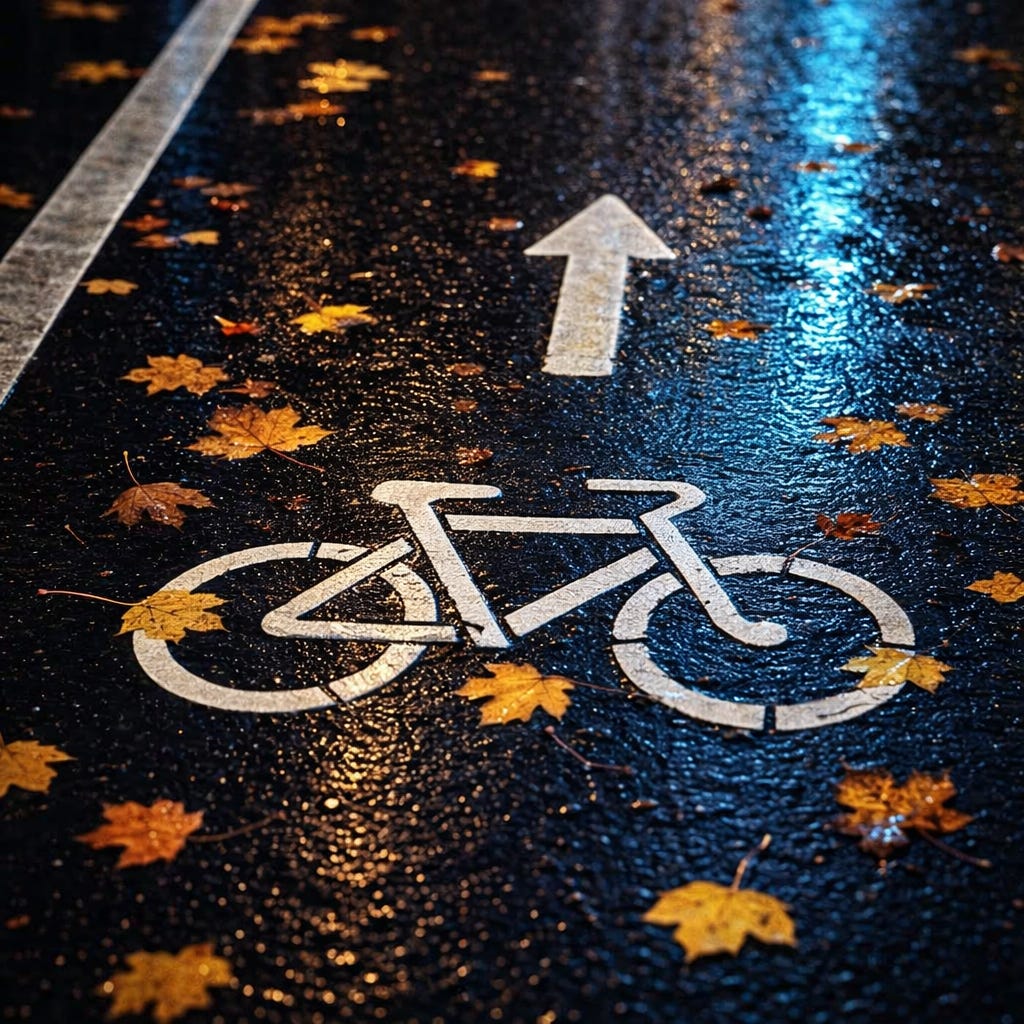
We’re already essentially at 100% capacity on bike lanes. In some places, we’re definitely getting to the point where, yeah, you might need to drive to your front door, but you’re going to have to do it at 20 or 30 kilometres an hour. This road is a shared road, and it’s got to be made safe for a variety of users.
AM: So we need better bike lanes. We need secure bike storage—
KML: Bike lanes, or we need to deal with traffic management in a way where we’re willing to say, “Yeah, driving 70 or 80 or 90 on Parkside Drive is not okay.” You can drive somewhere, but you shouldn’t be able to drive at those speeds. Look at speed governors, speed enforcement with cameras. The bottom line is, in our cities, we need to prioritize transit. Transit needs priority. We need to slow down and make things safer.
The Safety Gap
AM: Let’s move from making the city safe for cyclists to making everyone else safe from cyclists. There are two problems people talk about: e-bikes are dangerous because people ride like maniacs, and e-bikes explode and cause fires.
KML: For both problems, the solutions start with the federal government dealing with what comes through our borders and what gets manufactured here.
Part of the problem is it’s not hard to make an e-bike travel faster than is legal, or to purchase a bike designed from the outset to go faster than legal limits.
AM: My e-bike motor cuts out at 32 kilometres per hour. I can go faster, but it’s only my physical effort that maintains that speed. Is that where the law says it has to be?
KML: Essentially across Canada, the law is 32 kilometres max assist speed and 500-watt motor maximum. In Europe, it’s 250 watts—they have better motors—and their max is 25 kilometres. The US is higher: 25 miles an hour (40 kilometres) and 750 watts. Lots of bikes have 750 watts. Essentially all motors can produce more with software. Some have no lock, which means you have a button that you can click on for ‘more power please’.
There should be limits on power. There simply isn’t any enforcement on the rules that exist.
AM: Will that also help with the battery problem? Is that a problem with all batteries or some batteries?
KML: Any lithium-ion battery thrown on a campfire creates a big problem. When you think about the fire in that Thorncliffe Park building, or in Hong Kong… we all have lithium batteries in our computers, phones, gadgets. E-bike batteries are much bigger than those for most consumer items, an EV car excepted. The problems stem from badly made things, badly treated devices, people fiddling with them or trying to charge them faster than they should.
There are certifications. The UL standard in North America is the top standard for safety and certification. But I read something… Health Canada was doing a survey about battery safety, but their survey explicitly doesn’t deal with e-bikes because they sort of fall under some other vehicle designation. There’s a line in it that said there’s essentially zero requirements for lithium-ion batteries to be certified in Canada. It’s freaking shocking. It’s not like there haven’t been fires. That problem starts with the Feds… has to start with Feds saying what can come into the country and creating rules. Even today’s rules aren’t enforced.
When we started renting bikes six years ago, the first bikes had seven-amp batteries: 36 volts, seven amps. Today, typical food delivery people have 35 amps and 48 volts. That’s almost ten times as large, almost an order of magnitude bigger. Are they better and certified? Some are, not all. There are bikes out there with 60-amp batteries. It’s crazy the amount of energy on that bike that can get put into a subway car or an apartment building.
AM: So it makes sense—the issue isn’t that the technology is bad, it’s that there are manufacturers cutting corners. Just like with any unsafe product, we need regulation to prevent misuse.
KML: We need a bar. There is essentially no bar for making a lithium-ion battery, and we need one. We need it higher than now. Then we need enforcement.
What irked me with GO Transit’s rules: they talked to me, then nine months later said, “In two weeks, this new rule is coming in”. Imagine! When any level of government says, “We’re moving towards some percentage of your cars have to be EVs,” it’s “Oh, we can’t do it in 10 years. That’s too fast.” But while they were planning this, two years ago, the bike show was on. There was no GO Transit booth at the bike show talking to retailers about these new standards coming in. New York essentially said everyone is going to have to abide by this… And the date’s going to be here, 12 to 18 months out, so you can prepare for that. And that’s what everyone should do, signal standards and socialize them with retailers well before enforcement.
AM: There’s an interesting idea here that the body most affected is actually the transit providers. They’re going to have to exercise leadership, even if they’d prefer not to.
KML: They’ve already done it in Toronto. TTC just bans all e-bikes for five months of the year: December, January, February, March, April. And GO requires batteries to meet these two certifications, one’s European and one is this UL certified. One or the other. Everyone is all for safety. It’s just… why are we just doing it there? Why are we not bringing this elsewhere and encouraging the whole industry to move forward?
The crisis Kevin describes is real, and largely invisible. Consumers see bikes on sale and assume it’s a good thing. They don’t see the retailers bleeding money or the broken trust between manufacturers and the shops that sell their products. The industry that services and supports e-bikes—the machines that could meaningfully shift urban transportation—is hollowing out.
What struck me most in our conversation was the policy vacuum. To me, Kevin’s story suggests two policy problems operating on different scales of urgency.
Firstly, we have a retail sector trying to survive an inventory hangover that has lasted years, stemming directly out of the pandemic and still unresolved. Secondly, a regulatory vacuum around batteries and power limits that is now being partially filled, imperfectly, by transit agencies with the most to lose.
Regarding the first, I don’t think this requires inventing a new policy regime. What it requires is acknowledging that bike retail absorbed a pandemic shock in service of public health goals, and that the hangover has not cleared on its own, and there is an appropriate public role in helping. That could mean temporary credit facilities, inventory-financing support, or targeted programs that help viable retailers survive long enough for demand to normalize. These are policy choices, and they require us to acknowledge that there is, in fact, a problem.
Regarding the second, Canada has essentially no certification requirements for lithium-ion batteries in e-bikes. Health Canada’s battery-safety survey explicitly excludes them, while Transport Canada is not prioritizing the enforcement of the rules on motor power and speed. Meanwhile, the infrastructure that would make e-bikes safe and practical—protected lanes, secure parking—is already at capacity in the cities that have built it, and nonexistent in most others… and that is where it isn’t being removed, a misguided rollback of the improvements we made during the pandemic.
I shake my head at the fact that it is transit agencies like GO Transit and the TTC that have become de facto regulators because they have skin in the game; they’re the ones whose subway cars and buses catch fire when batteries fail. So they’ve imposed certification requirements and seasonal bans that other orders of government would be better equipped to promulgate and enforce. It’s regulatory leadership by accident, driven by necessity rather than strategy.
For all of that, e-bikes remain, as Kevin puts it, a “fucking game changer.” They solve problems that have bedevilled cycling advocates for decades: hills, sweat, distance, age. They make trips possible that would otherwise require a car. But realizing that potential requires policy attention that hasn’t materialized on battery safety, on infrastructure, and on industry support. The technology is here. The policy isn’t. And that means that the industry that could most easily improve urban transport, by making e-bikes ubiquitous, is fighting for survival.
E-bikes won’t fix our city streets on their own. But they do make the genuinely better option—better for the user, better for the environment, better for the city—easier, not harder. If you’re curious, check out Kevin’s company, Zygg, which would be happy to sell you an e-bike, or offer you an e-bike subscription service; you can try this out for yourself without committing to purchase.
I've heard this. I can see why it would be a problem. Bikes last a long time (I bought my current daily rider in 2008 and I have no intention of giving it up any time soon). I also think there is a ceiling on how many people are willing to take this activity up. E-bikes will not change the (not entirely unjustified) perception that this is a dangerous activity, and they won't make a cold rainy day any warmer or drier.