


Earlier this year I attended Progress Conference in Berkeley. The exigencies of my schedule meant I did not fly directly from Toronto, but instead changed planes at Denver International Airport (DEN) en route to San Francisco International (SFO). This means that, on one trip, I had the pleasure of spending time in two of the USA’s ‘quiet airports’.
Most airports are very noisy, but it’s hard to notice that, just as it’s hard for fish to notice water. Blare is everywhere: constant announcements about gate changes, boardings, which groups are now eligible to board, security warnings, last calls, alerts about property left at the security screening area, greetings from the mayor or the governor, requests for individual passengers to speak to an agent, and more.
It’s cacophony. If you’ve never waited for a flight in its absence, you don’t realize how much you are obliged to tolerate.
DEN borrowed the idea of a quiet airport from SFO, whose quiet program began in 2018. The latter airport’s director of customer experience told Denver’s program lead that “the traveling public loves it”. And yet few other North American airports have done the same.
Why not?
The obvious answer is that airlines don’t want to. When DEN made the change, its second-largest airline held out, for a time. But DEN’s experience also suggests that airports have leverage here, if they choose to use it. If we can understand what holds other airports back, we can help to nudge them in the right direction, meaning we get to keep the quiet without losing the value that the noise provided.
How Denver Went Quiet
Travellers at Denver International Airport have been free of cacophony since August 2025. Between July and October of that year, the airport reprogrammed about two hundred microphone stations so that a gate agent’s call, which formerly could reach as many as 70 gates, would instead reach only that gate and its immediate neighbours. Agents also cut back on reading lists of passenger names into the PA and reduced the number of ‘final calls’ to one. (Yes, you read that right.)
In June 2025, the average Denver gate heard 358 announcements a day, its own and its neighbours’. Working back from DEN’s figures, that came to a daily total of about an hour and a half of amplified speech at each gate. In October 2025, the average gate heard only 113, and, by DEN’s own measurement, the time they took fell to 26 minutes a day. A year on, the quiet has held: in October 2026 the average gate heard 106 announcements, about 24 minutes in all.
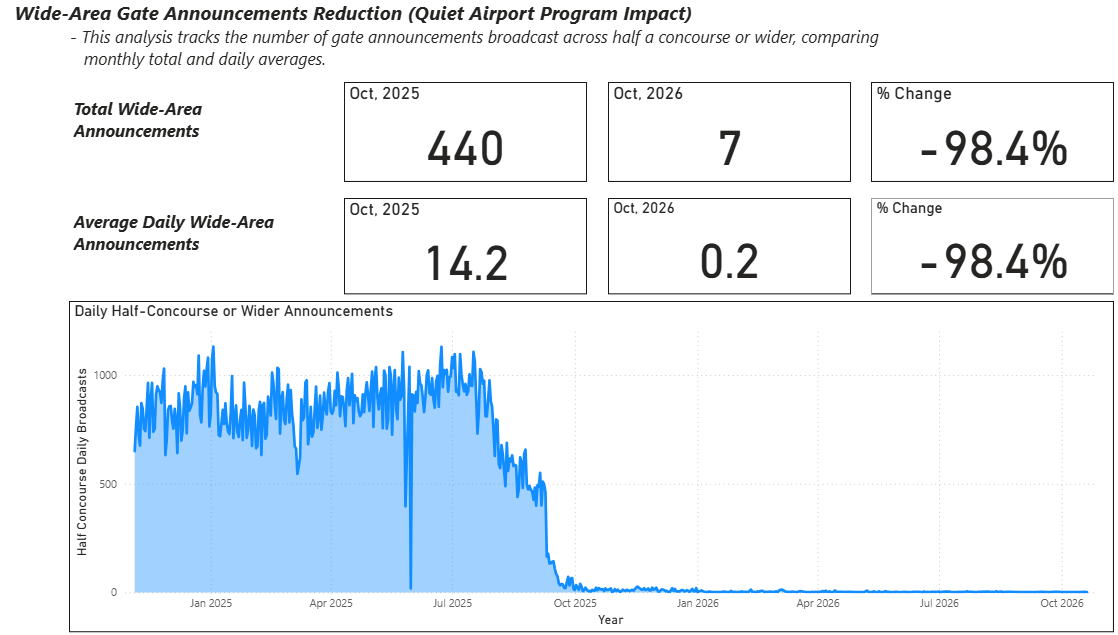
Daily announcements broadcast across half a concourse or more, Denver International Airport (DEN), 2025–26. Data and chart courtesy of DEN.
The striking thing in DEN’s data is what did not change. Agents make about as many calls as before, roughly 95 per gate per day; what changed is how far each one carries. Announcements broadcast across half a concourse or more, which ran at roughly 800 to 1,000 a day before the change, numbered seven in the whole of October 2026.
(I note that the federally required security messages about unattended bags, liquids, and the like continue at Denver every thirty minutes. The Transportation Security Administration will not be deterred from its infuriating and unnecessary tactics, as I’ve argued in the New York Post and in Airports Are Too Safe.)
I applaud what DEN has done here, because noise is a cognitive tax. That’s intuitively true, and empirically as well. One study found that loud noise measurably reduced participants’ ability to pay attention. Earlier research that study reviews links noise to weaker working memory and concentration. So an airport running about an hour and a half of amplified speech per gate per day imposes these costs on every passenger waiting at a gate, and on every worker in the building all day.
The bigger cost is that constant noise undermines any value it provides. Most of the information given out is not actionable. Some is just audio slop, like the greetings from the local mayor; others are useful, but only to a few of those who hear them, such as a boarding call for a flight that most people aren’t taking. In such conditions, the sensible move is to stop listening, meaning that useful information must first break through the complacency of people trained to ignore what they’re hearing. Fewer announcements mean more valuable ones.
Some readers may object on behalf of the visually impaired, who can’t read signage or take cues that the sighted can. It is certainly the case that the rules of the U.S. Air Carrier Access Act (ACAA) require carriers to give passengers who identify themselves as needing visual or hearing assistance prompt access to the same information everyone else receives. Under the Department of Transportation’s reading of the rule, information shown only on a screen, such as a gate change, must be given orally to visually impaired passengers (who have identified themselves).
A broadcast is one way to meet that duty (the rule doesn’t prescribe how to do so), but at least some visually impaired passengers find it violates the spirit. See, for instance, this 2023 op-ed by Justin Yarbrough, a blind accessibility coach, who argues that precisely because he navigates by sound, audio clutter overloads his senses. He describes SFO’s quiet program as one of the most relaxing airport experiences he’s ever had.
Why So Many Announcements?
Constant announcements are annoying and counterproductive. So why are there so many of them? Two reasons: they’re simple and they’re cheap.
They’re simple because they are the easiest way to solve the problem of conveying information when you don’t know where the person who needs it is, or what tools they have available. Airlines want every booked passenger aboard, because a missing passenger means a cost; a customer complaint, a delay, or a checked bag to pull from the hold. When a passenger is not accounted for, the airline doesn’t know where they are, and can’t automatically pick them out from among the thousands of people in the terminal. Pushing an alert to a screen on a wall doesn’t help, because the target might not be looking at it; pushing it to an app doesn’t help, because they might not be looking at their phone, or have the app installed. But an audio alert pushes that information to everyone at once, irrespective of what they’re looking at or what tools they have available.
They’re cheap because the cost of using them doesn’t fall on the airlines. Using the loudspeaker takes seconds only and costs the airline nothing extra (it’s the airport that builds and maintains the speakers). The cognitive costs are large, but they fall on the people in the concourse. Economists call costs one imposes on others externalities; everyone else calls them ‘someone else’s problem’. The crooked timber of humanity is such that those posing them usually fail to notice them at all.

Wally Gobetz, Denver: Denver International Airport – Jeppensen Terminal, taken August 19, 2010. Flickr. Licensed under CC BY-NC-ND 2.0.
Denver’s own rollout shows that indifference at work. At launch, Southwest Airlines, Denver’s second-largest carrier and the dominant tenant on one of DEN’s three concourses (Concourse C), did not take part. Gary Leff of View from the Wing asked the airline in September 2025 why that was, and was told only it would comply “when it rolls out to Concourse C”. Yet DEN told me the program covered all three concourses, Concourse C included, from its launch, with implementation complete on 27 October 2025, and that it works by reprogramming the microphones rather than by asking airlines to opt in. They also told me that every airline was briefed before the change took effect and given a chance to comment, and that each airline remains responsible for its own announcements, with the airport’s guidance asking only that they be brief.
I asked Southwest for background on the policy and its compliance with it, but the airline declined to respond to me. Absent that information, we can only speculate.
Leff offered a few speculations in his piece, which I think are sound. At peak periods, he suggests, Southwest’s gate areas overflow, meaning that gate-confined calls might not reach all passengers; some of them might be visually impaired, and the ACAA requirements still impose a duty that must be met. Continuing with ample broadcasts solved Southwest’s problems cheaply. Add to that the externalities problem: finding a missing passenger would require agents to roam the concourse, meaning slower boarding and flight delays. That imposes costs on Southwest, and remember The Iron Law of Air Travel: passengers choose flights on price, not on how quiet the concourse will be. Southwest’s incentives all run toward keeping up the blare.1
Those incentives apply to other carriers as well, and they explain why airlines like the blare. They do less to explain why so few airports have turned it down.
The Airport Holds the Switch
Airports do have to tread carefully with their airlines, which are their biggest customers. This has not stopped airports abroad: Schiphol Airport in the Netherlands is quiet, leaning on screens, its website, and its app to convey information. It gets its way partly because it runs its own gates and their announcement systems. But North American airports, by contrast, often lease gate areas to airlines to run them. U.S. airports negotiate use-and-lease agreements with their airlines, whose rates back the airports’ bonds, and these often give airlines review or approval rights over capital projects. Canadian airport authorities set their own fees and consult airlines rather than give them a veto, but the airlines are still their biggest customers. Given that leverage over multibillion-dollar capital programs, airports in North America have reason to tread carefully in their negotiations.
There are other obstacles. Airports don’t have an obvious incentive to be quiet; passengers may like it, but they won’t let it influence what city they fly out of (the Iron Law at work again), so assuming costs to improve the customer experience is not a slam-dunk case. And while upside is limited, downside is not: a single passenger who misses a flight and blames the silence would make the news, while the thousands who enjoy a more peaceful stay in the concourse will not.
Even so, some airports that have tried it report that the downside never arrived. When Dubai International cut its daily announcements from more than 2,000 to fewer than 700 in 2010, working with its airlines to limit each flight to two calls, its chief executive reported no impact on departure performance. SFO followed in 2018 and Denver in 2025. Palm Springs launched its own program that December.
Let’s stipulate that an airport, or even an airline, listens to its customers and decides to proceed with quiet operations. What will it take for them to succeed?
The first thing is to recognize the scope: quiet doesn’t mean silent. SIN in Singapore (Changi Airport) ended final boarding calls and paging in 2018 but kept announcing delays and gate changes. While DEN denies gate agents the power to broadcast across a concourse, each airline’s designated customer-service staff still can.
Then, understanding the assignment, airports must assume the capital costs. Public-address systems need to have a channel for the whole concourse, but default to the gate and its immediate neighbours. This part is cheap—DEN estimates about $40,000 to do all the microphone reprogramming—but what follows can be more expensive. Each gate needs bigger, better screens, as PSP in Palm Springs does. Each gate also needs hearing loops (which directly transmit announcements to hearing aids), as PHX in Phoenix has at some of its gates. To ensure duties to the visually impaired are met, airports should invest in Aira services or the like, as MSP in Minneapolis–St. Paul does. Carrier apps need to have better push notifications, though this is happening already, as omnipresent attention to mobile devices becomes the norm.
With those in place, airports can ask airlines to cut the announcements that remain, and keep measuring. If the changes are causing delays, adjust; if they aren’t, take the victory lap, and publicize that accomplishment, pour encourager les autres. Only if airlines resist should the terms go into the lease at renewal.
I like Denver’s numbers, and I give DEN full marks for collecting and sharing them. In the narrow sense, they are a success: fewer announcements, carrying less far, causing less cognitive overload. In the broader sense, the jury is still out. Is essential information reaching the passengers who need it as reliably as it did before? This is harder to collect and more painful to broadcast. The evidence so far is indirect: so far, SFO and DEN have kept the program (and Dubai reported no effect on departures when it went quiet) I am cautiously optimistic that the policy is a success. If so, that means DEN will have an easier time getting future carriers to embrace it, which in turn means other airports will have less reason to fear implementing a similar approach themselves.
On my own trip through Denver and San Francisco, I made my connections and enjoyed the peace. The case for quiet airports is strong enough that I expect, one day, every passenger will get to have that experience.
In all fairness, though, Leff engaged Southwest in September 2025, and the work was not complete till the end of October, meaning at the time Leff got his answer, Concourse C might not have been ready yet. If that was the case, perhaps the airline meant exactly what it said.
We were in a quiet airport (I think Vancouver?) recently, and the difference was striking. Not only were PA announcements almost nil, but the terminal layout was full of soft absorbent material instead of 3 open acres of marble tile. It was serene and relaxing, completely different from other airports.