


Waymo’s service levels have doubled since I wrote this—250,000 paid trips a week then, 500,000 now, a million promised by year-end—but that is still about a hundredth of one per cent of American car trips. The 50 per cent threshold I write about here remains distant, but the friction I anticipated has begun to be felt. To the extent that the US Congress is considering driving automation regulation, it is debating a cap on robotaxi numbers plus a per-mile fee; that is, the second policy option proposed here. As I suggest, it will be a painful transition, only just getting underway.
Imagine a four-way, unsignalized traffic stop, where two human drivers and two robotaxis arrive simultaneously. Who should proceed first?
The human drivers improvise a negotiation. Perhaps one makes a hand gesture; after you. Or perhaps another edges forward slightly and waits to see if anyone challenges.
The robotaxis do nothing. They sit motionless, sensors spinning, cautiously waiting for certainty about right-of-way. Those sensors record the hand gesture, but the system doesn't understand it. Conversely, the sensors also see the inching forward and the system does understand it; any intention on the part of the robotaxis to proceed is immediately squelched. Human drivers behind them, seeing the robotaxis surrender the right of way, are presumably unhappy about this. Does one of them, feeling impatient, attempt to pass the robotaxi on the left? Maybe not the first time this happens; but the tenth? It seems likely.
This scene is fiction… so far. But the moment when such incidents play out every day is coming. And that moment will be fraught.
The most dangerous moment in traffic automation is not today, when automated vehicles (AVs) are unknown in most cities and are still curiosities in others. Nor will it be in the future, when AVs dominate the roads. It will be instead when various forms of automation reach 50% penetration of the streets, when neither human drivers nor automated vehicles dominate.
As my co-authors and I explore in The End of Driving (forthcoming in August!), it's at this moment that the problems in our transport system will be most complex and dangerous, when the competing systems of driver assistance, conditional automation, and full autonomy collide with maximum force.
Absent good policy, that 'moment' might last decades.
The Calm Before (Fewer than 30% Automated Drivers)
It's a Tuesday afternoon in San Francisco's Mission District, and a Waymo robotaxi is stuck behind a double-parked Amazon delivery van (a perennial problem). The driver of the van is long gone, presumably in a nearby building delivering a package. A human in such a position would glance around, nudge forward to check if they were clear, and then ease into the oncoming lane just far enough to slip past. But the Waymo? It sits motionless, waiting for certainty.
This or something like it actually happened in November, captured on video and shared across social media. It ultimately ended without drama: no crashes and no injuries, just delay and exasperation. The only headlines it generated were of the 'man bites dog' variety, which is understandable. Waymo recently announced that it was providing about 250,000 paid trips weekly in the United States. That is impressive from one standpoint; seven years ago, Waymo was providing zero paid trips. But from another, it's trivial. Since there are (very roughly) 3-to-4-billion car trips happening weekly across the country, that means that Waymo is serving perhaps 0.007% of all American car trips.
Given those numbers, it's only natural that confusions like this are fodder for clickbait rather than headline news or serious analysis. That’s because this early friction is manageable. Human driving norms continue to dominate, and AVs bear the burden of adaptation. Each incident seems isolated, fixable with better programming or clearer rules. The problem seems to be imperfect AV behavior that will improve with time.
But time will reveal the actual problem is something else.
The Storm Approaches (30% to 45%)
As various forms of vehicle automation collectively pass 30% of road use, the real problem will become apparent: there are no longer enough human drivers to establish uncontested human traffic norms, but there aren’t enough automated vehicles to coordinate effectively with each other. And between these extremes sits a muddled middle ground of semi-automated vehicles that require constant human supervision.
Consider what traffic will look like at this stage. A Tesla with Autopilot engaged sits behind a Waymo robotaxi, which has stopped for a pedestrian who jaywalked but is now safely across the street. The Waymo remains motionless, waiting for absolute certainty. The Tesla's driver, accustomed to the car handling most situations, belatedly realizes they need to take control to merge around the obstacle. Behind them, a traditional human driver grows impatient and attempts an aggressive pass, startling the Tesla driver who's still figuring out whether to override the automation or let it handle the situation.
This scenario reveals a deeper coordination problem. Human drivers can improvise and break rules when necessary, and no one driver suggests how any other must behave; while automated vehicles follow strict protocols within their operational domains; each Zoox drives like every other. Semi-automated vehicles exhibit the most variety: Tesla's Autopilot behaves differently from BMW's Active Driving Assistant, which behaves differently from Mercedes' Drive Pilot. Without interoperability standards, these different kinds of automation create interactions that other road users struggle to predict. Sometimes, these different kinds of automation are present in the same makes and models of vehicle; infamously, Tesla’s Autopilot can be set to ‘Chill’ but also to ‘Assertive’ (since renamed ‘Hurry’), and it isn’t obvious from the outside which setting is active.
But even this is not the most dangerous ambiguity, which is the fact that cars with Advanced Driver Assistance Systems (ADAS) cars are only partially automated; they can operate without human direction—maintaining speed and keeping the lane, executing lane changes and turns as necessary—but only under straightforward circumstances. They hand control back to humans when they are unable to manage the situation themselves. That is precisely in those situations that are most complex, time-sensitive, and high-stakes. Even a skilled, attentive human can be overwhelmed by the sudden demand to retake control in a context the vehicle has already failed to navigate.
Pedestrians and cyclists face particular challenges in this mixed environment. These road users have always relied on subtle social cues: eye contact, hesitation, hand gestures. Some automated vehicles may detect these signals but cannot interpret them meaningfully. Meanwhile, the cautious behavior of fully automated vehicles creates perverse incentives—pedestrians who step into the road assuming AVs will always yield, cyclists who grow uncertain whether the vehicle beside them has registered their presence or simply failed to respond appropriately.
The chaos extends beyond individual interactions. Robotaxi fleets, absent regulation, begin to deadhead—cruising neighborhoods while seeking rides, occupying road space without passengers. Each empty vehicle represents only a small inefficiency, but in aggregate they reshape traffic patterns, curb access, and street-level expectations. As automation becomes more common yet remains fragmented across different systems and brands, these inefficiencies accumulate. These inefficiencies may seem manageable at this stage. But as automation becomes more common yet remains fragmented, the frictions begin to accumulate.
And soon, they stop adding up. They start to tip over.
Peak Chaos (45% to 55%)
At the midpoint of AV road share, the system no longer risks mere strain, but failure. When the roads contain a complex mix of fully human-driven vehicles, ADAS-supervised vehicles, conditionally automated vehicles, and geo-fenced robotaxis—none dominating—no single behavioural logic will govern traffic.
Pity the poor human drivers caught in this jumble: they won’t be able to predict whether the car next to them will suddenly slow for an invisible obstacle (a cautious robotaxi), continue regardless of conditions (a human driver), or abruptly switch from smooth automated to jerky human behaviour (an ADAS system hitting its limits). Many of those human drivers, in turn, will think they can seize advantage from wholly-automated vehicles with reckless merging and seizure of the right-of-way. And when emergency vehicles appear, some vehicles will pull over, others will slow down and wait for clearer protocol, and ADAS-equipped vehicles will require their drivers to suddenly resume manual control.
Behind these incidents, a deeper problem becomes harder to ignore: the atrophy of human skill. Drivers reliant on ADAS become accustomed to passivity. Even when a system hands back control in a reasonable and well-signaled way, the human behind the wheel may no longer have the reflexes, judgment, or confidence to respond. The fallback is no longer reliable—not because the system failed suddenly, but because the human has forgotten how to succeed.
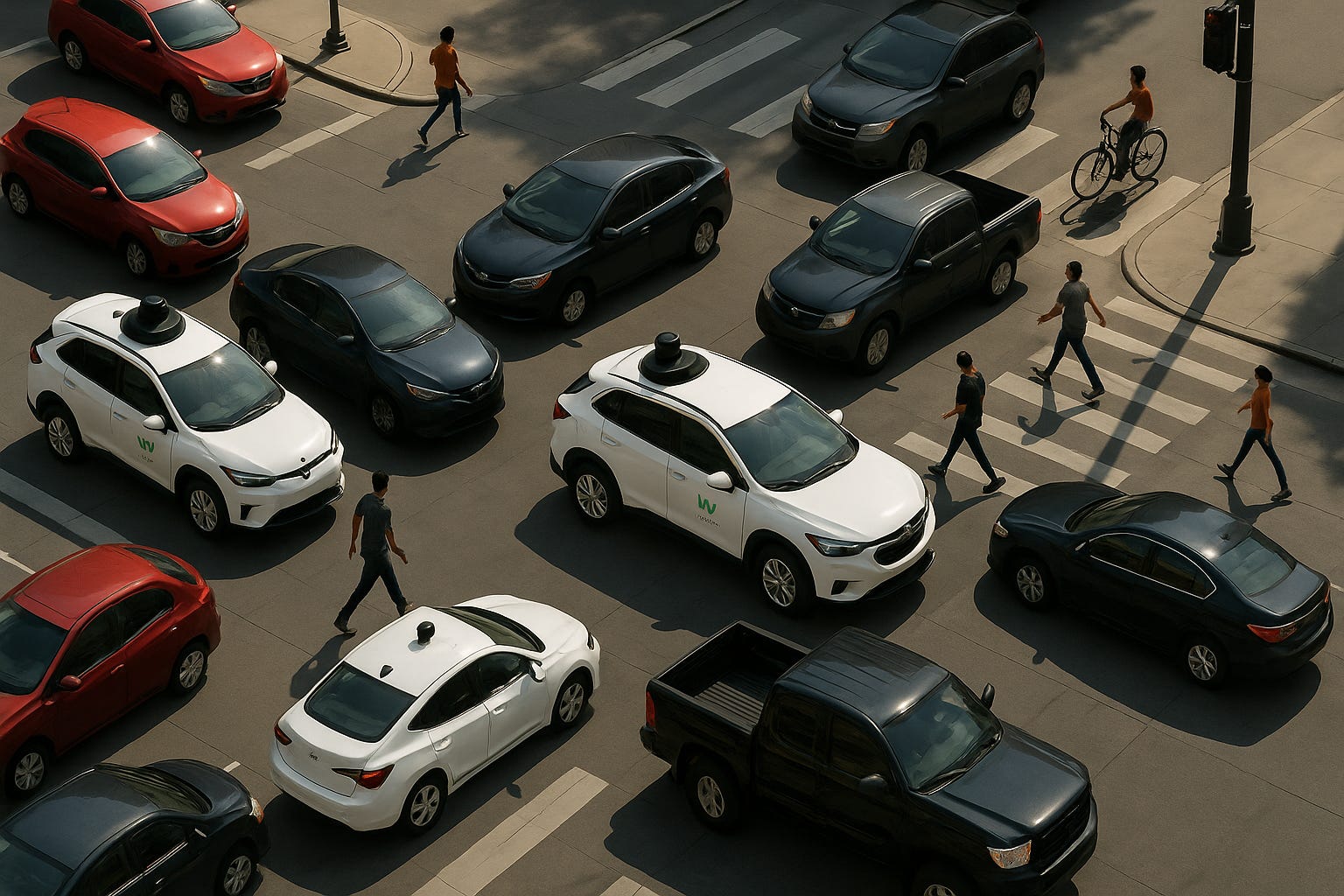
The net effect of all this is not that roads will become ungovernable. There will be no Mad-Max-style free-for-alls. But it is reasonable to fear that the experience of driving and navigating traffic will be worse than it is today. And, barring appropriate policy, the stalemate will persist: too many AVs for human norms to govern, too few for machine coordination to dominate. This is the worst of both worlds: a transportation system caught between two rulebooks, with neither in charge.
The Promise Beyond (55% to 70%+)
Beyond the 50% mark, when we get there, we will finally be in the sunlit uplands that futurists have been hyping for the past twenty years. At perhaps 60% to 70% of road share taken by AVs, machine coordination will establish new rules of the road. Removal of the unpredictable human element will permit cars to follow more closely, accelerate and brake more smoothly, and use road space most efficiently.
But we shouldn’t assume this future automatically resolves into coordination and efficiency. If left to market logic, automation will not replace car dependency, but supercharge it, especially in the suburbs. AVs, designed for comfort and convenience rather than coordination, will enable people to live farther from where they work. Commuters will tolerate longer drives when they can spend them watching videos or answering e-mails. The daily burden of distance will soften, and with it, the incentive to reduce trips, vehicle ownership, or commute times. The result is more travel, not less; and as such, more vehicle miles, more dispersed land use, and more energy consumption. And because this additional travel will happen, for the most part, in vehicles that are privately owned, it offers no shared gains: just individualized comfort at collective cost.
This dynamic also undermines shared fleets. If traffic remains unpredictable and robotaxis are delayed by human chaos, private AV ownership starts to look like the safer bet. Absent direct action to prevent it, we won’t get convergence and efficiency, but fragmentation and sprawl.
The system will never be a perfect machine, because human drivers will never disappear entirely. Emergency responders, construction personnel, rural residents, and hobbyists will continue to operate vehicles themselves. But they will find themselves less and less catered to in a system that is increasingly optimized for algorithmic precision. They will be the edge cases. Meanwhile, non-vehicular road users—pedestrians, cyclists, and other travelers—will persist as well, meaning the human element will remain. But they will operate in an environment where the biggest risk to their well-being, namely fast-moving vehicles, will consistently behave themselves.
It won’t all be sweetness and light, particularly in the suburbs. But at least these costs will be felt in the realms of land use and social engagement. In the domain of mobility, at least, things will be better than they are today.
Hastening the Transition
Once we recognize the complexity of the 50% problem, we can see how we should approach AV deployment. Instead of assuming smooth progression, we need strategies specifically designed to manage the dangerous interactions between manual vehicles, ADAS systems, conditional automation, and full autonomy.
These include:
Skip Through Quickly. One approach will be to accelerate deployment in controlled zones. Geofence specific areas for rapid AV adoption, pushing from 30% to 70% penetration within a few years rather than decades. Singapore's city-state structure allows this; closer to North America, Chandler, Arizona has experimented with AV-heavy zones. The key is moving fast enough that neither system gets stuck at parity.
Stay Below 50%. Some jurisdictions could deliberately cap AV penetration to maintain human dominance. Use permits, fees, or operational restrictions to keep automation below the chaos threshold. This preserves manageable early-phase friction rather than risking systemic breakdown.
Segregate. Finally, jurisdictions might separate AVs and humans spatially or temporally. Lanes could be dedicated to AVs during peak hours, or at the extreme off-peak (say after 2100h). Time-based restrictions like these would give each approach clear dominance during specific periods. Or, as my team and I argued at Sidewalk Labs, particular zones could be absolutely restricted to AVs (and emergency vehicles) permanently. As these were shown to be successful—and, I expect, popular—they could be expanded.
These strategies aren't mutually exclusive, and smart policy might combine elements of each. Choosing among them will depend on local conditions. Particular neighbourhoods might benefit from aggressive geofencing, while sprawling metropolitan areas might have enough redundancy in their road systems to segregate.
No matter what solution we choose, though, the mix of automation levels, with the resulting inefficiencies and strain on the road system, will be a long-term condition. Even generous projections suggest we’ll have human drivers, ADAS users, and full AVs sharing roads for decades. Rural drivers, emergency responders, and classic car enthusiasts will not disappear, and emergency vehicles and other specialized fleets may never automate fully. We can make choices that limit its effects and get through the pain quickly, but whatever we do, the future isn’t pure vehicle automation. It’s permanent hybridity.
There’s ample precedent; other complex systems have evolved the same way. Our energy grid mixes coal, solar, gas, and wind. Our trains run diesel alongside electric. Air traffic control accommodates both jets and prop planes. As much as we might like to imagine some of these as immature stages, the sober view sees them as stable configurations, and ones that must be managed. The same applies to our road systems as well.
This fact should change how we expect to design in the future. We can, if we wish, design some spaces to be automated-only; I think we should, and in so doing demonstrate the merits of that approach, and lead by example. But that part of the song is the minor key. The major key will be designing our infrastructure, regulation, and protocol on the assumption that both human, partially automated, and wholly automated driving will coexist for the foreseeable future. Coordination at parity should be our baseline.
If we misread this phase as temporary, we’ll build brittle systems: policies and platforms that collapse under the weight of persistent coexistence. Let’s design instead for hybridity. It will fall short of triumphalist dreams, but we can nonetheless build traffic systems that are safer, more efficient, and more resilient than today’s.
When automated cars become common enough, I assume someone will develop a means of communication between vehicles, even from different makers. This will allow them to navigate road conflicts. In the case where human drivers are still common, maybe these can be usable by humans also. For example, a robotic hand on the dash board that can wave, beckon or give the finger or other readily apparent gestures to other vehicles .
Andrew, thanks for a thought-provoking piece. You nail the reality that mixing cautious software with human improvisation will create a frustrating culture clash. But concluding this 50% threshold is the "most dangerous" era reveals a few blind spots.
First, friction does not equal fatality. A robotaxi freezing at a four-way stop is exasperating, but by pausing it has neutralized its kinetic threat. The actual danger is the impatient human swerving into oncoming traffic. Swapping out 50% of easily distracted drivers for 360-degree vigilant AVs removes massive systemic risk, even if it temporarily increases gridlock at some poorly designed intersections.
Second, the hypothesis treats the tech as static. By the time we hit 50% adoption, sensor suites will have commoditized into affordable factory options. When vehicles communicate via V2V telemetry, that four-way stop negotiation happens in milliseconds, bypassing human hand-waving entirely.
Finally, capping AVs is the exact wrong policy reflex. If the 50/50 mix is truly the most painful phase, why artificially trap our transit grid in it for decades? Instead of protecting the status quo, we should incentivize the transition. Look at Norway’s EV adoption: they built an incentive structure that made the legacy tech economically impractical.
Market pressures will soon do this for AVs. Skyrocketing insurance premiums for accident-prone humans will eventually collide with affordable AV subscriptions, fractional ownership, and cheap private autonomous options.
The transition will be bumpy, but the solution is to accelerate through the friction, not pull the emergency brake.