


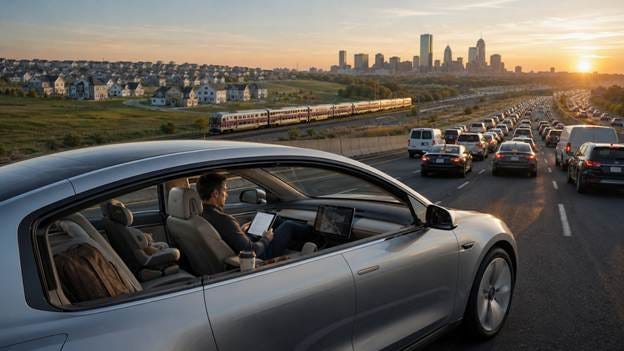
A personally-owned self-driving car offers unparalleled freedom. It seems to promise that its owners will be able to read, answer e-mail, hold a meeting, or sleep, in security and comfort. It’s an attractive prospect… so attractive that we can expect that people will drive much more than they do today, scattering households further from their jobs and bleeding transit systems of riders.
This is a story I have been telling in Changing Lanes since its inception, and now, courtesy of Prof. Benjamin Shiller, we can attach some numbers to it.
Shiller, an associate professor of economics at Brandeis, has recently published a paper, co-written with Imke Reimers of Cornell: Will New Driving Technologies Change the Value of Public Transportation Investments? In it, the authors estimate how residents trade off price, time, and the discomfort of travel, then simulate a Greater Boston in which private self-driving cars are widely owned. The paper puts firm numbers on intuitions I have been pressing for years: that automation will induce more driving, push development outward, and wear away at transit ridership.
To learn more, I spoke with Shiller on 16 June 2026. The transcript of our talk has been lightly edited for clarity.

Prof. Benjamin Shiller (provided photo)
Modelling a City of Self-Driving Cars
Andrew Miller: I went through some of your work, and I hope you don’t object to this, but I wouldn’t characterize you as an economist of mobility. The through-line in your work seems to be this: once upon a time there were markets, but they had a very fuzzy sense of who the consumers were. That’s all changed. Markets now are adjusting to a world where counterparties can have unprecedented understanding of who their consumers are, and how that changes the easy assumptions we’ve made. Tell me if that’s a fair characterization… and if it is, what are you doing with self-driving cars in Boston? How does that fit into your larger intellectual corpus?
Prof. Benjamin Shiller: I view my interests as somewhat broader: it’s generally how technological change will impact markets, and so much of my research focuses on more information being collected about consumers. In fact, it was based somewhat on this local law…
AM: When you say local, you’re at Brandeis, so you mean Boston?
PBS: Well, it was across all the towns in Massachusetts: if you were near public transit, you had to increase the amount of housing, or at least increase zoning, so that they could build more housing.
But I started thinking: do we really want to put all of this housing right by the public transit stops if self-driving cars are going to be very common in the future? In Massachusetts, there have been proposals to spend as much as $55 billion on public transit, which is about $8,000 per Massachusetts resident. And I think that makes a lot of sense if you’re anticipating that the life of these improvements is quite long. But if self-driving cars become common in five or ten years and people no longer want to take public transit, then maybe it’s a poor choice. It’s an empirical question.
AM: I certainly have strongly held takes on this, but for now let’s keep the focus on the paper. So you modelled what would happen when self-driving cars arrive in Boston at scale. And before we get into the conclusions, tell me about your methodology. How did you go about making the estimations?
PBS: It’s a challenge, because we don’t have widespread self-driving vehicle adoption, so you can’t use the standard methods from reduced-form economics. The way I did it is with a method common in industrial organization, where I estimated people’s preferences for particular characteristics of transportation.
I looked at how much people dislike a minute spent sitting passively on a commuter rail line, or in the future a self-driving car; how much they dislike a minute spent actively driving; how much they dislike having to transfer on public transit, and how much they dislike price. Once I’d estimated those, then I could create this new option, the self-driving vehicle, which would have the advantage of allowing you to sit there passively like you now can on a train, but could utilize the road network.
One complication that I had to account for in these counterfactual simulations is that if there are more vehicles on the road, that could increase traffic. And I know there’s research out there that suggests self-driving vehicles might use roads more efficiently, but I took the stance that they’re going to be like us and they’re going to increase congestion. And so I estimated, within sample, this shape of how congestion impacts the travel times in various concentric circles around Boston. I could then incorporate how an increase in road usage would slow down travel times. Thus, when I calculate a new equilibrium with self-driving vehicles, I can, and do, account for both the lower disutility of time spent driving and the increase in travel time due to congestion.
AM: I have always argued that self-driving is going to increase congestion. That argument rests on the Jevons Paradox, that if you make it less mentally taxing to drive, what you’ve done is reduced its cost, and if you make something less costly, people consume more of it, which means more driving and more congestion. It’s good to have a model that demonstrates this, rather than just an intuition.
PBS: I agree. Very recently I got Gemini in my car and I found myself much more willing to drive, because I can just have long conversations. I can ask it to look up e-mails, stuff on my calendar… driving is much less of a pain now. I was assuming that the disutility of time would be equivalent in a self-driving vehicle and on the commuter rail or on the subway, but I now think that it will be less painful to spend time in your own vehicle. You could do all sorts of things that you couldn’t necessarily do on a train, like have private conversations, maybe even shave or something like that.
AM: Well, for me, the smoking gun is that right now a Waymo trip in San Francisco costs more than a ride-hail trip, but people still take it. Part of that, I suppose, is luxury signalling. But the other part of it is that in conventional ride-hail, the presence of even one stranger, the driver, one who is guaranteed not to talk to you—which is not the case on a commuter rail—even this best-case scenario is still inhibiting in some ways.
In your own car, that’s set at the temperature you like, with seats that don’t have stains or crud on them, where you can listen to whatever you want… it is absolutely going to be much more comfortable. If I was constructing such a model, I would say that travel time in your personal vehicle is going to be more attractive than even a convenient ride on public transit.
PBS: Yeah.
What the Model Found
AM: That’s the methodology of it. And what were the findings? What’s the headline conclusion?
PBS: There were several findings, some I found obvious, and others surprising.
First, the basic finding: there was more congestion, as people drove a little bit more, but also moved further away from where they worked. I have different estimates from slightly different models, slightly different assumptions, but we’re talking about a 30%-to-40% increase in mileage. And I should note that this was just commuting to work, without accounting for midday trips or increases in delivery services. With self-driving trucks, it becomes cheaper to ship items, so we’d probably expect people to ship them even more.
The impacts on public transit were more surprising. I found a modest decline in public transit revenues and usage, a little over 10%. Why wasn’t there much of an impact? It seems to be congestion: as the benefits of driving increase—or the disutility decreases, when it’s not as painful to spend a minute sitting there passively—it nonetheless takes longer, so you’re spending at a lower disutility per minute, but nonetheless spending more time.
Interestingly, I also found that with even small improvements in public transit, like increasing the speed just a little bit, you could completely offset the reduction in revenue that was attributed to self-driving vehicles. So it was very easy to get usage and revenues back up to where they would be, if you only had modest improvements in public transit.
AM: Driving automation and its effects on transit is a complicated matter. In my view, the first thing to disambiguate is what you’re talking about when you say transit. Are you talking about surface buses, or are you talking about higher-order transit: subways, and commuter rail, and LRT?
PBS: That’s a great question. So in the research, I had public transit as its own category, and I didn’t distinguish between the different ones, but I was thinking about commuter rail and subway in particular. The commuter rail actually has a high price, and it caters largely to people with relatively high incomes. These, and to some extent the subway lines, where they’re not sharing the roads and having to struggle with increased congestion.
AM: There’s also the fact that the demographics of the usage and the periphery-to-central-business-district that’s being connected, you get fewer people using it for non-travel purposes, who are often bad actors. But yes, the key thing is that it has its own right-of-way. And what that means is that, if it’s a well-run system, travel time is faster than a car of any sort, and reliably so.
The Fleet Gap
AM: In your paper, you have modelled self-driving cars that are privately held. The model starts with the world as we have it, but then assumes that every car (to use my favourite metaphor) has a metaphorical ‘drive for me’ button on the dash. But that’s the only change: everyone still owns private cars, and uses them in the same way, as they do today. And the paper then considers how this new functionality changes our behaviour and what the emergent properties of the system become. That’s very much worth exploring.
But if you look at self-driving as we have it now and where it’s headed, it’s a different model, where most self-driving vehicles are robotaxis. So my book, or rather the one that I co-wrote with my two esteemed co-authors, was about two scenarios of the future: one, the one you’ve described, where everyone has a private self-driving car, versus one where everyone has access to a self-driving robotaxi fleet that’s cheap and reliable and convenient.
PBS: You’re saying the world where everyone owns their own vehicle is more likely?
AM: We would love to see a world where Waymo and its competitors are so ubiquitous that people drop the number of cars they own and just rely on robotaxis. But we think the path we’re on, absent severe policy intervention, is more like the world that I think your paper is describing, where private manufacturers just introduce self-driving capability and nothing else changes. That is what you are describing in your paper, which is why I think it’s good that you are modelling it. But I wonder: have you thought about the fleet model, and what implications it has, and if you did that model, how would it be different?
PBS: I’m glad that we think alike, especially since you have thought very deeply on this subject. Many people that I encounter argue that I should have taken the fleet model as the subject. And I did consider it. There are some challenges there; it’s harder to simulate the future— you must make assumptions about things like prices per ride and behavioural economics. But in the end, I agree with you, I think private ownership is more likely. I think that there are advantages to it, and that there are some real problems with the fleet model.
AM: That’s why I wanted to talk to you. I don’t need to talk only to people who agree with me—how boring would that be? Lay it on me.
PBS: There are big advantages to owning your own personal self-driving vehicle. One is just logistical: if you don’t live right in the urban core—so I’m thinking more like the suburbs—there’s a wait every time you want to catch a ride. Today, if I get an Uber, it’s not that long of a wait, but it’s still a hassle that I don’t necessarily want to deal with.
Additionally there’s some convenience to having your own vehicle. I have kids; I can leave the car seats in there. Maybe I want to keep certain things in it, my sunglasses, or soccer equipment if I’m a soccer coach; there’s an advantage of having it as a storage space too.
People also have a difficulty in parting with money. If you have a ride-hailing service or a fleet model, every time you catch a ride you would typically pay some cost. That’s the only way it would really work, otherwise the marginal cost is zero and people would overuse it, and that could be problematic when there’s a limited number of vehicles. So if every time you have to go through this mentally painful process of parting with money—because it’s very salient, when you open the app it has a price right there—I think people are going to be reluctant to do so. Whereas if you own your own vehicle, it might be more expensive overall, but when you take a trip you’re not really thinking of the price.
Another challenge is that the fleet model really struggles with surges and declines in demand. Now, if we think about self-driving vehicles, they could operate like Uber and bring more onto the road when there’s an increase in demand, but there’s this problem that the self-driving vehicles are largely built with a single purpose—a high fixed cost to create them. For Waymo, maybe it’s like $150,000, something like that. And so they’re incurring this large upfront cost, and if they’re only going to use it an hour a day or two hours a day during rush hour, it doesn’t necessarily make economic sense. So I don’t think they would necessarily want to provide a large enough fleet to provide all the rides needed during times of peak demand. And so then you have the situation where, if you don’t own your self-driving vehicle, either you’re paying through the nose when you actually want to be taking the trip, or you’re just not getting a ride when you really want it.
I think that’s a fundamental problem with the fleet model.
AM: Yeah, I agree. I wrote a whole piece, There Will Still Be Private Cars in the Future, drawing upon the book, and it makes those same arguments, that people will want them. The question is how many people are going to switch to the fleet model. Imagine I’m the CEO of Waymo or Zoox, I have to ask myself, do I size my fleet to the peak, or do I size it to the steady state? You’ve described very well: if you size it to the peak, that means you’ve got an awful lot of stranded assets at every time of day that isn’t the peak, whereas if you size for regular demand, your customers can’t use you during the peak when they really want it, and they’re mad at you. It is a tough problem.
Someone—not me, I think it was Reilly Brennan—has suggested that robotaxi fleets are sized to base demand, and human drivers jump in to handle that surge in peak periods, and when it’s done they take those cars off the road, because off-peak they can’t compete against the robotaxis. I think that is most likely.
How Transit Survives
AM: You’ve got some ideas about how transit is going to survive in this future. What do you think transit will need to do?
PBS: I think it needs to get more attractive in a number of ways. So, for example, in Boston, it needs to run more frequently. It would be nice if you could have a little more privacy, or have some ways to avoid disorder and other negative aspects. Economists often think about how you increase usage of something, and usually that’s reducing the price. So I tend to favour subsidizing some of these public transit lines, or even making them free.
If you do that, how do you keep people from misusing public transit and behaving badly on it? Maybe requiring a credit card to swipe in; perhaps you could track people and see if they’re behaving badly and revoke access. So I think a lower price, more convenient service, and then some way to handle the bad behaviour could make it so that the commuter rail, or the transit network in general, is something that can survive and still remain attractive in a world with self-driving vehicles.
AM: So I agree with most of what you’ve suggested. We should have lower fares, though I wouldn’t say zero; we should have more service. Anything you do to encourage people to use it not only makes the experience better, but it also builds a political constituency, so politicians want to fund it more.
Swiping a credit card is maybe not necessarily the first step. The first step is to have fare gates that you can’t hop over. Just getting fare-beaters out of the system—requiring a nominal fee to get in—it’s amazing how many bad actors that screens out. We had two natural experiments. One was COVID, where suddenly, the good actors had no reason to travel, and it was just bad actors on the subway, plus essential workers—and the essential workers then started leaving, because they couldn’t take it, it was too unpleasant. The other side of it is the congestion charge in southern Manhattan. Suddenly, the subways were crowded, crammed with people who formerly drove, and having all these law-abiding citizens on the system, things got way better. It is harder to abuse the system when you’re surrounded by other people.
PBS: And automation doesn’t just relate to cars; it also relates to public transit. There’s drivers, and so a fixed human cost per train, and that contributes to the lumpy service. If the public transit lines were automated, you could have a single train car coming every seven minutes, the same number of cars over an hour, but spread out. I’m sure this exists somewhere, but it seems like such an easy problem to solve. If we can make self-driving vehicles that work on paved roads, then it would seem so simple to make a public transit train that can drive itself on a train track.
AM: Yeah, rail is the easiest mode to automate, because there are only two directions to go: forward and back. Later this week, on Thursday [ed. note; out now!], I’m publishing a paper with the Institute for Progress, as part of their Transit Abundance Playbook, arguing that what we really need to do to improve public transit in the United States is automate it. And there’s one—not even a law, a subsection—Section 13(c) of the Mass Transit Act says you cannot automate without making every single worker whole. And all Congress needs to do is strike that one provision. The only automated system in the United States is Honolulu, because they built it to be automated from the start; there were no workers to displace. Nowhere else has done it, because it’s just too expensive.
PBS: That’s really unfortunate, because worker displacement is how we develop economically, right? If we just protect workers—an example I give in my book is that 200 years ago, 80% of US workers worked on farms; now it’s 1%. That’s because of automation, and if we still had 80% of us working on farms, we wouldn’t have all this other stuff. So yes, it’s painful for people to lose their jobs, but over time they find new jobs, and that’s how progress happens.
AM: Well—just so that no one thinks that I’m picking on Americans—Waymo wants to come to Toronto, but the mayor’s press secretary said explicitly that Waymo is only welcome in the city if it can show that no ride-hail driver will lose their job as a consequence of Waymo arriving. There was a time when everyone got around by horse, and then the car came along, and everyone who was a stable hand or a farrier lost their job. But do we think that was a bad outcome? I don’t think so.
In fact—I’ll put on my economist hat: just buy them out. Figure out how much money you’re going to save, figure out what they will accept; it’s like, “All right, leave aside the future generations of workers that won’t have jobs, what will it take to make this generation whole? We’ll buy you out.” Given those parameters, we could find a deal worth taking. We just need to find a counterparty who will accept it.
This has been a wonderful conversation. Benjamin Shiller, thank you for your time.
By way of postscript: Prof. Shiller is also the author of a recent book, AI Economics: How Technology Transforms Jobs, Markets, Life, & Our Future, which trains his economist’s gaze on what artificial intelligence will, and will not, change. I expect to review it in a future issue, but if the topic interests you, don’t wait on me, order your own copy now!
While I'm at it, I'll share a few other critiques that I made note of while reading the paper:
I was suspicious of where this was going in Section 2.1 where he claims public transit carries 14% of commutes in the U.S. That number is way above anything I’ve heard (5% being the usual number I see), so I checked the footnote and it’s proprietary, not public data. But then I noticed the modes listed add up to more than 100%. 107% to be precise, and it may still be omitting some modes like carpool. So we started in a weird place with inaccurate data that assumes almost 3X more transit usage than even the industry lobbying group.
The paper concludes that doubling parking charges will decrease miles driven, presumably because you have to pay to park near your office, and if parking costs more, you might choose transit. It doesn’t consider that people with AVs aren’t stuck paying the high price of parking downtown. They just have the vehicles drive back out to where parking is cheap. At 18 cents per mile marginal cost, you can drive a long way and still save money. This could double VMT if everyone’s car just drives home for the day.
It talks about modest changes to public transportation being enough to make a difference. Such as a 40% reduction in travel time. “40%” doesn’t sound like much, but that’s the same as saying making public transportation 67% faster. This is a massive challenge. Each moving segment has to be 67% faster. Each dwell time has to be 67% faster. These are not easy, simple changes. Especially during a cycle when transit usage (even under the optimistic model) is going down.
It’s a good paper that furthers the argument that AVs will increase sprawl and congestion. I still think he underestimates the impacts, especially on transit. Despite a lot of detail on how the model is set up and calibrated, it just skips to the conclusion that somehow transit is hardly affected by the introduction of AVs.
Given the setup of the model, that doesn’t make sense. They cut the disutility of driving to be equal transit, but now with an AV you get to take a direct trip, without out-of-the-way travel and transfers and a general mode preference that prefers a personal space. How does this not take away ridership from transit?
Figure 4 is the one I can’t figure out. It shows a 40% increase in driving, with no change in home locations, but transit usage drops by only <5%?? Where do these new drivers come from? At first I assumed I was reading it wrong, but in the appendix, there is a simlar Figure A.2. It sums to zero as you expect it would – the shift to driving is matched by a corresponding drop in transit.
This part fails the common sense test – having your own SDV beats transit in time, comfort, transfers, everything except cost, but even that is fairly close … and somehow people still choose transit at about the same rate as today? Something’s off.