


This is the third piece in an ongoing series on Alto, Canada's proposed high-speed rail project to connect Toronto and Montreal. Earlier pieces examined the project's structural premises, and its dependence on regional rail that doesn't exist.
In 1994, France opened Haute-Picardie, a high-speed rail (HSR) station roughly equidistant from Amiens and Saint-Quentin, about 40 km from either. Shuttle buses link it to both cities, but there is no connecting conventional rail service. Locals call it la gare des betteraves, the beetroot station, because the fields surrounding it are full of beets, not people. Annual ridership peaks at around 400,000. For comparison, Arras, the next station in line, has 4 million annually; Lille-Flandres, the next stop the other way, has 80,000 passengers daily.1
The chief value Haute-Picardie station gives the world is serving as a cautionary tale of why we should build transit stations not where it’s cheap or politically convenient to construct them, but instead where passengers want to go.
I’m thinking about Haute-Picardie because I’m thinking about Alto, the putative high-speed rail link that will connect Toronto to Montreal via Ottawa.2 I’ve written about Alto twice before; once arguing that the project is structurally flawed from the outset, and once that the project depends on a regional rail network that doesn’t exist, setting it up as an inferior substitute to air travel. I remain skeptical about whether Alto should be built at all, but if it is to be built, and increasingly it looks like it might, then I want it to succeed… and its success will depend on where it places its stations.
The emerging picture is not encouraging.
Station placement is not a mere detail; choosing where the stations are is the decision point that will most determine the success or failure of the line. And in Canada’s two most important cities, the structural conditions already look more likely to produce the gare des betteraves than the Gare de Lyon.
Station Placement First, Everything Else Second
Despite the name, high-speed rail’s value proposition is not about speed, but about door-to-door travel time. That may seem to be a fussy distinction without a difference, but it’s not. It’s the crux of the matter.
On pure speed, trains can’t compete with aircraft. The fastest HSR in the world, parts of Japan’s Shinkansen network, reaches around 300 kph, while a typical commercial airliner cruises at roughly 800 kph. Air wins on speed by a factor of nearly three, and that ratio will not change in rail’s favour.
Nonetheless, HSR consistently wins versus air on many corridors: Paris–Marseille, Madrid–Barcelona, and Tokyo–Osaka, to name a few. Why? In part because HSR does away with most of the security theatre surrounding air travel, meaning that travellers can arrive minutes before departure rather than hours… but also, and more importantly, because they arrive somewhere they want to be. Not at a facility optimized for aircraft, typically far from the city centre, but at a station in the urban core, walkable to many destinations and connected by transit to the rest.
The arithmetic is revealing. A careful Toronto–Montreal traveller flying today faces roughly 45 minutes getting to Pearson, a two-hour arrival buffer recommended by airlines and CATSA for domestic flights, an hour in the air, baggage claim and deplaning, and then 45 minutes or so into downtown Montreal: something under five hours door-to-door. Conversely, Alto promises a three-hour train journey. Add 30 minutes at each end for first/last mile travel to and from downtown stations, and the total is four hours, meaning that Alto wins. HSR’s victory is partly because it foregoes security theatre, but as I have argued elsewhere, that’s neither a necessary nor permanent advantage. What can never be taken away from HSR is the placement of its stations: HSR can deliver passengers into the city rather than to a facility outside of it.
Erase that advantage by putting one or both stations somewhere inconvenient, and the arithmetic shifts; one bad choice can make HSR’s win on travel time into a tie, or worse. The TGV from Paris to Marseille captures roughly two-thirds of all journeys between those cities, not because it’s faster than flying—it isn’t—but because Gare de Lyon in Paris and Saint-Charles in Marseille are both centrally located. The competitive advantage lives in the stations.
Alto Is Poised to Compromise
Alto plans roughly 1,000 km of new track between Toronto and Quebec City. That choice makes sense: high-speed trains can’t share track with the freight-optimized network VIA Rail currently uses, and dedicated infrastructure is a prerequisite for the speeds that justify the project’s existence.
But dedicated infrastructure needs somewhere to go, and in Canada’s two largest cities, the right places for it to go already seem to be out of bounds.
In Toronto, the obvious candidate is Union Station. It already serves as the intermodal hub linking the subway (TTC), the regional rail network (GO), and the intercity rail network (VIA), and anchors the city’s central business district, which is immediately accessible on foot, via two distinct networks: the surface-level streets and the underground PATH tunnels. This dense web of connections and accessibility makes Union Station Canada’s busiest transport hub, hosting 65 million passenger trips per year. It was no surprise when Alto’s CEO Martin Imbleau told the Senate transport committee that, with respect to Toronto, “the objective would be to have a station in the vicinity of Union Station”.
It was surprising, to me at least, when he immediately qualified that with “if it’s feasible and we can make it affordable… it needs to be economical”.
I can understand not arriving in Union itself. Despite recent, lengthy, and remarkably-expensive upgrades, the facility may be at or even over capacity. But an Alto stop being merely close by would be fine. One might imagine that Alto being in the vicinity of Union Station would mean something like how Toronto’s intercity bus terminal or air-rail link station are nearby.
One has to imagine, because Alto has not been more specific. The project’s consultation documents identify three candidate zones: one near Union, an eastern site, and a western site, but without details. The eastern site would be “close to public transit and the financial district”, and the western site “closer to attractions like the CN Tower and Rogers Centre”, but no more detail is available. Alto has stated it’s studying approaches “from the north or the east, using existing corridors or solutions such as tunnels or elevated tracks,” but where they imagine siting the station has not yet been revealed. Alto has also not released any information on tunnel lengths, engineering assessments, or cost estimates that would allow anyone to judge what it means by vicinity.
The most specific candidate to emerge from independent analysis is East Harbour, the mixed-use development planned for the former Unilever site near the mouth of the Don River. East Harbour has genuine transit credentials: the Ontario Line will serve it, and Metrolinx has long planned a major interchange there. In that sense, it satisfies Alto’s stated criterion of being “close to public transit.” But East Harbour sits roughly three kilometres east of Union Station; three kilometres away from everything that matters, but close to nothing important. A passenger arriving there and wanting to reach the central business district, or government precincts, or any tourist attraction still faces multiple transfers through local transit. The western candidates are worse: they draw tourists, not commuters, and the surrounding streets offer nothing approaching Union’s transit density.
The implicit benchmark Alto should be aiming for already exists, in the form of the two facilities directly across the street from Union. The Bay Street bus terminal is a distinct building, connected by a pedestrian bridge. The UP Express station at John Street is a covered walk away. Both are technically separate from Union Station, but neither feels that way, because passengers move between them on foot. That is the standard that we should hold vicinity to: not a twenty-minute transit trip, but a ten-minute indoor walk. Reaching that standard, in a corridor approaching downtown from the north or east, will almost certainly require a dedicated tunnel or elevated structure into the core of the city. That would incur an enormous cost, but the alternative is worse: building a terminal station in Canada’s largest city that no one wants to use.
Bad as the Toronto situation is, Montreal’s is even worse.
Alto’s current routing hypothesis is that HSR will reach downtown Montreal from the north. The obvious way into Montreal from the north is the pre-existing Mount Royal Tunnel and its access to the Gare Centrale. Unfortunately, to serve Montreal’s REM light metro, the tunnel was converted from heavy rail to automated light metro standards, installing REM-specific signalling and building two new underground stations within it. The REM runs automated driverless trains at headways as brief as 90 seconds, using technology that is incompatible with conventional or high-speed rail in every way: gauge assumptions, signalling, vehicle dimensions, and power systems. In other words, interoperability with the REM through the Mount Royal Tunnel “will not be possible“, meaning that Alto’s access to the Gare Centrale is unlikely.
Since the pre-existing downtown access route is unavailable, Alto proposes to build its own. It is studying a tunnel, perhaps as long as 10 km, under Mount Royal. Recent Canadian tunnel construction costs suggest a price of more than $1 billion (CAD) per kilometre, and if the project ends up paying that much, the Montreal access infrastructure would cost somewhere between $7 billion and $16 billion, so between 12% and 18% of the total project budget.
Nor is that all. Coming in from the north means that the Montreal tunnel, being built at great expense, will be a stub line; trains will arrive from the north, stop, then reverse back out to continue east toward Quebec City.
This may sound like a minor inconvenience, but it is not.
A commuter train terminating at a downtown station reverses as a matter of course; the train arrives and empties; sometimes the crew walks to the other-end cab, sometimes they stay where they are; and the train departs as a new outbound service. There is no time penalty, since the switchover is accomplished while passengers alight and new ones board. GO trains at Toronto’s Union Station work exactly this way, and they work fine.
But Alto’s Montreal station is not a terminus; it’s an intermediate stop on a Toronto–Quebec City corridor. Every train that serves Montreal must arrive, stop, and then continue in the opposite direction. That means every through-service is doing what GO does at Union, but in the middle of its journey, not at the end. The difficulties will compound quickly. HSR can’t be run from the back, with the locomotive pushing rather than pulling, as GO does; a mid-journey reversal requires the crew to walk the full length of the train and reconfigure safety systems for reverse-direction operation. A realistic estimate for a well-run reversal at an intermediate HSR station is ten-to-twenty minutes added to every schedule.
For commuter service, fifteen minutes is noise. For HSR service whose value proposition is compressing the Toronto–Quebec City journey to something competitive with flying, fifteen minutes is significant: a permanent tax on every through-journey for the life of the line. Worse, reverse running is a capacity constraint on the entire corridor: Alto will only run as many trains through the Montreal station per hour as it can complete reversals, which is far fewer than a through-station allows.
Italy has been living with this problem since the 1990s. The Florence station, Santa Maria Novella, sits in the middle of the Milan–Rome corridor, and every HSR service that serves the station must reverse there. The result is a systemic throughput ceiling that has constrained Italy’s primary HSR route for three decades. After twenty years of planning, Italy is currently spending €2.73 billion to build a 7 km underground bypass beneath Florence precisely to eliminate that reversal (construction began in 2023 and completion is still years away.)
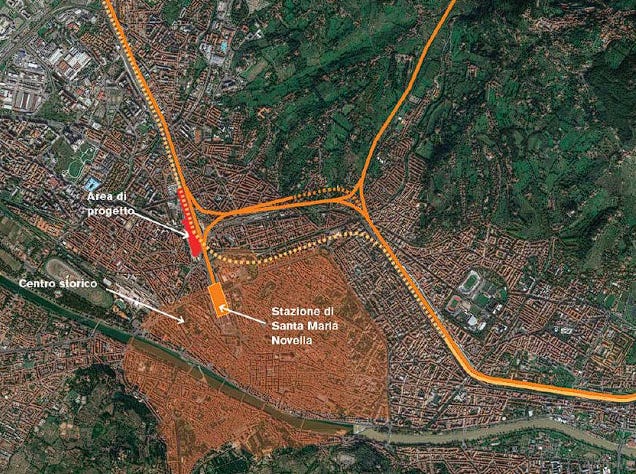
The Florence high-speed rail bypass (Passante AV di Firenze) project location. This satellite map shows the relationship between Florence’s historic centre (Centro storico), the existing Firenze Santa Maria Novella terminal station, and the planned high-speed bypass infrastructure:
The orange lines and box show the existing rail lines and station
The red area marks the excavation site for the new underground Firenze Belfiore high-speed station
The dotted yellow lines mark the alignment of new HSR-only tunnels that will allow high-speed trains to serve Florence without having to reverse3
The lesson is unambiguous: designing a reversal into your system from the outset is a foundational error and patching it will require extraordinary cost later. Alto’s current hypothesis for Montreal is making this error now.
The patterns of concern we see in Montreal and Toronto exist elsewhere. In Ottawa, the politically-preferred station option is the former Union Station at 2 Rideau Street. It’s convenient to downtown, but reaching it would require a new tunnel of approximately 4 km, and the original building is a stub-end terminal, meaning yet another reverse-run on the line. The operationally sensible option is the existing VIA Rail station on Tremblay Road, which has through-tracks, room for expansion, an on-site LRT station, and highway access… but is four LRT stops from downtown. Neither option is ideal.
The intervening stop between Ottawa and Toronto, Peterborough (population less than 100,000) is a gare des betteraves in the making. Trois-Rivières and Laval are not so obviously inappropriate, but the pattern persists: vague references to transit-connected sites without specifics, meaning all the intermediate cities are drifting toward the greenfield model that produces beetroot stations.
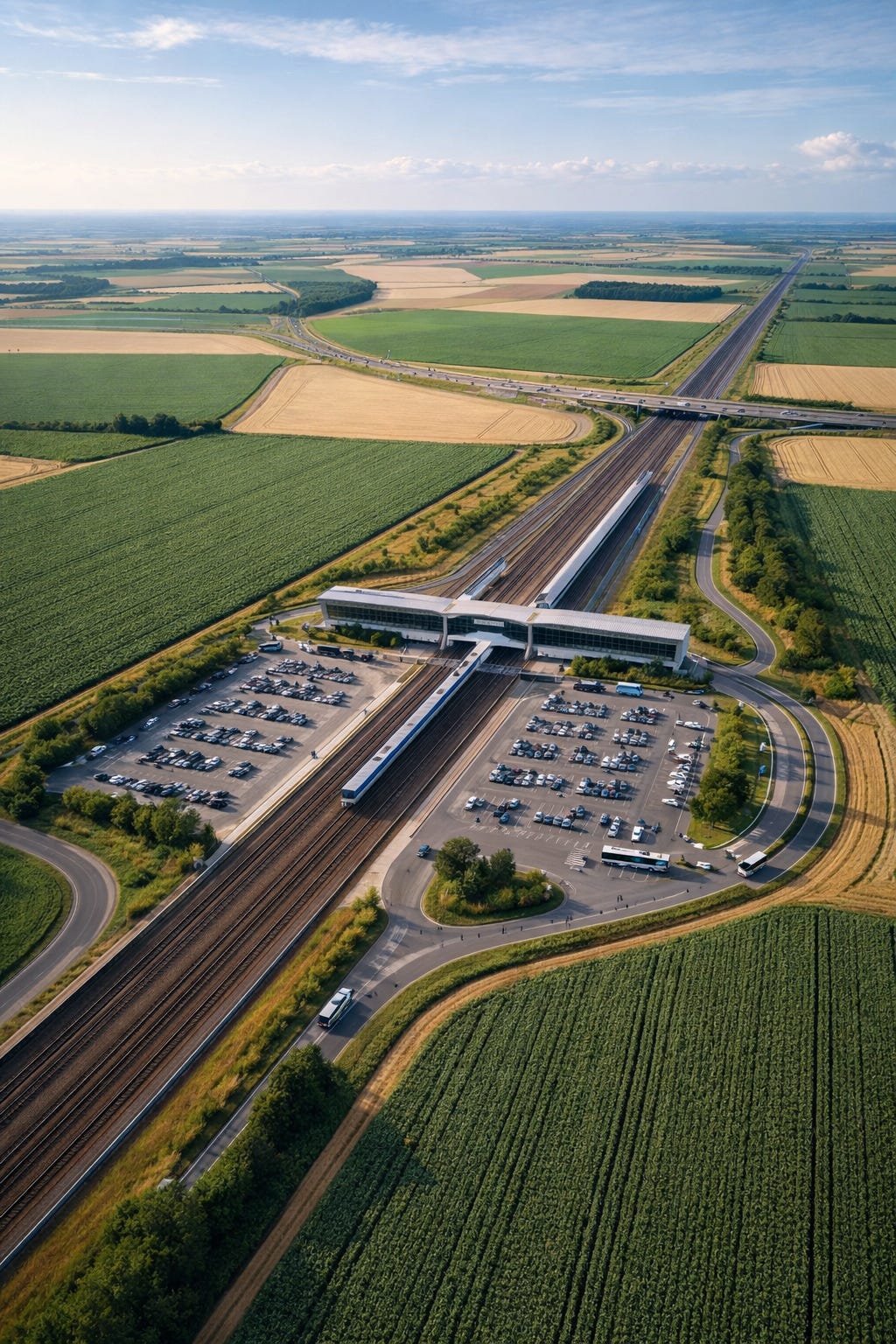
Not a real HSR station. Let’s keep it that way
What Alto Needs to Do
No one building HSR in a dense, expensive, mature city finds it to be easy. To pick only one example, HS2 in Britain is currently spending billions tunnelling into London’s Euston specifically because the alternative, terminating at Old Oak Common, was described by a government source as “pretty much the definition of a railway to nowhere“. I don’t fault Alto for taking its time to determine what its options are and how much they will cost.
But they do need to make their thinking public at some point. When they do, what would change my assessment of Alto’s prospects is a committed, publicly-announced station location in downtown Toronto with a specific site, a credible access plan, and an honest cost estimate; a solution to the reversal problems in Montreal and Ottawa; and a demonstrated understanding, at the project’s leadership level, that the station question is prior to all other questions. That is, station placement is the constraint around which everything else must be organized, not a consideration to be traded against others.
We live in hope of these things, but that hope is fading in the face of discouraging language: “the intent is to go downtown,” “it needs to be economical and affordable,” and it is “too early to speculate on locations”. These sound reasonable in isolation but alarming in accumulation.
They’re alarming because getting this right is fundamentally important.
For Alto to succeed, downtown stations—walkable to many major destinations, connected by higher-order transit to the rest, and configured to permit through-running—are prerequisites. Without them, Canada will spend tens of billions of dollars (possibly more than a hundred billion by the end) on a project that cannot compete with the air links that already connect these cities. This would mean that upon completion, we would then need to spend even more to get something that actually works.
Constant readers know that, in my view, this project isn’t worth doing, and that the money would be better spent making air travel work better: more sustainably, and with fewer delays. But disagreeing with me to insist that Canada build HSR is defensible.
But it’s only defensible if you bite the bullet that we must spend whatever it takes to get the stations we need.
Believing we can build high-speed rail on the cheap is building half a bridge: spending too much money for something that won’t succeed. The obvious example of that failure mode is California HSR, which promised to connect Los Angeles and San Francisco, and may end up connecting only Bakersfield and Merced. The political logic that produced that outcome, namely putting off hard decisions and doing the easy things first, is precisely the logic that Alto’s official communications are beginning to replicate.
Alto will deliver the speed in high-speed rail; of that I have no doubt, because it’s the easy part of the project. The hard part, which will determine whether Alto only duplicates existing air service at vastly greater expense, is where the trains will stop.
On current evidence, we should all be concerned.
Respect to Mike Riggs for feedback on earlier drafts.
It will go on from Montreal to Quebec City with an intervening stop at Trois-Rivières, but Alto’s principal value will be to connect Canada’s two largest cities by way of the capital.
Source: Rete Ferroviaria Italiana (RFI), Sottoattraversamento AV di Firenze / Passante AV di Firenze project documentation, Figure 1–1 “Posizione dell’opera rispetto all’abitato.” Taken from the Italian Ministry of Infrastructure and Transport cost-benefit analysis of the project.
All VIA Rail trains currently using Central Station have to back in or back out using the wye that takes them over the Victoria Bridge to the South Shore, or else they have to be turned somehow, as I think the Ocean to Halifax does (as if that train actually matters anymore.) Central Station was designed as a stub terminal and it worked because all trains started and ended in Montreal, the centre of the universe. Going from Toronto or Ottawa to Quebec City, Halifax, or the U.S. you changed trains in Montreal, sometimes just across the platform. Same was true when CN and CP ran their passenger trains. Part of this is constrained by Montreal being an island. A stub meant building only one rail bridge and yard throat, not two. So imagining through service from Ottawa to Quebec City means redesigning Montreal as a waypoint, not as a terminus. Someday it will be a bettrave, but that's for another day. Toronto is a through station with two long throats. Most GO Trains on the two Lakeshore Lines don't reverse in Union but run straight through from Hamilton to Oshawa and back. Rush hour trains often do reverse and of course they reverse on the other lines to places like Kitchener and Unionville and Barrie because of the way the tracks were laid nearly 200 years ago.
Ottawa's downtown Union Station used to be a through station, because the Montreal sections of both CPR and CNR's transcontinental trains after splitting in Sudbury/Capreol ran through Ottawa on the way to their termination in Montreal. But the tracks running east from the old Ottawa station crossing the Rideau River along the Ottawa River out through Vanier are long gone.
Shoehorning HSR into built environments where tracks have been converted to bike paths is going to be wildly expensive.
Worth remembering that most Chinese HSR stations are not in the urban core, but over time have developed entirely new urban cores of their own. One might argue the best locations for Alto would actually be somewhere like YZD in Toronto. Connected to metropolitan transport, cheaper to build and part of North America's largest brownfield urban development.
It's quite possible that having a central station can be ideal, but given the cost and engineering challenges, the opposite of a good idea can be an equally good or perhaps even better idea.