


Since I wrote this, governments around the world have begun to recognize the problem and take action, but not the action I hoped for.
The UK Department for Transport found 97 per cent of British drivers are at least sometimes dazzled by oncoming headlights, leading a third to cut back on night driving. Transport Canada's spring survey on the same question drew roughly 380,000 responses (I submitted this newsletter as one such response). India's Supreme Court has ordered a maximum luminance. I am pleased the problem is being taken seriously!
But I am dismayed by the remedy everyone is reaching for. The bill now sitting in the US Congress, the LIGHT Safety Act, aims to cap low-beam brightness. As I argue here, that is simple, intuitive, and wrong. We do want fewer night-time crashes, and good headlights help us with that. The fix is not lumen caps, but remains self-cleaning and adaptive beams. The EU has mandated this; everyone else needs to follow suit.
Several times a year, it happens: I am driving at night and become unable to see.
Not because there’s anything wrong with my eyes, but because of other drivers.
The typical scenario unfolds like this. I am driving on a city road in my four-door sedan. Waiting at a red light, I am overtaken by an SUV or a pick-up truck. Its headlights are so powerful, and mounted so much higher than my car, that the lights shine directly through my rear windshield into my car, reflect off my rearview mirror, and dazzle my eyes, effectively blinding me. I’m obliged to twist my head or block my mirror with my hand to proceed safely, hoping all the while that the other driver decides to pass.
Perhaps you’ve had a similar experience. Many people have, and some have had worse.
If you've noticed a dramatic change in your nighttime driving experience over the past decade, you're not alone. Night driving has gotten worse, thanks to a combination of technological evolution, regulatory gaps, and unintended consequences.
Specifically, we’re caught in a prisoner’s dilemma: headlights have gotten much better, in ways that help individual drivers, but that also make everyone else using the road worse off.
Birth of the Cool
In the earliest era of the automobile, manufacturers used a variety of approaches to night lighting, but by the 1950s automakers converged on a technology that would remain standard for decades: sealed tungsten-filament headlamps that emitted, on low beam, about 600 to 700 lumens, in a warm and yellowish hue; on par, in colour and intensity, with a typical household bulb. That would remain standard for about 40 years. Then technology began to evolve, such that by the end of each subsequent decade, a new standard had emerged.
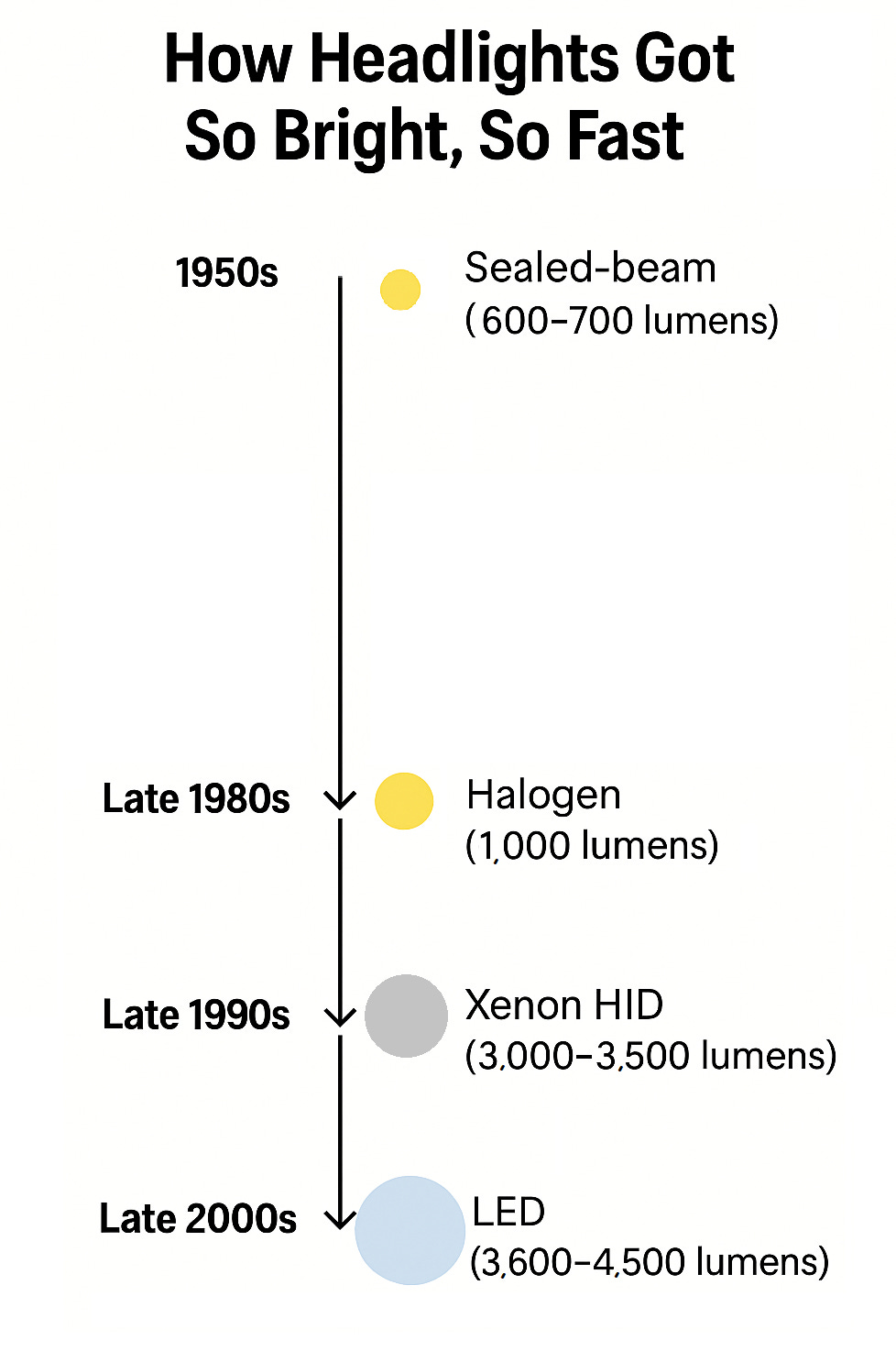
As the infographic shows, in just twenty years from the late 1980s to the late 2000s, headlight brightness tripled or even quadrupled while emitting light that is much whiter and cooler.
Both of these changes were beneficial for drivers. Bright light makes it easier to see longer distances, and bluer light provides better contrast, making it easier to spot features of the road. Thus brighter, bluer headlights have helped drivers sense and understand the road ahead. But what is good for drivers has proved bad for other road users. Brighter lights have reached a scale where they are higher than the human eye can comfortably tolerate.
We measure brightness of light in lumens, and intensity of light in lux, where lux is lumens divided by the relevant area in square metres. Put another way, the difference between lumens and lux is the difference between volume—how much light is produced—and illumination, i.e., how much of that light reaches a given surface. As noted above, the brightest LED headlights emit 3,600 to 4,500 lumens of light. Given the focus and directionality of headlights, that makes for 36 to 45 lux. The human eye can comfortably tolerate only 1 lux. Worse, the human eye is more sensitive to light at blue wavelengths than to yellow, making our pupils contract more, intensifying feelings of discomfort.
Imagine if over the space of a few years, horn volume tripled in volume while increasing in pitch. This is analogous to what has happened with headlights; it’s as if they were trying to become intolerable.
Every driver has stories like mine, about being blinded by other drivers’ headlights. Behind anecdotes like these are grim data: nighttime pedestrian fatalities in U.S. road incidents have increased 92% since 2010. You may think, as I did when I first learned about this, that distracted driving, in particular the mobile phone that every driver has to hand, is to blame. And yet, during the same period, daytime fatalities have increased by only 28%. Something is making night driving specifically more dangerous for pedestrians.
The likeliest culprit is increasingly bright, and increasingly blue, headlights; in particular, the fact that these cause more glare.
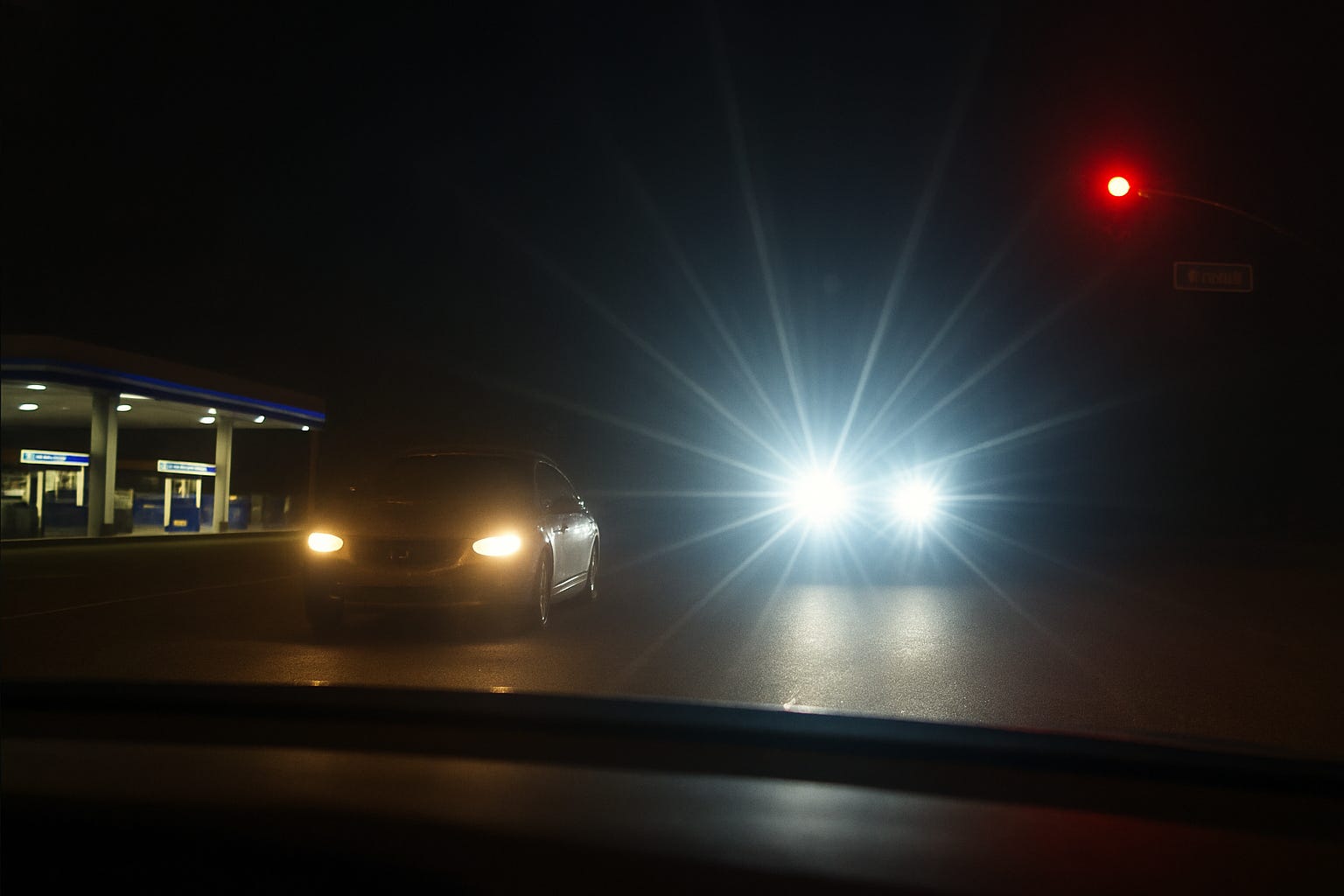
Glare is light that interferes with the ability to see. It does so in two ways. It induces discomfort, i.e., a psychological sensation of annoyance or even pain. But it also physically reduces our visual capacity, irrespective of how we happen to feel. Modern high-intensity headlights produce both effects. When intense light enters your eye, it scatters, obscuring objects in your visual field, making it easy to miss a pedestrian in the road. If that pedestrian is wearing dark clothing, it’s even easier: glare also reduces our ability to detect contrast.
It gets worse: bluer light induces more glare, as its shorter wavelength permits it to scatter more within the eye. And irrespective of the light’s colour, our sensitivity to glare increases with age, as the eye’s lenses become less transparent, and as such scatter more internal light. Thus older drivers’ experience of glare may be as much as three-to-four times worse.
Beyond glare, too-bright headlights also key into the psychology of attention in harmful ways. Human vision naturally focuses on the brightest objects in our field of view; there’s a reason that video-game designers, when they want a player to travel to a particular area, make that area better lit. Because ultra-bright headlights dominate the visual field, they pull attention away from less illuminated areas; so much the worse for other road users in those spaces.
Speaking of other road users, those not in their own cars face even greater challenges. Cyclists and pedestrians lack the partial protection of a windshield and often have their eyes fully dark-adapted when vehicle headlights approach. Consequently, the blinding effect can be total, and take longer to recover from. For a pedestrian attempting to cross a road or a cyclist navigating a narrow shoulder, temporary blindness can be life-threatening.
At this point you may think that there’s an obvious answer to the problem: we should just limit how bright headlights can be, right?
That answer is indeed obvious. It’s simple, intuitive, and wrong.
After all this rehearsal of the problems with bright headlights, it’s easy to forget the fundamental purpose of headlights, which is to illuminate the road ahead; and that brighter, farther-reaching headlights make it easier for a driver to see and avoid obstacles. One study found that vehicles with ‘Good’ headlights (often brighter LEDs with well-focused beams) have about 20% fewer nighttime single-vehicle crashes compared to those with ‘Poor’ headlights. Twenty percent is a substantial benefit, and we shouldn’t dismiss it out of hand.
Our philosophy here at Changing Lanes is never to say, as some do, ‘this technological improvement to our transport system has some bad outcomes, and therefore should be banned’. Instead, it is to look for ways to thoughtfully regulate new technology to seize its advantages while limiting its harms, especially to other system users.
There are several ways available to us. Some are technical, and some are regulatory. Let’s take those in turn.
Solutions
The technical solution is to require auto-leveling, headlamp cleaning, and adaptive driving beam (ADB) systems on North American cars.
Auto-leveling systems use sensors to detect the vehicle's pitch and automatically adjust headlight aim to maintain proper alignment regardless of loading or road conditions. Courtesy of sensors mounted on both the axles, the system monitors the vehicle's pitch relative to the road surface. When the vehicle tilts—due to passenger load, cargo weight, acceleration, or traveling over hills and bumps—the system detects this and uses small motors to automatically adjust the headlight's vertical aim.
This keeps the beam properly positioned irrespective of the vehicle’s angle, preventing scenarios common in North America, where an SUV crests a hill and temporarily blinds oncoming traffic; or like the one I described earlier, where trucks shine their lights directly into interiors of cars closer to the road. The technology is mature and relatively inexpensive (~$50–$100 USD per vehicle), making it a high-value intervention.
Headlamp cleaning systems prevent dirt and grime from scattering light unpredictably. A thin layer of road dirt can significantly increase glare by obscuring the headlight beam and diffusing its light. Simple high-pressure nozzles that jet fluid onto the headlamp cover can clean the lens can reduce this effect.
Adaptive driving beam (ADB) systems are less mature than the former two but show great promise. In essence, they are high beams that are always on but that never blind other drivers. ADB systems use the car’s cameras—increasingly standard as part of advanced driving-assistance systems (ADAS)—to detect oncoming vehicles and other road users, and then dim the portions of the headlight beam that would cause glare. Consequently, drivers benefit from maximal illumination everywhere… except in the precise directions that would affect others. Imagine ‘fingers’ that automatically block just the right parts of the beam, creating ‘shadows’ around other vehicles while maintaining full brightness elsewhere.
The performance data is impressive. ADB systems provide up to 86% more illumination of the roadway compared to standard low beams, without increasing glare for other drivers. Various implementations exist, ranging from simple two-zone systems to sophisticated matrix arrays with dozens or even hundreds of individually-controlled LED segments. But all of these approaches help to address the problem of glare and enhance driving safety.
ADB finally became legal in the U.S. in 2022 when the National Highway Traffic Safety Administration updated FMVSS 108, after years of being available in Europe, Asia, and Canada. Like other ADAS features, ADB adds approximately $1.0K to $1.5K USD to the cost of a vehicle. That means that it is currently mostly available in luxury vehicles (like BMW, Mercedes-Benz, and Cadillac), but as with most ADAS features, Wright’s Law applies and will make ADB cheaper, and eventually ubiquitous, in years to come.
Immediate regulatory solutions depend on mandating the use of this technology. While North American drivers continue to struggle with blinding headlights, Europe found effective measures years ago. Since 1990, the European Commission has required automatic headlight leveling and lens-cleaning systems on any headlamp with output above 2,000 lumens. The USA and Canada should do the same. Given how expensive it is, ADB fails a cost-benefit test today, but regulators should keep a close eye on the technology, and begin mandating it when it passes, which we might expect to happen sometime in the next decade. While they’re at it, they could establish standards for headlight colour temperature, to shift away from glare-inducing blue-white light and back towards yellower tones.
The next time you drive at night and find yourself momentarily blinded by another driver’s headlights, you may well curse. But the target of your ire shouldn’t merely be the self-absorbed driver of the other vehicle. You should consider to what extent you are that self-absorbed driver. Be the change you want to see in the world, and when it comes time to buy a new vehicle, invest in a car with headlamp cleaning, or a truck with auto-leveling systems, as a good-faith concession to other road users.
But, having done so, you should consider further that brighter headlights are a classic prisoner’s dilemma: they make individual drivers better off and everyone else worse off. This means that game theory has provided us with the classic solution to the problem: we should ask for these decisions to be taken out of the individual’s hands. Rather than consumers being required to do the right thing, it should be a matter of policy and regulation that such tech be required.